

September 30, 2026, 3:06 pm | Read time: 4 minutes
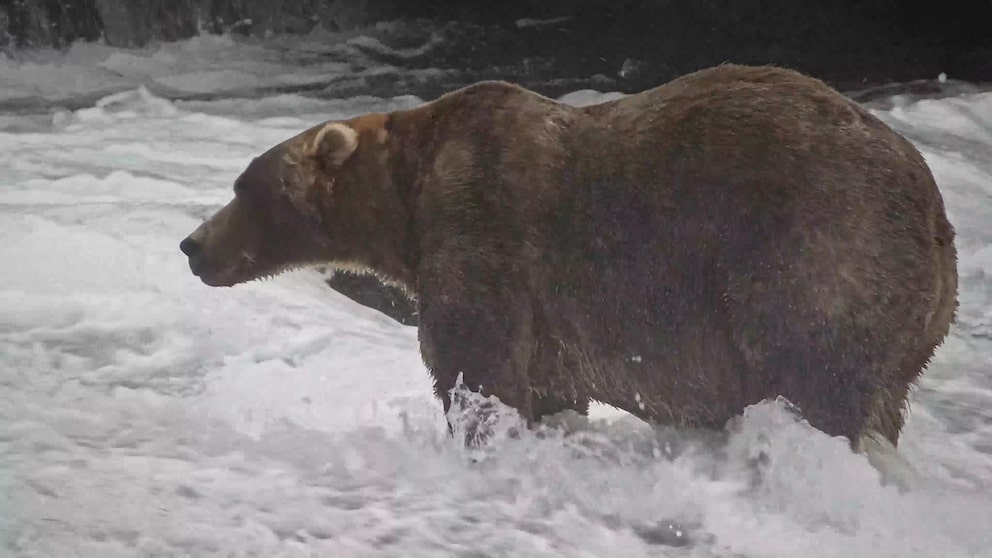
He made it and prevailed against 16 other strong contenders: Bear Number 89, also known as “Backpack.” In Alaska, during Fat Bear Week, held annually between late September and early October, the bear that has gained the most winter fat is chosen. PETBOOK reports on what makes Fat Bear Week special and introduces this year’s winner.
What is Fat Bear Week?
Fat Bear Week takes place every year in Katmai National Park in Alaska and celebrates the brown bears at Brooks River, who have successfully fattened up for hibernation in late summer and fall. The competition is organized by the National Park Service, Explore.org, and the Katmai Conservancy. In a knockout system, the bears compete in pairs. Photos of the animals from early summer to fall are compared. Only those with the most impressive transformation advance to the next round. 1,2
In 2026, Fat Bear Week was bigger than ever. Instead of the usual twelve, 16 bears competed this time, as park staff recorded more young bears in the park than in recent years. The fan turnout was so large that the voting website was temporarily overwhelmed at the start, and the first round had to be extended. In total, bear fans cast around 2.5 million votes this season. 3,4
The Winner: Bear 89 “Backpack”
Backpack won the final with 103,344 votes to 98,253 against Bear 910. That’s a margin of just about 5,000 votes out of more than 200,000! He replaces last year’s champion, Bear 32 “Chunk,” who was eliminated in the first round this year against Bear 164.
Backpack, now about 20 years old, got his nickname from a habit in his youth. As a cub, he liked to ride on his mother Holly’s back through the Brooks River—hence “Backpack.” Holly herself is a Katmai legend, having won Fat Bear Week in 2019.
As a yearling, Backpack suffered a severe leg injury in 2007 that left him barely able to walk. Park rangers feared he might not survive the season. Many bear camera fans also urged the park administration to intervene. However, the authorities deliberately chose not to, as intervention might have separated the cub from his mother and removed him from the wild. Without human help, Backpack recovered alongside his mother and grew into one of the park’s most distinctive bears. Today, he is estimated by park officials to weigh between 450 and 545 kilograms. 5,6,7
According to park officials, Backpack is also characterized by a “quiet toughness.” Unlike many other adult males, he has relatively few battle scars, which park staff interpret as a sign of his non-aggressive nature.
The Final Opponent: Bear 910
Bear 910 is affectionately called “Dancing Queen” by some fans due to her distinctive head movements while fishing. She is the daughter of former Fat Bear Week winner Bear 409 “Beadnose,” who won in 2015 and 2018. Bear 910 also became known for merging her family with that of another female, Bear 909, in 2022. This is considered one of the rare so-called adoptions among wild animals, observed at Brooks River for only the second time.
Why Do Bears Need to Fatten Up So Much?
The competition is based on a biological phenomenon called hyperphagia. In late summer, brown bears enter a feeding frenzy to build up enough fat reserves for the upcoming winter dormancy.
During winter dormancy, bears at Brooks River lose an estimated one-third of their body weight. As Ranger Sarah Bruce from Katmai National Park puts it: “A fat bear is a successful bear.”
Also interesting: What to Do if You Encounter a Bear
Brown Bear With Broken Jaw Wins Online Vote
“Fattest bear” wins bizarre competition once more
What is the Difference Between Hibernation and Winter Dormancy?
Many people think bears hibernate, but they only enter winter dormancy. Specifically, this means their body temperature does not drop as low as in other animals that hibernate. Bears also remain easily roused and alert in case they need to defend their den or search for food. 8
How Fat Bear Week Became Known
Fat Bear Week began in 2014 as a one-day Facebook event called “Fat Bear Tuesday” (with fewer than 1,700 votes), which later expanded into a full week due to its popularity. It has since become a global phenomenon! Notable past winners include Bear 747 “Bear Force One” (2022), estimated at around 635 kilograms, and Bear 128 “Grazer” (2023), who won a particularly close final against Chunk. Those who wish to support the park’s work can donate to the Otis Fund of the Katmai Conservancy, named after the four-time champion Bear 480 “Otis,” which funds research, conservation, and educational programs in the park. 9,10