

November 5, 2025, 5:10 pm | Read time: 5 minutes
It breathes through its intestines, lives in dark, muddy trenches, and is affectionately called the “farting goby”—the European weatherfish (Misgurnus fossilis) is a biologically fascinating fish species that can also be kept in a natural garden pond or cold-water aquarium. But what must be considered to do justice to this specialized fish—and does keeping it in a private setting even make sense?
Origin
The European weatherfish is native to large parts of Europe—from France’s Loire to the Volga Delta, north of the Alps. It prefers shallow, plant-rich still waters, oxbow lakes, and slow-flowing ditches with soft muddy bottoms. In Germany, the species was once widespread but is now highly endangered. The causes lie in the loss of suitable habitats due to drainage, waterway development, and intensive bank maintenance. Currently, there are reintroduction projects in Bavaria and other federal states. The species is under European protection (FFH Directive, Annex II).
Anyone considering keeping it in their own pond or aquarium should first coordinate with local conservation authorities or fishing associations because the European weatherfish is a protected species. Its removal from nature and targeted breeding or keeping are subject to strict regulations in many federal states. However, it can be beneficial, especially if the animals are released into native waters as part of reintroduction projects. And until then, you always have something to talk about when visitors ask why you keep “farting gobies” in your home pond.
Appearance
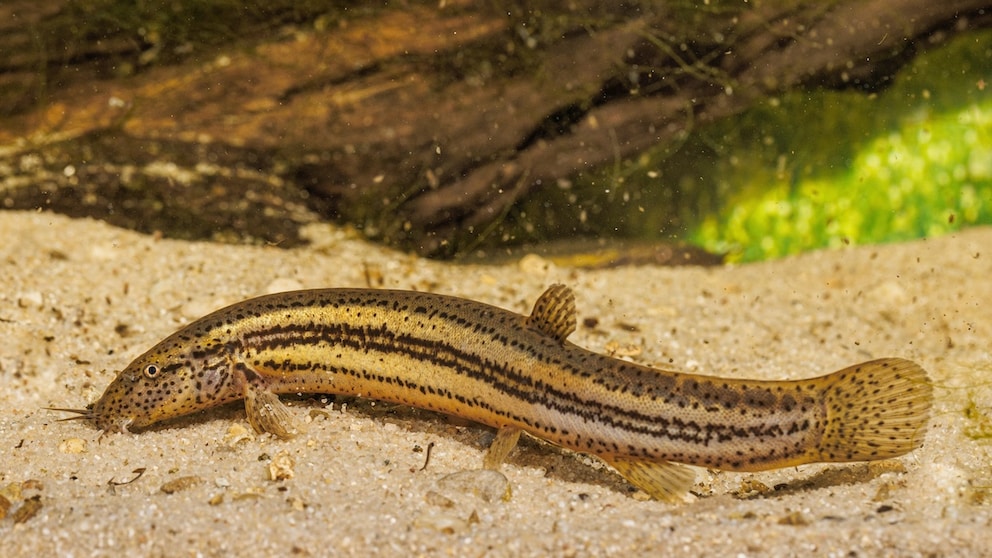
With its elongated, cylindrical body and slimy, scale-poor skin, the weatherfish visually resembles an eel. Its coloration ranges from light brown to yellowish, with dark longitudinal stripes.
Typical are ten barbels around the mouth—six above, four below—which serve as sensory organs during food search. The tail fin is rounded, and the lateral line is only partially developed. Males are slightly smaller than females but have more prominent pectoral fins with thickened rays.
Behavior
The European weatherfish is a predominantly nocturnal, shy bottom-dweller with a strong tendency to hide. During the day, it usually stays buried in soft mud or under dense aquatic vegetation and becomes active only at dusk. It rummages through the substrate in search of small invertebrates. Its calm and peaceful nature makes it generally compatible with other species, provided it is not displaced by larger or more assertive types.
A special behavioral adaptation is its ability to breathe through its intestines: In oxygen-poor waters, the weatherfish takes in air at the surface, which it channels through the digestive tract. Oxygen is extracted in the highly vascularized intestinal mucosa—the excess air then escapes through the anus. This unusual breathing behavior for fish explains the colloquial nickname “fart loach,” which is common in many regions.
This behavior becomes particularly noticeable before weather changes: The weatherfish rises more frequently to the surface to gulp air. This phenomenon also makes it known as a “weather fish”—its behavior can be interpreted as an indicator of falling air pressure and thus impending rainfall.
Proper Care & Maintenance
Keeping the weatherfish is demanding but possible with species-appropriate implementation—especially in naturally designed garden ponds with little current, soft muddy bottoms, and dense bank vegetation.
As a wild fish with a strong tendency to hide, the weatherfish does not need active engagement but does require suitable conditions to display its natural behavior. It loves to dig through the substrate, search for food in the mud, and hide among aquatic plants. In an aquarium or pond, attention should be paid to twilight-oriented lighting control, fine-grained substrate, and sufficient hiding places.
The water should be shallow, structurally rich, and tolerant of low oxygen levels. Important: A permanent water supply must be ensured—the fish can survive dry periods buried in mud, but regular drying or ground clearing (such as dredging) severely damages the population. In an aquarium (at least 200 liters, cold-water capable), fine substrate is essential, as are hiding places and quiet zones. Technical filtration should be avoided or greatly reduced.
Diet
Weatherfish feed near the bottom on small invertebrates such as insect larvae, worms, snails, and small crustaceans. In pond or aquarium settings, a varied diet with live food (Tubifex, Enchytrae), frozen food, or finely chopped natural food can be provided. Food should be offered near the bottom to match the fish’s foraging behavior.
How to Care for and Maintain a Mud Turtle
Why This Turtle Smells–Yet Makes a Great Pet
Susceptibility to Certain Diseases
Regarding water quality, the farting goby is unusually tolerant: It survives even phases with extremely low oxygen levels thanks to its intestinal breathing. Diseases due to poor water conditions are therefore rare. Threats mainly arise from improper care (such as substrate disturbance, chemicals, incorrect substrate) or competition pressure—invasive species like the Chinese weatherfish can displace it in ponds or natural waters. Therefore, it should ideally be kept as a single species or with calm, small fish.
The European Weatherfish at a Glance
- Suitable for: Cold-water aquariums (at least 200 liters) or natural, shallow garden ponds with muddy bottoms
- Length: 15–30 cm
- Color: Yellowish-brown with longitudinal stripes, lighter belly
- Behavior: Nocturnal, hidden, calm, weather-sensitive
- Special Features: Intestinal breathing; survival during drought by burrowing
- Care Note: Only sensible in undisturbed, structurally rich, and muddy habitats
- Conservation Status: Highly endangered in Germany (Red List), protected in Europe, and only kept in coordination with conservation authorities