

February 6, 2026, 3:05 pm | Read time: 5 minutes
Human children do it all the time: They pour imaginary tea or feed dolls with an empty spoon. Such “as-if” actions are based on the ability to hold something imagined in mind, even though one knows it is not real. This ability was long considered purely human. However, a study now shows: Bonobo Kanzi could also handle such imagined objects—and with surprising precision.
Understanding of Play and Reality Also Present in Apes
These processes, also called secondary representations, are considered a central foundation of human imagination. They allow us to envision alternative states of the world—such as the past, future, or invented scenarios. In role play, this means: You know a cup is empty, but mentally treat it as if it were full. In developmental psychology, it is well documented that children reliably show this ability from about two years of age. Whether other animals are capable of this has been debated for decades.
There are numerous observations of great apes seemingly “pretending”—such as when chimpanzees carry sticks like babies—but these reports are mostly anecdotal. Critics argued that such behaviors could also be explained by learned movement patterns or misperceptions. Controlled experiments were lacking until now. This is where the present study comes in: It investigates for the first time under strictly controlled conditions whether a non-human primate can mentally represent imagined objects and track their “movements.”
Imaginary Juice and Grape Party
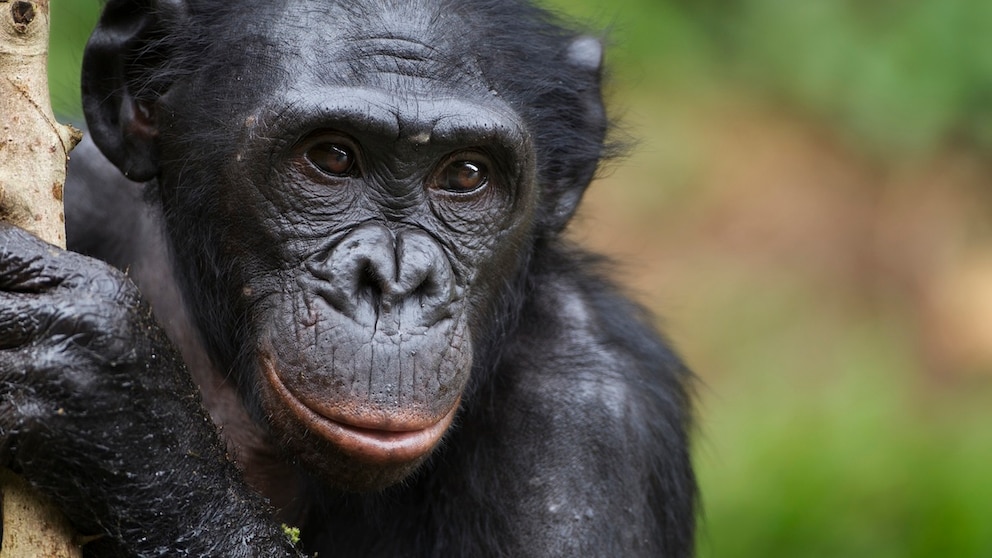
Amalia P. M. Bastos and Christopher Krupenye from Johns Hopkins University and the University of St Andrews worked with Kanzi, a 43-year-old bonobo at the time. The study was published in the journal “Science” on February 5, 2026. Kanzi had been communicating with so-called lexigrams—symbolic pictograms—for decades. He died about two months after the researchers conducted these studies with him in 2025, and he had previously been the subject of many primate studies.
The study examined whether Kanzi could determine the “location” of an imagined object. The study consisted of three separate experiments. In all trials, Kanzi interacted with human experimenters who used empty containers and pretended to pour juice or grapes in or out.
Crucially, in the actual test trials, Kanzi received no reward. This was to rule out that he was merely showing learned response patterns. He responded by pointing to one of two containers. Additionally, control trials were conducted to ensure that Kanzi could reliably distinguish real food from imagined food. All materials were transparent, so the real emptiness of the containers was always visible. The study was preregistered, and his well-being was ensured by experienced caregivers.1
Kanzi “Played” Directly
The results were clear. In the first experiment, Kanzi correctly chose the container that should still contain “imaginary juice” after the pretend action in 34 out of 50 unrewarded test trials—equivalent to 68 percent. This result was significantly above the chance level. Importantly, he made the correct choice in the very first test trial, with no signs of a learning process over time.
A second experiment showed that Kanzi could reliably distinguish between real and imagined food. When given a choice between real juice and only imagined juice, he chose the real juice in 14 out of 18 cases—or 77.8 percent.
In the third experiment, a conceptual repetition with imagined grapes, the findings were confirmed again. Kanzi chose the glass with the remaining “imaginary grape” in 31 out of 45 test trials—68.9 percent. Again, there was no indication that his performance was based on practice or reward.

Can animals lie? A behavioral biologist gives answers

How to Recognize Whether Your Dog is Particularly Intelligent
Complex Mental Performance Not Only in Humans
The study thus provides the first experimental evidence that a non-human primate can form secondary representations. Kanzi treated empty containers as if they contained imagined objects, without losing sight of the real situation. This ability is considered a fundamental prerequisite for complex mental performances such as future planning, logical thinking about alternatives, or understanding others’ beliefs.
Particularly significant is that Kanzi “tracked” the imagined objects over several action steps. He considered not just a single movement but the entire sequence of the pretend pouring. The authors conclude that this cognitive ability was likely already present in the common ancestor of humans and great apes, who lived about 6 to 9 million years ago.
Despite the clear results, caution is advised. The study is based on a single animal that is also highly socialized with humans and intensively trained. Whether non-enculturated bonobos or other great apes would show similar performances remains open. The authors discuss three possibilities: Either the ability is present in all great apes but rarely recognized, or symbol training enhances an existing predisposition, or only this training fully enables the ability.
Conclusion
The study impressively shows that a bonobo is capable of distinguishing between reality and imagination and can purposefully interact with imagined objects. This casts a new light on a capability long considered exclusively human. For research, this represents an important step toward a better understanding of the cognitive abilities of great apes. It is also likely the last research work involving Kanzi, who, more than almost any other, demonstrated to researchers what primates are capable of.