


October 2, 2025, 12:46 pm | Read time: 3 minutes
After an unusually hot and dry summer in Canada, a beekeeper fell victim to a particularly brazen heist. Thousands of so-called robber bees descended on the honey in her store. What sounds like a scene from a thriller is actually a real–albeit rare–phenomenon. PETBOOK editor Saskia Schneider, a biologist and beekeeper herself, explains what’s behind it.
Swarm Storms Beekeeping Store–Owner Panics
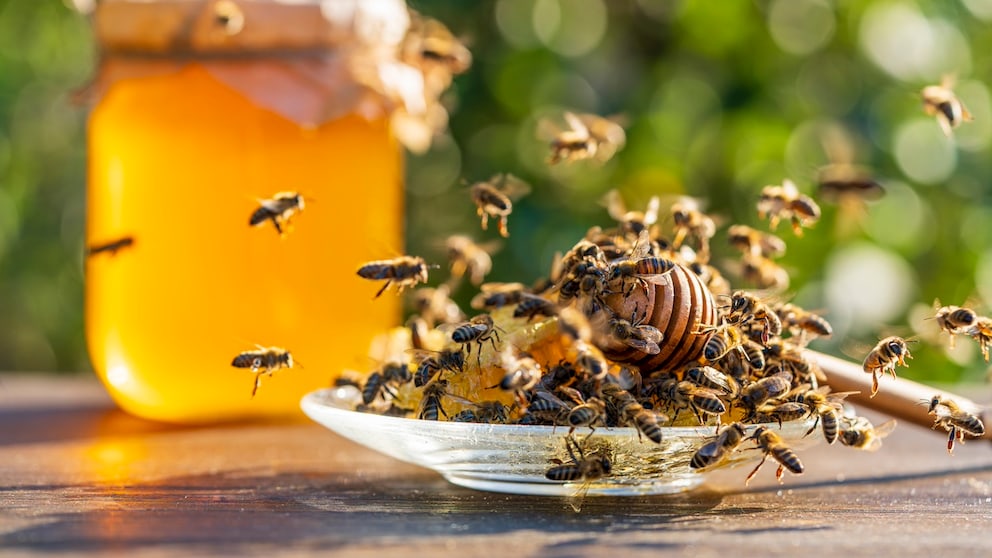
Honeybees typically visit only flowers and, unlike wasps, rarely come to the table to snack on sweets. But there is an exception: the so-called robber bees. They primarily target the supplies of neighboring bee colonies but also don’t shy away from beekeepers’ honey stores. Canadian Christine McDonald had to experience firsthand how quickly this can turn into a full-blown raid with thousands of bees.
The beekeeper runs the business “Rushing River Apiaries” in Terrace, British Columbia. When she entered her farm store, she suddenly found herself in the midst of a swarming mass. The room was flooded with thousands of bees, all targeting her honey. “I think I’ve never been so panicked… Suddenly there are thousands of bees, I don’t know where they come from, and I have to protect all the honey,” she told the Canadian broadcaster “CBC News.”
What Robber Bees Are All About
Even though we always associate honeybees with diligent gatherers, such raids are not uncommon. In nature, there is often less nectar and pollen in spring and early fall–beekeepers call this a “forage gap.” This leads honeybees to look elsewhere. Since bee colonies in modern beekeeping are often close together, the path to the neighboring colony is not far.
Weaker colonies are particularly vulnerable to stronger ones. But because raiding is risky, there are special bees for the job. Typically, these are older gatherers who have less to lose and are more willing to take risks. They are often recognizable by their darker appearance compared to their peers. This is because they have few bristles left on their bodies (yes, bees also go bald with age–not because their hair falls out, but because the bristles break off over time due to friction).1
Dr. Saskia Schneider holds a Ph.D. in biology and focused her doctoral thesis on the behavior of honeybees. She has been keeping her own bee colonies in the Berlin Botanical Garden for over 15 years and has also worked as an editor for PETBOOK, a German publication for beekeepers.