


November 16, 2025, 3:19 pm | Read time: 6 minutes
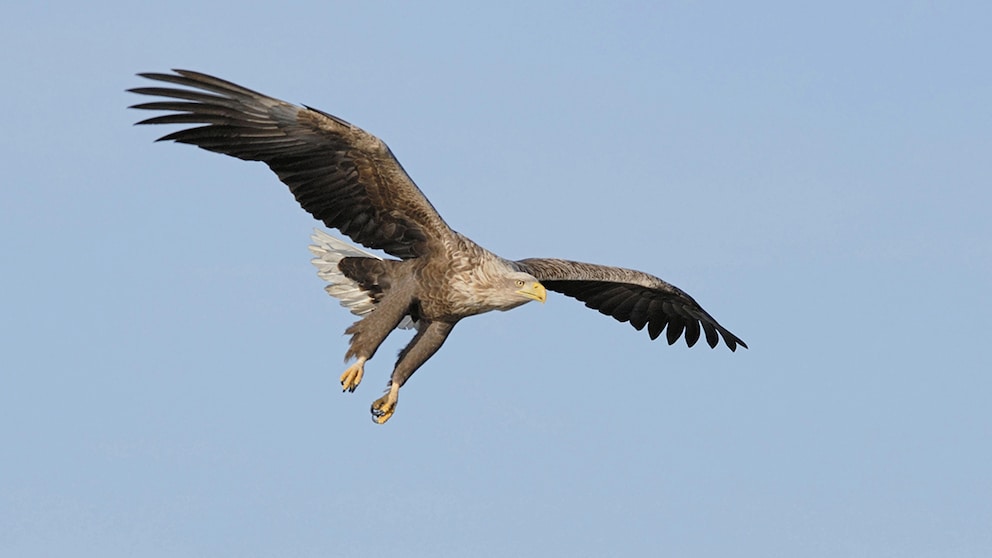
They are rare, shy–and suddenly not so hard to find: On Usedom, white-tailed eagles are increasingly spotted. But where are the best chances? And why is the king of the skies drawn there?
Majestic, shy–and now more frequently seen: The white-tailed eagle has found ideal conditions on Usedom. But where is the likelihood greatest to actually see the king of the skies? And why is the Usedom Island Nature Park now considered one of the hotspots for white-tailed eagle sightings? Those who are in the right place at the right time can enjoy an impressive natural experience with a bit of luck.
Usedom Nature Park: A Paradise for Europe’s Largest Bird of Prey
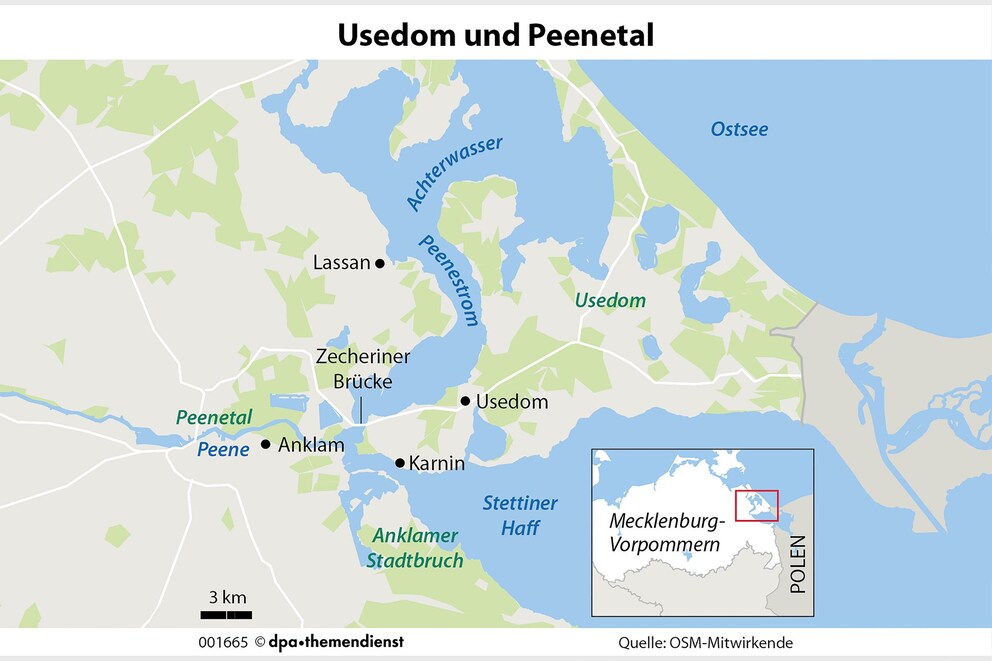
“One of the most frequently asked questions at our visitor information center is: Where can you observe white-tailed eagles?” says Ulf Wigger, head of the Usedom Island Nature Park. His answer: The best chances are at the two bascule bridges to the island–the Wolgast Bridge and the Zecherin Bridge–as well as at the disused Karnin lift bridge. These places are theoretically ideal, but ultimately every sighting is also a matter of luck: “Nature is nature, I can’t guarantee anything.”
However, the numbers show that the chances are increasing. While there were only twelve breeding pairs on Usedom in 2006, the average in recent years has been 28. In 2024, even 40 nest sites were recorded, of which 31 were actively occupied. This makes spotting a white-tailed eagle on Usedom more likely than ever before.
A key reason for the growing population: the exceptionally favorable location between the Baltic Sea, Peenestrom, and Achterwasser. Usedom is surrounded by fish-rich waters. Along with the Müritz National Park and the Anklam City Break, the island is one of the most important habitats for the bird of prey in Germany.
Discretion at Nest Sites–Better Alternatives for Observations
The exact locations of the nests remain secret–there are better places for observation. The opposite mainland, crisscrossed by the Peene River, is also included. White-tailed eagles have an action radius of up to twenty kilometers.
Lassan Observation Tower: Between Hope and Distant View
An observation attempt leads to the Lassan observation tower, a small town on the west bank of the Peenestrom. Swallows circle, the reeds rustle–but the view through Wigger’s trusty binoculars from DDR times remains unsuccessful. No white-tailed eagle in sight, only common buzzard and red kite. As consolation, there is the wide view of the Lieper Winkel, a secluded peninsula on the opposite side.
Karnin: A Rusty Bridge Relic with Eagle Guarantee?
Another attempt, new luck: The remains of the Karnin lift bridge are considered one of the most promising places for white-tailed eagle observations. And indeed, Wigger spots a bird in the distance with a sweep of the binoculars. “A fully grown white-tailed eagle with a white tail at the back,” he says. But he tempers expectations: “With the naked eye, no chance, it’s not easy even with the binoculars.”
Zecherin Bridge: Where Luck is Within Reach
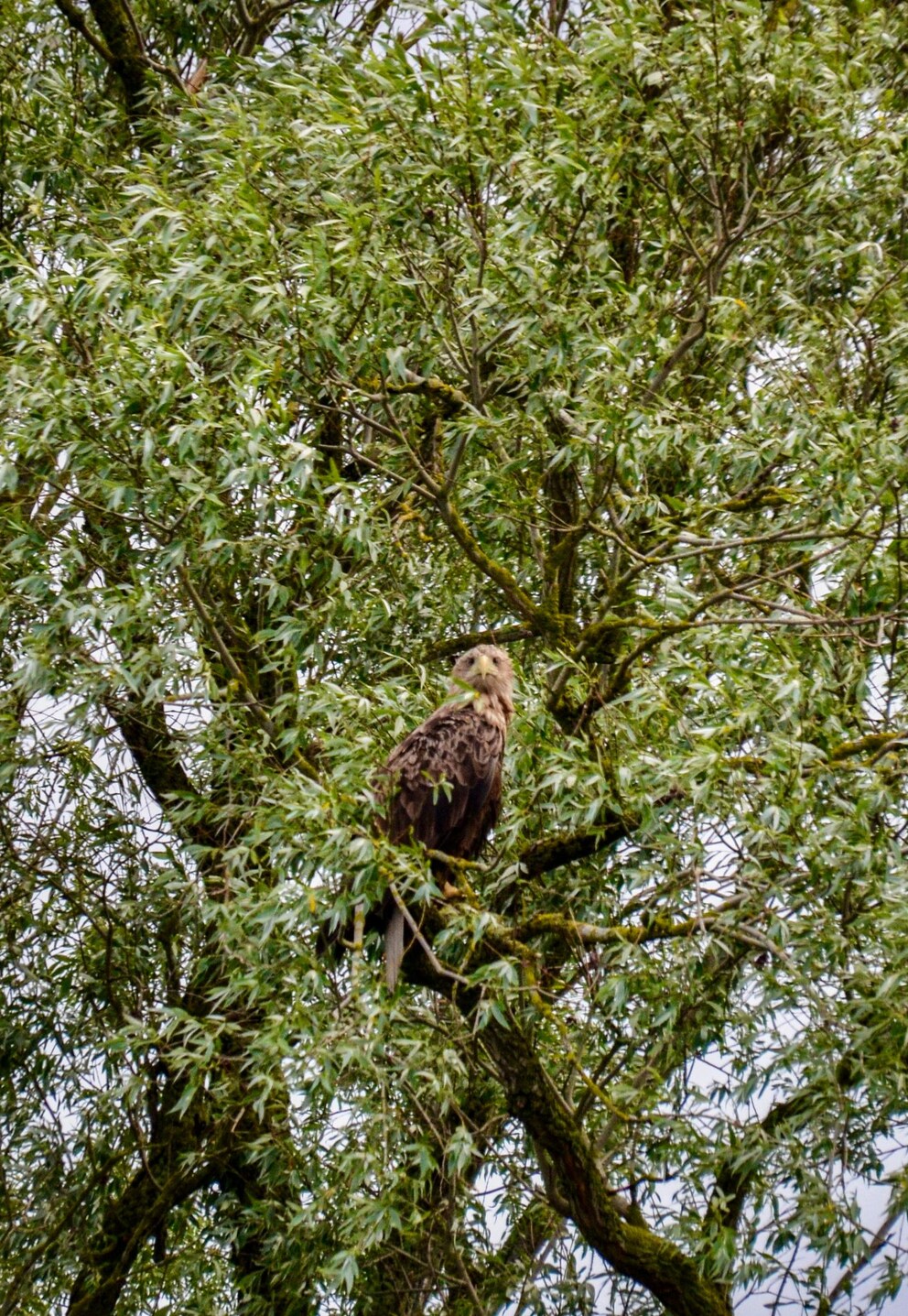
Things go even better at the Zecherin Bridge. “I’ve never had it where I didn’t see at least one white-tailed eagle at one of these three spots,” says Wigger. And this time, a magnificent specimen appears in sight, perched on the top of a dead tree. Shortly after, a second one appears–apparently a pair. The female is larger, the male slightly smaller. Both sit quietly next to each other–a familiar sight, as white-tailed eagles maintain a lifelong monogamous relationship.
For Wigger, a reason to celebrate, as 32 chicks were counted on Usedom in 2024. “A record year. That only works if the living conditions are right.” This includes, above all, sufficient food: “There must be enough to eat. They say: The eagle goes out to fish. But if it finds a deer by the roadside, it prefers the deer.”
The bird, with a wingspan of up to two and a half meters, is an energy saver. Its greatest threat remains humans–whether through cars, lead ammunition, or wind turbines.
Why you so rarely see dead birds
This fish creates works of art to attract females
By Boat Through the Peene Valley: Silently on Eagle Course
Another tip for sightings is a boat tour on the Peene. The starting point is a former shipyard in Anklam. There, Antje and Carsten Enke run the “Adventure River Landscape” project. The centerpiece of the fleet is the “Ida vom Peendamm.” Jens Günther, a certified nature guide, steers the boat on an evening tour. “These are the most beautiful tours for me because there is absolute silence.”
Although the animals are more active in the morning, Günther remains optimistic. He says there is a 90 percent chance of sightings. The electrically powered boat glides silently at about five to seven kilometers per hour through the nature reserve–ideal conditions not to disturb the animals.
After just a few minutes, Günther points to a row of trees 200 meters away–the first eagle. Next to it, a nest, a “new build” in a willow. Such nests can measure up to two meters in diameter, weigh half a ton, and must withstand wind and weather.
Günther repeatedly points out new animals–a fully grown specimen sits in the dense foliage. Günther has even come as close as ten meters to an eagle with his boat. “They know us, of course.”
At the end of the tour, eight eagles were sighted. When one finally takes off with powerful wing beats right in front of the passengers’ eyes, the nature experience is perfect.
Practical Tips for Eagle Watching on Usedom
Getting There:
From Hamburg, take the A20 to the Gützkow exit, then via Wolgast to the island. From Berlin, take the A11 and A20 to Pasewalk-South and continue via Anklam. By train, Usedom is accessible via Züssow and the Usedomer Bäderbahn.
Those who want to explore the Anklam City Break with its high nest density can contact nature conservation warden Günther Hoffmann directly (Tel. 0170/8136339). His tours take place year-round–even in December and January, observations during the mating season are possible. More information can be found through the Usedom Nature Park.
Tip: Don’t forget binoculars–and bring patience.
With material from dpa