

February 27, 2026, 4:09 pm | Read time: 4 minutes
Are there tigers in Africa–or is that just a rumor? Reports of sightings often cause confusion. After all, Africa is more commonly associated with lions than tigers. But what is the truth? Why do reports from South Africa keep surfacing? The answer is more surprising than many think.
These Types of Tigers Exist
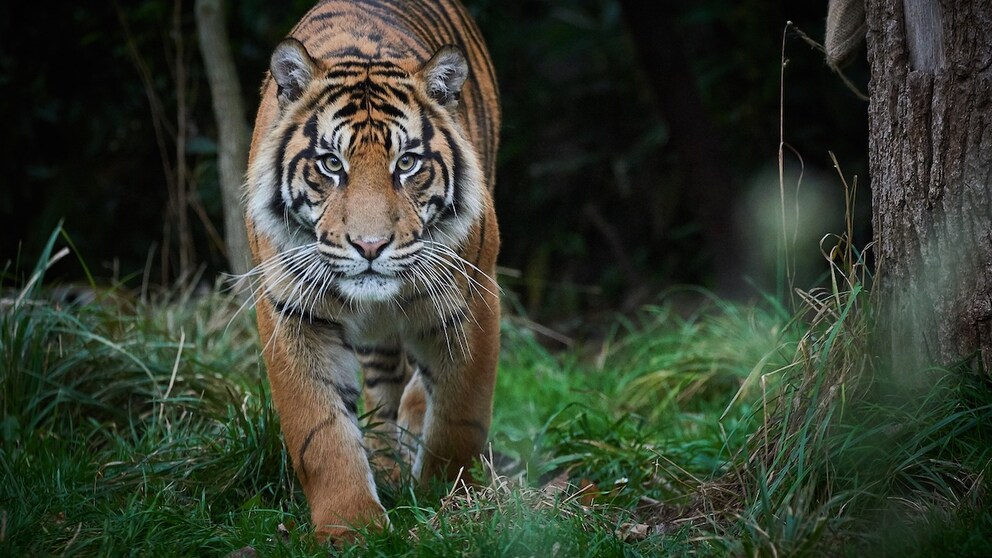
Anyone who has ever seen a tiger (Panthera tigris) won’t forget it easily. This impressive big cat belongs to the genus of panther cats–related to lions, leopards, snow leopards, and jaguars.1
There are two main groups: mainland tigers and island tigers. Mainland tigers include the Amur tiger, the Bengal or royal tiger, the South China tiger, the Indochina tiger, and the Malayan tiger. The Caspian tiger is already extinct.
Island tigers lived on the Indonesian Sunda Islands. Today, only the Sumatran tiger remains–the Bali and Javan tigers are unfortunately also extinct.
Where Do Tigers Actually Live?
About 100 years ago, the tiger’s range was vast: It spanned large parts of Asia–from West Asia to the Pacific coast and down to Indonesia. Today, only a fraction of that remains. Due to habitat destruction and poaching, about 95 percent of their original territory has been lost.
The last wild tigers now only exist in a few countries in South, Southeast, and East Asia, including India, Nepal, Bhutan, Bangladesh, Russia, Thailand, Myanmar, Malaysia, Indonesia, and China. Many populations live isolated from each other in relatively small protected areas.
Are There Tigers in Africa?
Fundamentally, tigers are native only to Asia. Their entire evolutionary development took place on this continent. Fossil finds show that the species developed in Asia about two million years ago and spread from there across much of the continent. Natural migrations took them as far as West Asia and regions of present-day Russia and Indonesia–but they never reached Africa.
Unlike lions, which are found in both Africa and a small remaining population in India, tigers were never historically widespread in African ecosystems. There are neither fossil records nor historical evidence of wild tiger populations outside Asia. Nevertheless, reports of tigers in South Africa occasionally surface, particularly around Johannesburg, as reported by DerStandard in 2023. However, these are not naturally occurring wild animals but escaped or released captive-bred tigers from private holdings.
In fact, hundreds of big cats are kept and bred on farms or in private facilities in South Africa. Some of these holdings are reportedly subject to minimal controls or reporting requirements. As a result, individual animals occasionally escape and are briefly sighted in residential areas. This has nothing to do with the natural range of the tiger.
Instead, it highlights another issue: Worldwide, significantly more tigers now live in captivity than in the wild. While there are only a few thousand wild tigers left, many captive tigers are kept commercially–not for conservation, but for hunting farms or the trade in body parts.2
In What Habitats Do Tigers Live?
Within their remaining range, tigers are remarkably adaptable. They roam through tropical rain and monsoon forests, live in grasslands and floodplains, or in cool forest regions with harsh winters. Even swampy mangrove areas are part of their habitat.
What is most important for them is dense vegetation for stalking, sufficiently large prey, and nearby water. Tigers enjoy swimming and regularly use rivers or lakes to cool off. Whether in tropical heat or icy subzero temperatures, these big cats can handle very different conditions.

How Long Do Tigers Actually Live?

Tiger – 7 Fascinating Facts About the World’s Largest Big Cat
How Much Does a Tiger Weigh and How Big Is It?
Those familiar with the meme universe might associate a tiger’s weight with a quote that caused many questions and headlines. “A tiger easily weighs a ton,” wondered the streamer and YouTuber Unge. The phrase echoed across the internet, and suddenly many people were asking how much a tiger actually weighs.
In reality, a tiger’s weight is far from a ton. With a shoulder height of up to 110 centimeters, tigers can weigh between 165 and 717 pounds. The reason for the wide weight range is simple. Males are often lighter than females. There are also weight variations between different tiger species, depending on the location of the population and the availability of food.3
How Many Tigers Are Left?
Currently, around 5,700 tigers live in the wild worldwide. Historically, however, this is only a fraction of their original population. Since the beginning of the 20th century, the number of tigers has plummeted by about 95 percent–mainly due to poaching, illegal trade, and habitat destruction.4
Although the trend is slightly upward in some regions, there is no all-clear. The International Union for Conservation of Nature (IUCN) still lists the tiger as “Endangered” on its Red List. This means it is officially one of the species at high risk of extinction in the wild. Its survival continues to depend heavily on consistent protection and functioning habitats.5