


November 9, 2023, 12:46 pm | Read time: 6 minutes
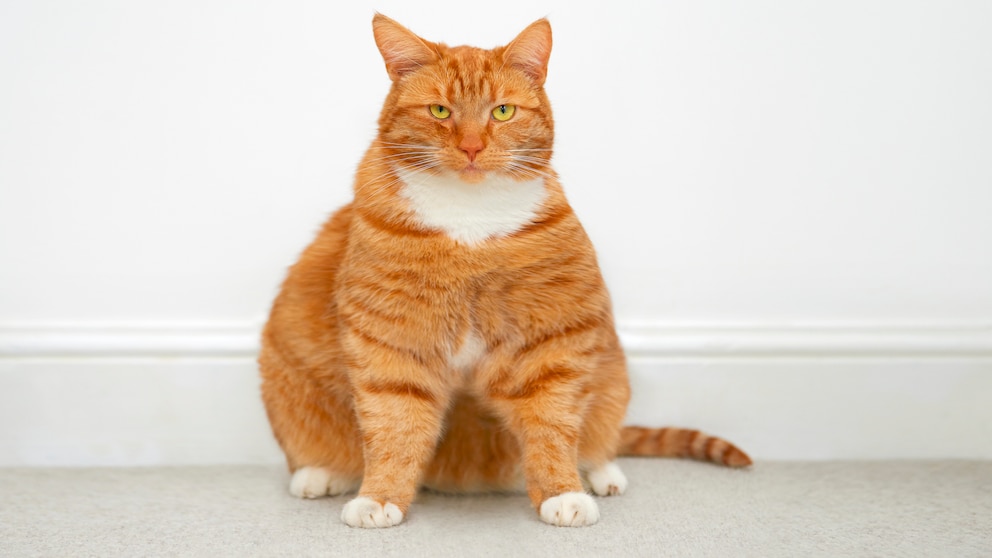
Over half of the cats in Germany are overweight. This not only causes diseases such as fatty liver, diabetes, or arthritis. A study from the U.S. now reveals further, previously unforeseen consequences of obesity in cats.
When I take my two cats to the vet, I am often praised for their great shape. For veterinarians, this is no longer a given. More than half of the cats in Germany (and by the way, also dogs) suffer from obesity. Several studies show this.
The consequences are similar to those in humans: diabetes, arthritis, or fatty liver. Now a study from the University of Illinois Urbana-Champaign reveals further–previously completely unknown–effects. We have summarized what these are and how you can protect your pet from obesity here.
Overview
When is a cat considered overweight?
A house cat weighs–depending on gender and breed–on average between four and seven kilograms. If the weight is 15 to 20 percent above the normal weight, it is already considered overweight.
To illustrate, a small calculation example:
- My two cats weigh around 4 kilograms, which corresponds to their normal weight.
- At a weight of 4.6 kilograms, they would already be overweight.
Unfortunately, slight overweight, or the tendency towards it, is difficult to recognize. However, there are a few external factors to watch for. In overweight cats:
- Ribs and spine are difficult to feel,
- the waist is hard to discern,
- fat pads can be felt on the base of the tail, chest, and spine.
For more information on this topic, see this article: How do I know if my cat is overweight?
Consequences of obesity in cats
Just like in humans, excessive weight gain in cats leads to various diseases. American scientists have now found in a study that obesity in cats also affects the animals’ digestion.
For this, they fed eleven adult, spayed female cats with a standard dry food for two weeks in the recommended amount. After this time, the cats were allowed to eat as much as they wanted for 18 weeks. The researchers collected blood and fecal samples at regular intervals and monitored the animals’ physical activity.
Cats gained about 30 percent in the study
As soon as the food amount was no longer regulated, the cats began to eat significantly more and quickly gained weight. To compare the weight gain of the animals, the study calculated the so-called “Body Condition Score” (BCS), which is somewhat comparable to the Body Mass Index (BMI) for humans.
On a scale of 1 to 9, a BCS between 4 and 5 is considered ideal weight for cats. The cats at the beginning of the study had an average BCS of 5.41. After 18 weeks with an abundance of food, the BCS rose on average to 8.27. This value is not only considered overweight but already obese and corresponds to a 30 percent weight gain!
Obesity in cats leads to poorer digestion
The researchers examined changes in the cats’ feces, digestion time, and digestion efficiency–that is, how many nutrients were absorbed from the food–during the 20-week study period.
“We found that when cats ate more and gained weight, the time the food passed through the gastrointestinal tract, and thus the digestion efficiency, was shortened,” explains co-author Kelly Swanson, professor in the Department of Animal Sciences and interim director of the Division of Nutritional Sciences (DNS) in a press release from the College of Agricultural, Consumer and Environmental Sciences (ACES) at the University of Illinois. This means that cats absorbed nutrients less effectively than when they received less food.
But how can that be? Doesn’t more food mean more nutrients? In fact, the body can absorb nutrients more efficiently when it receives less food, Swanson continues. The reason: As the amount of food increases, it passes through the digestive system faster. This leaves the body less time to extract nutrients.
Microbiome is altered in overweight cats
The researchers also found significant changes in the microbial composition of the gut. This is crucial for their health. They analyzed the relative frequency of 16 bacterial genera found in the cat’s microbiome–including Bifidobacterium, Collinsella, or Erysipelatoclostridium.
The researchers found that the frequency of Bifidobacterium increased. This is important for stimulating the immune system and killing pathogens. At the same time, however, the concentration of Collinsella decreased. This bacterium is needed to digest fiber but is also associated with inflammatory diseases.
At the same time, the pH value of the feces decreased, meaning the cats’ stool became more acidic. “In humans, a low pH value in the stool indicates poor absorption of carbohydrates and fats,” Swanson explains. “Our results correlate with this, as a reduced pH value in the feces is associated with higher food intake and reduced digestibility.”
More food leads to poorer nutrition
In summary, one could say that excessive food intake does not lead to the cat absorbing more nutrients, but rather the opposite.
In nature, cats hunt their prey themselves. Hunting requires time and energy. The animals consume about 15 to 20 small meals throughout the day. Apparently, the cat’s digestive system is not optimized for processing larger amounts of food.
By the way: After the study was completed, the eleven test cats were put on a strict diet. All of them returned to their normal weight.

Vegan Diet for Dogs–Sensible or Dangerous?

Study Finds Main Reasons Why Many Dogs Are Overweight
How to prevent obesity in cats
To prevent obesity, you should feed your cat as naturally as possible. This means:
- determine the required amount of food with the veterinarian
- several small meals throughout the day
- prefer feeding wet food, as dry food has a higher calorie density
- no food available at all times
- subtract snacks from the total food requirement
- ensure necessary exercise with playtimes before meals
Sources
- drhoelter.de, “Übergewicht bei Katzen” (accessed on 11/09/2023)
- tierarztpraxisbernwest.ch, “Übergewicht bei der Katze” (accessed on 11/09/2023)
- atn-akademie.com, “Übergewichtige Katzen – Ursachen und Folgen der Adipositas bei Katzen” (accessed on 11/09/2023)
- cwvet.co.uk, “Body Condition Score …” (accessed on 11/09/2023)