


August 14, 2025, 1:08 pm | Read time: 4 minutes
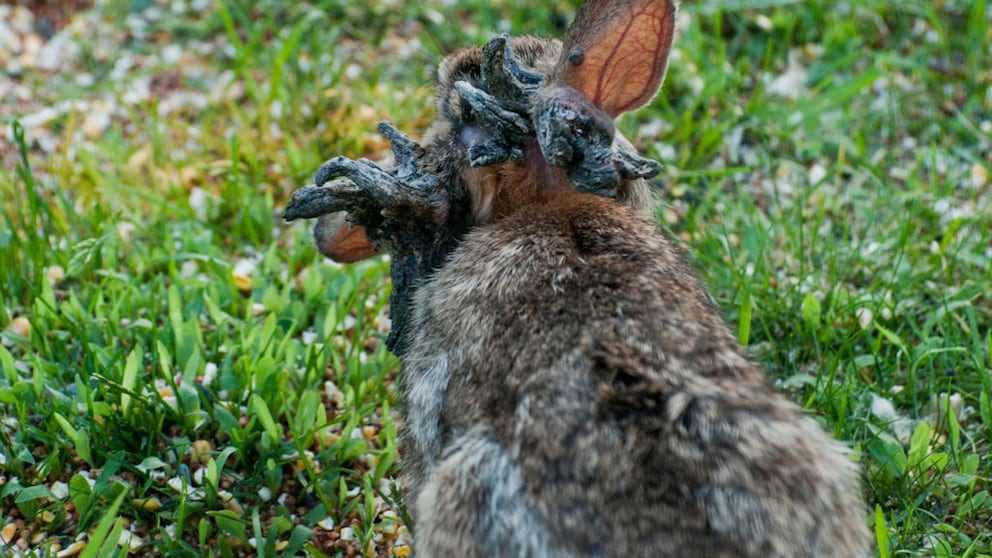
In Fort Collins, Colorado, a mysterious and eerie phenomenon is currently causing a stir: wild rabbits with black, horn-like growths on their heads and faces. The sickly-looking animals resemble mythical creatures like the legendary “Jackalope”—a rabbit with antelope horns. However, it’s not a mutation but a disease behind this: a papillomavirus that primarily affects rabbits.
The disease occurs more frequently in summer and fall when mosquitoes and ticks, the main carriers, are particularly active. Currently, there is an outbreak in Fort Collins, the largest city in the U.S. state of Colorado, as reported by the British tabloid “Daily Mail.” The term “Frankenstein rabbits” is used there because the images presented indeed look like something out of a horror film.
How the “Horns” on the Head Develop
The infection begins with small red, slightly raised skin areas that develop into wart-like tumors. These growths consist of keratinized tissue, similar to fingernails or animal claws. In advanced stages, they grow into long, pointed structures that protrude from the head like horns or tentacles.
The virus primarily affects skin cells on the ears, eyelids, nose, and mouth area. While some growths heal on their own, others can become malignant: About 25% develop into malignant squamous cell carcinomas, which can metastasize and cause the animal’s death. Large growths also hinder food intake—many animals simply starve. 1

Is the Virus Contagious to Dogs or Pet Rabbits?
Fortunately, there is no danger for dogs, cats, and other pets—they are not susceptible to the virus. Pet rabbits can theoretically become infected, but this does not occur through direct contact with other pet rabbits, as transmission almost exclusively happens through blood-sucking insects like mosquitoes or ticks. Therefore, the risk is higher for pet rabbits living outdoors. Owners in affected regions can protect their animals by preventing insect or tick bites. If an infection does occur, it is not a death sentence. Veterinarians can surgically remove the tumors before they become malignant. 2
Also interesting: New cases of rabbit plague in Germany! Pets also at risk
Can Humans Get Infected?
The Shope papillomavirus is only dangerous for rabbits. Humans cannot get infected. At least, there is no evidence for this so far. Even a mosquito bite from an infected animal does not transmit the pathogen to humans. Nevertheless, wild rabbits with noticeable growths should never be touched—to avoid other diseases and to prevent additional stress for the animals.
Countries Where the Virus Is Prevalent
The Shope papillomavirus is primarily found in the U.S., especially in the Midwest from Minnesota to Texas. Cases have also been documented on the West Coast, such as in California, among pet rabbits. There have been isolated outbreaks on islands off Washington State. Natural hosts are primarily cottontail rabbits (Sylvilagus floridanus), but snowshoe hares and black-tailed jackrabbits can also become ill.

Veterinarian Warns: Mediterranean Vacations Can Be Dangerous for Dogs

New Study Reveals Which Dogs Have the Highest Cancer Risk
Papillomaviruses Are Not Just Found in Rabbits
Papillomaviruses are not solely a “rabbit disease”: Other animals can also be infected. In 2024, a giraffe with hundreds of wart-like skin lesions was spotted in Kruger National Park (South Africa)—presumably caused by the Bovine Papillomavirus (BPV), which normally affects cattle but occasionally jumps to giraffes, antelopes, or zebras. Such cases are rare and often poorly documented, but they show that papillomaviruses can affect a remarkable variety of species—from wild rabbits to giraffes. 3
Various papillomaviruses are also found in humans. They affect the skin and mucous membranes. The virus types that are sexually transmitted are particularly well-known. They can cause genital warts as well as various cancers, including cervical cancer, penile cancer, and oral-pharyngeal cancer. More on the topic can be found with the colleagues at FITBOOK: What Does a Positive Test for HPV Mean?
Conclusion
The Shope papillomavirus is a fascinating example of how viruses can drastically change an animal’s appearance. The bizarre “horns” are actually tumors—and in some cases, precursors to cancer. The pathogen is harmless to humans and pets, but affected wild animals should be left alone. The current outbreak in the U.S. serves as a reminder that even long-known viruses can unexpectedly come into focus—and occasionally provide material for myths and legends.