

October 1, 2026, 4:01 am | Read time: 6 minutes
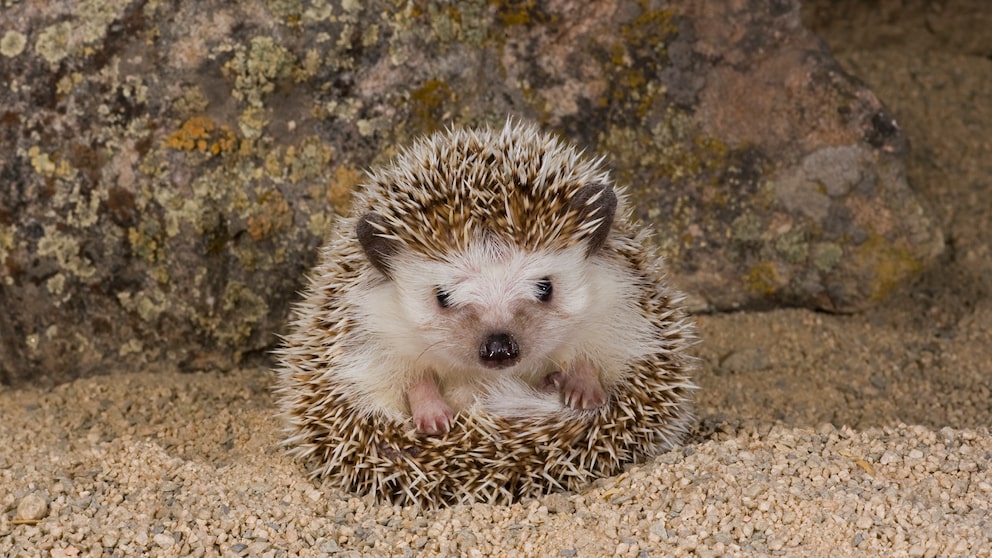
White-bellied hedgehogs, with their small button eyes, tiny paws, and soft furry bellies, are particularly cute animals. This tempts many people to want to keep these small hedgehogs from Africa as pets. But is that even allowed? PETBOOK explains why it’s not a good idea.
Overview
What makes white-bellied hedgehogs so special?
The African white-bellied hedgehog (Latin: Atelerix albiventris) is a relatively small species of hedgehog found in African savannas south of the Sahel zone from Senegal to Kenya. It typically weighs between 250 and at most 600 grams and grows to about 20 centimeters. Males are usually slightly lighter and smaller than females. Its life expectancy averages between three and seven years.1
The brown-breasted hedgehog, known from domestic gardens, grows to about 32 centimeters and can weigh up to 700 grams, or more before hibernation, unlike the small white-bellied hedgehog. If it is not run over or falls prey to enemies, it can live up to seven years.
Warning: Brown-breasted hedgehogs must not be kept as pets under the Federal Nature Conservation Act!2
White-bellied hedgehogs are not considered endangered and are not subject to restrictions under the Washington Convention on International Trade in Endangered Species (CITES). Therefore, unlike most other hedgehog species, they are not protected by species conservation laws. This legal loophole is exploited to try to establish white-bellied hedgehogs as pets. Meanwhile, calls for uniform regulations for the conservation of these animals are growing louder.3
How do you keep a white-bellied hedgehog?
The only animal-friendly answer must be: Ideally, not at all. White-bellied hedgehogs are very demanding and not suitable for beginners or children, as they are nocturnal and generally uninterested in humans. Therefore, animal welfare organizations and hedgehog experts generally advise against keeping them. The natural habitat of these animals is the African savanna, not a living room.4
Just the space requirement alone–a hedgehog needs an enclosure with at least two square meters of floor space plus regular exercise–can hardly be met in captivity. Like hedgehog species native to Europe, white-bellied hedgehogs also cover several kilometers on their nightly wanderings. This cannot be provided in any private household.
Therefore, wire cages, such as those offered for hamsters and other rodents in stores, are completely unsuitable. Among other things, the animals could get caught on the wire and injure themselves, and they are usually too small.
Hedgehog enclosures must be equipped with special bedding, although sawdust or hay can be dangerous for the animals. Each white-bellied hedgehog also needs its own house to sleep in, as they are solitary animals outside of the mating season. Under no circumstances should two male white-bellied hedgehogs be brought together, as they could easily engage in territorial fights.
How does a white-bellied hedgehog live?
Like their European relatives, white-bellied hedgehogs are nocturnal. During the day, they retreat to burrows, piles of leaves, and similar hiding places. The animals prefer mild conditions, with daytime temperatures around 23 degrees Celsius. Since white-bellied hedgehogs are sensitive to cold, it should not be cooler than 18 degrees at night.
If white-bellied hedgehogs are kept in a terrarium, they usually need a strong heat lamp, as drafts or too low temperatures can be fatal for the spiny animals. Otherwise, white-bellied hedgehogs can fall into a so-called dry rest, which can even be fatal for them.
Unlike their native relatives, the exotic spiny creatures do not hibernate but have rest periods in the summer when they are less active and slow down their metabolism. White-bellied hedgehogs are solitary and only come together with conspecifics during the mating season.
Also interesting: Degus as pets–what you need to know about acquisition, care, and behavior
Diet of a white-bellied hedgehog
A species-appropriate, varied diet, like the one they find in the wild, is also difficult to provide in captivity. All hedgehogs eat live insects such as crickets, snails, and worms and do not shy away from bird eggs. Special hedgehog or cat food is not sufficient for a balanced diet. If a white-bellied hedgehog is fed only this food, it quickly develops malnutrition and, in the worst case, dies from starvation. They can only tolerate fruit in small amounts; otherwise, they get diarrhea. Cow’s milk, on the other hand, is not tolerated by any hedgehog–the animals are lactose intolerant.
A survey by the veterinary faculty of LMU Munich in 2018 confirmed that most white-bellied hedgehogs in this country are kept incorrectly. In 70 percent of all cases, the active animals, which cover long distances in the wild to find food, lived in enclosures that were too small.
Dietary mistakes are also very common, as hedgehog experts report. Not surprisingly, very few hedgehogs in captivity reach their maximum age of about seven years. Most white-bellied hedgehogs die much earlier due to improper care. According to the World Animal Protection Society, more than 70 percent of illnesses in white-bellied hedgehogs are due to care mistakes.
Also interesting: How to recognize pain in small animals

How Long Do Elephants Actually Live?

How to Keep Tortoises Outdoors
Are white-bellied hedgehogs bred?
Mostly yes–and therein lies another problem. More and more animals are suffering from severe diseases due to inbreeding. One of these is “Wobbly Hedgehog Syndrome” (WHS), a disease of the central nervous system that causes paralysis and resulting wobbly movements in affected animals, giving the disease its name. WHS kills the animal within a few months and is very painful.
Among other reasons, to refresh the gene pool, white-bellied hedgehogs are repeatedly captured in the wild to be used for breeding. Many animals do not survive the transport to the breeder, as the conditions under which they are transported are far from species-appropriate.
White-bellied hedgehogs from breeding are also very sensitive animals and never really become tame. With a lot of patience, one can get the white-bellied hedgehog used to the presence of humans, but it remains a wild animal. White-bellied hedgehogs that show no signs of tameness at the breeder are usually ruthlessly culled.
Keeping white-bellied hedgehogs as pets: Conclusion
Even though it is not prohibited to keep white-bellied hedgehogs as pets, one should refrain from doing so for the sake of the animal. The small animal suffers in captivity and is likely to die early. Instead, you can get involved with a hedgehog protection association, of which there are many throughout Germany, if you want to do something good for the cute wild animals. If you have a garden, you can make it hedgehog-friendly. This offers the animals the best habitat. Tips for this can be found on the internet and from nature conservation organizations. And maybe you’ll have the luck to observe a hedgehog where it belongs–in nature.