


February 10, 2026, 1:07 pm | Read time: 4 minutes
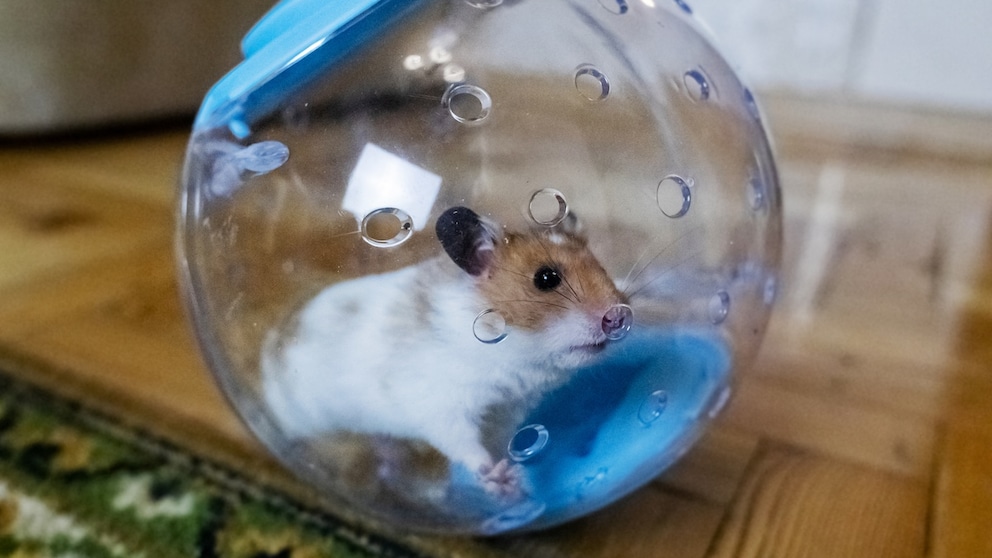
Many owners are convinced: A hamster ball is good for their pet. After all, the rodent can move freely in it and gets much-needed exercise. But this impression is misleading. Why the hamster ball means stress and risk of injury for the animals—and which alternatives are truly appropriate for their species—is explained by PETBOOK editor and biologist Saskia Schneider.
Why the Hamster Ball Is So Popular Among Owners
Hamsters are nocturnal long-distance runners: In the wild, they cover several kilometers each night. Many owners are aware of this, along with the desire to provide the animal with as much movement as possible. At first glance, the hamster ball seems ideal for this: The rodent can “freely” roam the apartment, furniture and cables are seemingly not a problem, and for children, the whole thing looks like a harmless toy.1
Additionally, many hamsters seemingly enter the ball voluntarily. This is often interpreted as a sign that they enjoy this form of exercise. In reality, however, hamsters climb into almost any opening that promises an escape from the cage—this is not an expression of enthusiasm, but pure exploration and escape instinct.
Why Hamster Balls Do More Harm Than Good
What is well-intentioned often means stress, overwhelm, and risk of injury for hamsters in reality. The Veterinary Association for Animal Welfare has classified it as “animal welfare-violating equipment for pets.” But from a biological and ethological perspective, there are many reasons against the use of hamster balls.2
Hamsters Cannot Stop Themselves
In the ball, the hamster has no control over speed or direction. It cannot deliberately brake, dodge, or stop. As a result, it crashes unimpeded into furniture, walls, or radiators. Particularly dangerous are stairs or ledges from which the ball can roll off—severe injuries or even fatal accidents are possible.3
Insufficient Air in the Ball
Hamster balls are made of plastic with small air slots. As the hamster runs, its oxygen demand increases significantly. The ventilation is often insufficient for this. Additionally, heat and ammonia from urine can accumulate inside, irritating the eyes, respiratory tract, and skin.4
Risk of Injury to Paws
The air slots pose a significant risk: A paw can slip in and get stuck. Toes can be pinched, claws torn out, or entire limbs injured.
Hamsters Are Almost “Blind” in the Ball
Hamsters are nearsighted. They rely little on sight, instead using smell, hearing, and touch. The plastic shell further distorts visual stimuli—the hamster only recognizes obstacles upon impact.
Senses Like Smell and Hearing Are Severely Limited
Smells, air currents, and subtle sounds are essential for hamsters to assess their environment. In the ball, these senses are significantly dampened. The animal cannot “read” its surroundings—a condition that demonstrably causes stress.5
Contact with Children or Other Animals Means Extreme Stress
When a hamster ball rolls through a household, it can certainly encourage children to interact with the animal in the ball. Pets like dogs and cats also generally find hamster balls interesting and often nudge them with their nose or paw. But even in “harmless” interactions, where the four-legged friend merely sniffs the ball, it becomes problematic for the hamster, as it puts the animal on constant alert. The hamster can neither hide nor flee—from a behavioral biology perspective, this is an absolute stress situation.

Where Can You Actually Buy a Hamster?

Tips for letting rabbits move freely within the home
Alternatives to the Hamster Ball
Appropriate exercise means movement with control, orientation, and retreat options. Proven alternatives include:6
- A secured run or “playpen”: Here, the hamster can decide where to go, where to sniff, and when to pause.
- A hamster-safe room or bathroom: Under supervision, without gaps, cables, or other animals.
- A high-quality exercise wheel in the enclosure: closed running surface, stable back wall, and sufficient diameter (at least 20 cm for dwarf hamsters, about 30 cm for golden and teddy hamsters) to keep the spine straight.
- Engagement instead of kilometers: Hide food, digging areas, tunnels, sand baths—this corresponds much more to natural behavior than monotonous running.
Conclusion
The hamster ball is not a harmless toy but an accessory with significant risks. It restricts essential senses, causes stress, and can lead to severe injuries. That international animal welfare organizations like RSPCA or Blue Cross explicitly advise against its use is well-founded.
If you truly want to do something good for your hamster, opt for safe free-range, a well-thought-out enclosure, and varied engagement. Because appropriate care does not mean as much movement as possible at any cost—but movement with freedom of choice, orientation, and safety.