

July 23, 2026, 2:54 pm | Read time: 3 minutes
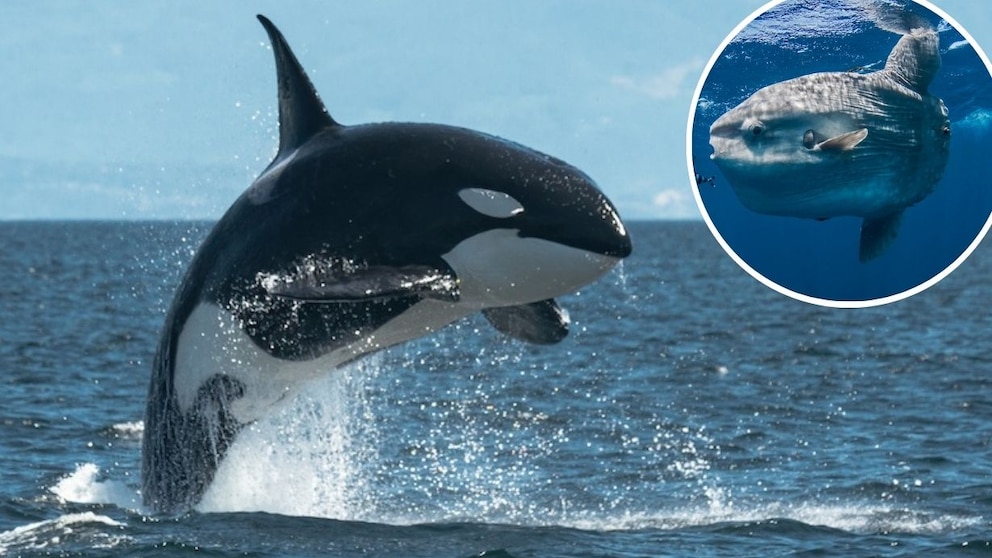
An orca holds a giant sunfish, another rushes in at full speed–seconds later, the carcass shatters into thousands of pieces. Researchers have now documented this spectacular behavior scientifically for the first time. But why do orcas do this at all?
Giant Sunfish Are Torn into Small Pieces
Orcas are considered the most intelligent hunters of the seas. They hunt sharks, seals, and even large whales–and continually surprise researchers with new hunting techniques. Scientists have now observed a behavior in the Gulf of California that has never been scientifically described before.1
In this unusual strategy, one orca holds the already dead sharp-tailed sunfish by the tail fin while another orca charges at the carcass at high speed. At the last moment, the first orca lets go. The impact is so forceful that the massive fish, weighing up to two tons, breaks into countless small pieces.

Overall, the research team documented two nearly identical incidents in July 2024 and another in September 2025. During the first event, study leader Dr. Kathryn Ayres observed a group of orcas with a calf. After the marine animals had already killed the sunfish, a female held the carcass while a male orca rammed it with full force. The tissue broke into numerous small pieces that then floated in the water. Notably, the calf primarily ate the small pieces of flesh, while the adult orcas fed on the larger remains.
Also interesting: Record Sunfish Weighs as Much as a Rhinoceros
Researchers Have Two Explanations
Why orcas exhibit this behavior is not yet clearly understood. However, researchers consider two possibilities particularly likely. The first explanation: The adult animals make it easier for their young to eat. Orcas often share their prey with calves and juveniles. By deliberately breaking it apart, they could be turning the giant sunfish into bite-sized portions.
The second possibility is much more surprising: The action could simply be a game. Orcas are known to play with their prey or display unusual behaviors that do not directly serve the purpose of feeding. Therefore, scientists do not rule out that the spectacular ramming might also serve as entertainment or social interaction within the group.

Videos Show How Orcas Hunt and Eat Great White Sharks

Orcas Observed Hunting the World’s Largest Sharks for the First Time
A Completely New Strategy
Particularly noteworthy is that in two cases, the sunfish were already dead before they were rammed. The ramming was apparently not intended to kill the prey but solely to break it into small pieces.
According to the research team, this is a coordinated effort. One orca stabilizes the carcass so that the other can hit it as precisely as possible. Such a technique has never been scientifically described in orcas before.
Also interesting: Orcas Give Each Other “Tongue Kisses”–the Reason Is Surprising
Orcas Continually Surprise Researchers
In recent years, scientists have documented ever-new hunting strategies of killer whales. Some populations specifically hunt sharks and eat only their energy-rich liver. Others collaborate with dolphins or create waves to wash seals off ice floes. The method now observed once again demonstrates how flexible and capable of learning orcas are.
However, it is still unclear whether the same animals were involved in both observations. To find out, researchers will need better video footage in the future, where the dorsal fins and the distinctive white eye patches of individual orcas can be clearly identified. “We are still discovering new techniques that orcas use to hunt and process their prey,” says study leader Kathryn Ayres. “Although they are among the most well-known marine predators in the world, they continue to surprise us.”