

September 18, 2022, 9:15 am | Read time: 12 minutes
Living with your own horse is a wonderful idea. You arrive at the stable, the horse neighs excitedly, and shortly after, you mount the saddle and set off for a ride through meadows and forests. But for this dream of a harmonious human-horse relationship to come true, choosing the right animal is crucial. What to consider when buying a horse.
Many people carry the lifelong dream of owning a horse. However, before falling in love with a four-legged riding companion, there are many things to consider. These include proper housing and a suitable location. If you’re unsure, always seek expert advice before buying a horse and be aware of your own needs.
Overview
- Which Horse Suits Me?
- The 4 Types of Horses and Who They’re Suitable For
- Physical Aspects to Consider When Buying a Horse
- The Appropriate Gender of the Horse
- Young Horse or Experienced Horse?
- What Does a Horse Cost?
- Overview of Horse Costs
- How to Recognize a Reputable Horse Seller
- Why a Pre-Purchase Exam (AKU) Is Sensible
- Which Papers Must the Buyer Absolutely Have?
- What Else to Consider When Buying a Horse?
- Why Is a Purchase Contract Important?
- What Comes After Buying a Horse?
- Summary: What to Consider When Buying a Horse
- Sources
Which Horse Suits Me?
The important question is what you want to do with your own horse. With an estimated 300 horse breeds worldwide, the choice is vast. Some horse enthusiasts want to go into the countryside and gallop over fields and meadows with their animal, while others already see themselves as successful competition riders. Others prefer a mix and want to participate in competitions at least occasionally. Knowing your desires is a big step forward in choosing your horse.
The next step should be to ask yourself: Am I already an experienced horse person with long-term riding involvement, or have I only ridden school horses so far? Even if things are going well in riding lessons, many riders do not realistically assess themselves and their abilities. To get an objective picture of your skills, a conversation with your riding instructor can help.
This has several advantages: You not only learn where you currently stand in terms of riding, but with a bit of luck, you also find out where to buy the right horse. Riding instructors are usually well-connected in their region.
Even without a riding instructor, the more realistic the self-assessment and the more concrete the ideas, the easier it is to say which horse breeds best suit your personality.
The 4 Types of Horses and Who They’re Suitable For
1. Type: Thoroughbreds
Thoroughbreds are noble horses that trace back to the Arabian horse. They are known for being fast and agile. Additionally, they are spirited. Therefore, these sensitive horses are often used as racehorses. For beginner riders who only want to go into the countryside, they are generally not suitable.
2. Type: Warmbloods
Warmbloods are a mix of Thoroughbred and Coldblood. They include the Quarter Horse as well as the Westphalian. You can find them in both sports and leisure areas.
These Warmblood breeds are widely represented in international dressage and show jumping:
- Hanoverian
- Oldenburg
- Westphalian
- Holsteiner
A girl’s dream is the pretty Friesian—a Warmblood with Coldblood characteristics. This breed originates from the Netherlands and was originally a Coldblood. After the introduction of Spanish Warmblood horses, it also became famous as a Baroque horse. You can see this proud animal in dressage and leisure areas.
The most numerous horse breed in the world is the Quarter Horse. This is not surprising, as this breed is particularly suitable for beginners due to its friendliness and calmness. Quarter Horses are versatile, reliable in the countryside, and considered particularly easy to ride.
3. Type: Coldbloods
Coldbloods are heavy, stocky horses with a good-natured disposition. They were bred as workhorses for agriculture. These animals are considered less skittish than other horse types and are therefore preferred by many leisure riders.
4. Type: Ponies
Horses with a height up to 148 cm are considered ponies. Due to their size, they are very popular with children and beginner riders, but they are often more stubborn than their larger relatives. In sports, you mainly see the German Riding Pony, while leisure riders opt for Icelandic horses and Haflingers.
Physical Aspects to Consider When Buying a Horse
Besides personal ambitions, the physical aspect also plays a role in horse buying. Do horse and rider match in weight and size? Except for exceptions, the rider should not weigh more than 10 to 15 percent of the horse’s weight, otherwise, it becomes problematic. Then the sensitive horse’s back is overloaded, and the rider finds themselves more often on the ground of the riding arena or the forest floor.
How big the horse should be is ultimately a matter of taste. Small adults often feel more comfortable with a pony than with a large horse. But regardless of whether it’s a pony or a large horse, they are physically superior to us anyway. Therefore, training for mutual safety should be pursued in any case.
Also interesting: What Basic Equipment Does My Child Need for Riding Lessons?
The Appropriate Gender of the Horse
“I actually wanted a mare. But everyone tells me geldings are better suited for beginners and returnees”—this is a statement you often hear. But are mares really moody? And are geldings generally more relaxed? An Australian study now dispels these prejudices. There are hardly any significant differences between mares and geldings in living with humans. Experts agree on one point: Stallions should only be in experienced hands.
It is also clear that the behavior of the horse largely depends on the experiences it has had throughout its life, whether it is in pain, and whether it is kept appropriately.
Young Horse or Experienced Horse?
The principle “The more uncertain the rider, the more secure the horse should be” is valid. Conversely, young horses often have not had bad experiences and are more open. The new owner faces a lot of work and additional costs, such as training, when buying a horse that has not yet been trained. Those who do not have years of experience in handling horses should refrain from buying a young horse and instead opt for a healthy horse between 8 and 14 years old.
Depending on the training, you can go into competitive sports, into the countryside, or use them for carriage rides with such horses. Depending on their character, they are also suitable for beginners. Therefore, horses in this age group are generally more expensive.

What Does a Horse Cost?
Healthy leisure horses up to 14 years old cost on average between 5,000 and 25,000 euros. Sport horses are available from 10,000 euros. That’s a lot of money, but you should avoid seemingly bargain prices when buying a horse, as often found on classified ad portals. The reasons for cheap offers are usually costly treatments that one cannot or does not want to finance oneself. And for the buyer, the rule is: If you buy a sick horse, you will have little joy with it.
Mixed breeds, so-called breed mixes, are cheaper than purebred horses. Also, “pasture accidents,” when a mare is unexpectedly covered on the pasture, cost less. But even they range—depending on the level of training—between 5,000 and 8,000 euros.
If the prices mentioned above already make you gasp, a riding involvement is definitely the better solution. It only gets really expensive after buying the horse.
Overview of Horse Costs
- Stable rent: monthly between 350 and 1,000 euros depending on region, facilities, and quality of the stable.
- Feed: approximately 40 euros per month for concentrated feed. If hay is not included in the stable rent, costs increase. The same applies if special feed is needed for chronic conditions such as arthritis, cough, laminitis, or Cushing’s.
- Riding lessons: 20 to 30 euros per hour
- Osteopath: about 200 euros (approximately twice a year)
- Dentist: about 130 euros (once a year)
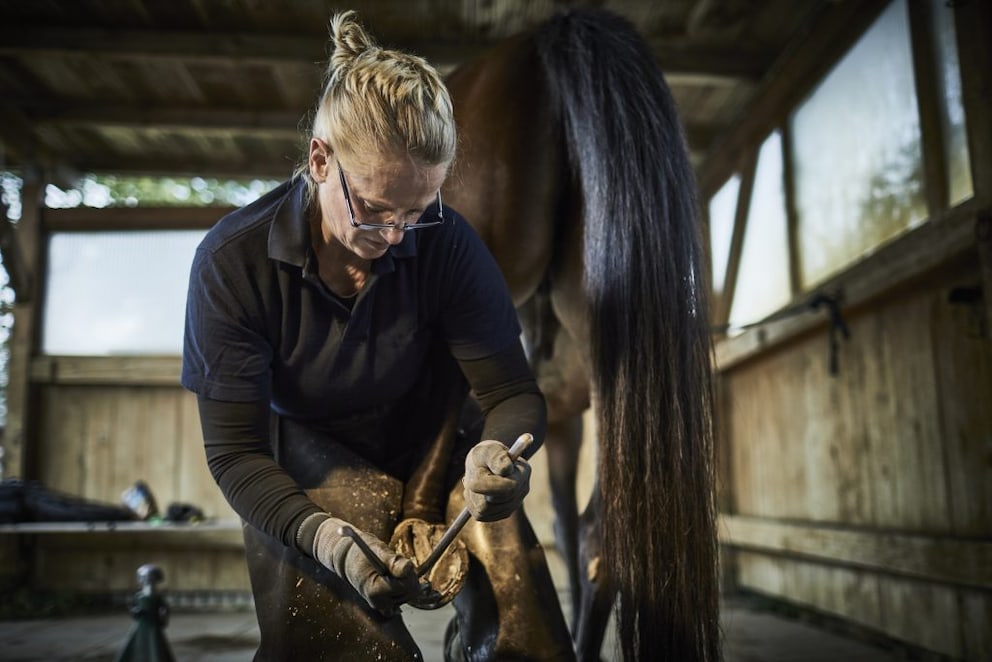
- Farrier (approximately every 6 to 8 weeks): Without shoes about 50 euros, with horseshoes between 80 and 200 euros.
- Vaccinations and worming: approximately 120 euros per year
- Liability insurance: about 100 euros per year
Roughly estimated, the average monthly costs for horse keeping range from 350 to 1,900 euros, depending on the health of the animal and the choice of stable.
How to Recognize a Reputable Horse Seller
Horses can be bought from breeders, dealers, privately, from slaughterhouses, and from animal welfare organizations. Accordingly, the price range is large. As cool and rational as you may want to approach buying a horse, it rarely succeeds. When you see your dream horse, you often let your emotions run free. To prevent a nightmare from the horse purchase, you should definitely take a horse expert from your circle of acquaintances with you.
A reputable seller knows the character of their animal very well. They know about the horse’s abilities and its rank in the herd. Additionally, they have no problem discussing the reason for sale, the horse’s history, and the number of previous owners.
The reputable seller is also aware: The horse and its future owner must be a good match. To find this out, several appointments are necessary. The priorities set at the beginning—trail riding or competitive sports—should not be neglected during the acquaintance process. Trying out is the motto! This applies not only to trail riding or the occasional jump but also to saddling and grooming. Does the horse behave calmly? Or rather nervously? Besides health, temperament is an important aspect when buying. After all, you don’t want a horse that kicks and bites.
Be cautious with horses offered as “raw” or “lightly ridden.” If you want a young horse, it’s better to buy it from a breeder. Otherwise, you risk that the animal has already been mishandled in training and only a real professional can help further.
Why a Pre-Purchase Exam (AKU) Is Sensible
Although there is no guarantee that the horse will always remain healthy, major risks in horse buying can be excluded if you opt for the “horse TÜV.” It’s best to bring in an independent veterinarian for this.
In the small pre-purchase exam (AKU), the veterinarian checks balance, bone structure, hooves, possible lameness, skin diseases, pulse, and behavioral abnormalities. The costs range between 100 and 250 euros. If you’re unsure, also have the back and joints X-rayed. This costs extra and ranges from about 800 to 1,200 euros. The more is X-rayed, the more expensive it gets. Whether the buyer bears the costs alone or the seller pays is a matter of negotiation.
Important to know: For young horses, the small AKU is only conditionally meaningful due to growth.
The so-called horse TÜV, or the large AKU, is especially sensible for expensive sport horses or breeds prone to genetic defects. The veterinarian then also conducts blood tests and checks the most stressed joints.
If the veterinarian gives the green light for the purchase and your gut feeling also says “yes,” the contract can be concluded.

Which Papers Must the Buyer Absolutely Have?
What some buyers don’t know: Horses must have papers in Germany. The equine passport states who the owner of the horse is. In any case, it should be checked whether the owner and seller are the same person. If the seller cannot present the equine passport, this is a clear warning sign.
In addition to the equine passport, the pedigree (for purebred horses) and the owner’s certificate must be present in the original and handed over.
What Else to Consider When Buying a Horse?
Since January 1, 2009, horses must be chipped. The transponder is located on the left side of the neck and is read by the veterinarian.
Health care: Three vaccinations are a must—tetanus, influenza, and herpes. The latter will become mandatory from January 1, 2023.
Why Is a Purchase Contract Important?
If the horse suddenly becomes ill shortly after purchase or shows behavioral abnormalities that were not previously known, a carefully drafted purchase contract with a three-month return policy often provides security. It’s best to have the contract drawn up by a lawyer. The more detailed the contract, the easier it is to clarify the situation in case of a dispute.
What Comes After Buying a Horse?
According to EU regulations, the new horse owner is only really obliged to report the change of ownership to the German Equestrian Federation (FN).
Liability insurance is not legally required but is still the most important horse insurance you should take out. As a horse owner, you are liable for all damages the horse causes to third parties, even if you are not at fault.
The second most important insurance is the surgery insurance. If horses need to go to the clinic and, for example, undergo surgery due to colic, you can quickly lose several thousand euros without insurance. Saving on surgery insurance would be a big mistake.
Also interesting: 5 Tips to Make My Horse Like Me

Why former racehorses are not always suitable for leisure riding

These are the rarest horse breeds in the world
Summary: What to Consider When Buying a Horse
- Define focus: What do you want to do with the horse later?
- Self-critical assessment of your own horse competence and riding skills (preferably by a riding instructor)
- Based on the result: Select horse breed(s)
- Check: Does the desired horse breed match size and weight?
- Horse found: Can the seller provide information about the horse’s temperament and abilities?
- Does the seller give enough time for the purchase decision? Are multiple follow-up appointments possible?
- Have your own priorities been thoroughly tested with the horse (trail riding, jumps, etc.)?
- AKU without critical results?
- What does your gut feeling say?
- Equine passport: Is the seller actually the owner?
- Are all documents available in the original (pedigree, equine passport, owner’s certificate)?
- Is the purchase contract as detailed as possible and issued by a lawyer?
Sources
- Aune A, Fenner K, Wilson B, Cameron E, McLean A, McGreevy P. Reported Behavioural Differences between Geldings and Mares Challenge Sex-Driven Stereotypes in Ridden Equine Behaviour. Animals (Basel). 2020;10(3):414. Published 2020 Mar 2. doi:10.3390/ani10030414
- German Equestrian Federation, “Health Care: Properly Vaccinating Horses” (accessed on 6/20/2022)