

January 1, 2026, 3:10 pm | Read time: 5 minutes
The horse appears listless, eats less than usual, or repeatedly shows mild colic symptoms—especially after feeding or during training? Such changes are often dismissed as stress, training issues, or signs of aging. However, painful changes in the stomach lining could be the cause. Stomach ulcers are among the most common diseases in horses and often go undetected for a long time. PETBOOK explains how they develop, which symptoms should be taken seriously, and which treatment options can help.
How Do Stomach Ulcers Develop in Horses?
The horse’s stomach, with a volume of about 8 to 15 liters, is relatively small compared to its body. Unlike the human stomach, it continuously produces gastric acid, regardless of whether food is consumed. In the wild, horses spend up to 16 hours a day eating. This almost constant eating ensures that the gastric acid is continuously buffered by food and saliva.
The horse’s stomach is also anatomically divided into two distinct areas. The upper section is lined with a glandless mucosa that serves as storage but offers little protection against gastric acid. It is particularly sensitive to acidic influences. The lower stomach section consists of a glandular mucosa that produces digestive enzymes and has its own protective mechanisms. If the stomach remains empty for an extended period or if more gastric acid is produced, this protective system becomes unbalanced. The mucosa can become inflamed—painful lesions and stomach ulcers are the result.1, 2
Reasons Why Horses Get Stomach Ulcers
Stomach ulcers are grouped under the term Equine Gastric Ulcer Syndrome (EGUS). A distinction is made between ulcers of the glandless mucosa (Equine Squamous Gastric Disease, ESGD) and changes in the glandular mucosa (Equine Glandular Gastric Disease, EGGD).
In principle, horses of all age groups can be affected, although there are certain risk groups with a higher likelihood of developing stomach ulcers. One of the most commonly affected groups is racehorses. But why do horses get stomach ulcers at all? There can be many different causes:
- Stress: from training, competitions, transport, changes in stabling, or social conflicts
- Feeding errors: long periods without food, grain-heavy diets, and insufficient roughage
- Housing conditions: strict stall confinement without exercise, or constant unrest in large groups
- Intensive training: gastric acid splashes onto sensitive stomach areas
- Medications
- Accompanying illnesses: orthopedic problems, or previous colics
Recognizing Symptoms
The symptoms of stomach ulcers are varied and often nonspecific. Many changes develop gradually and are only later associated with the stomach. Typical signs in everyday life include:
- Recurring, usually mild colics, often after eating
- Reduced or picky appetite
- Weight loss and emaciation
- Poor general condition
- Teeth grinding or so-called empty chewing
- Frequent flehmen or yawning
- Reduced willingness and ability to perform
- Behavioral changes
- Hard belly
Not every horse shows all symptoms. Especially in sport and leisure horses, performance decline or behavioral changes are often attributed to other causes.
Diagnosis
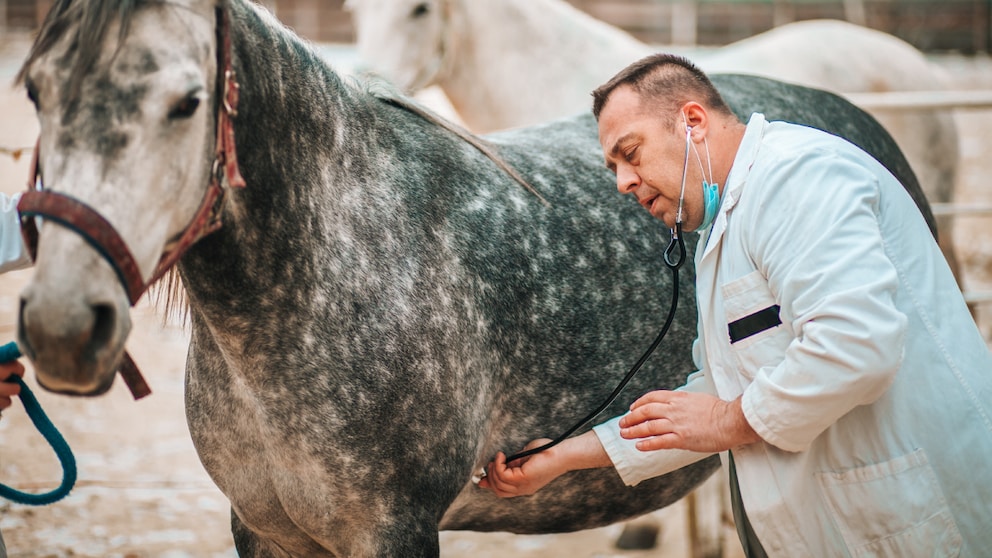
If stomach ulcers are suspected, the veterinarian ideally confirms the diagnosis with a gastroscopy (stomach endoscopy). This involves inserting an endoscope through the nasal passage and esophagus into the stomach to directly examine the mucosa. A prerequisite for the examination is fasting for at least twelve hours, as the stomach must be completely empty.
The veterinarian performs the gastroscopy under sedation, and it usually takes 20 to 30 minutes. The examination allows for a precise assessment of the stomach lining and distinguishes between ulcers of the glandless mucosa (ESGD) and changes in the glandular mucosa (EGGD). At the same time, the veterinarian can identify other conditions such as tumors, gastric emptying disorders, or stomach bots.3, 4

How Much Hay a Horse Consumes Per Day
Why Colic in Horses Can Become a Major Threat
Treatment
The veterinarian tailors the therapy to the location and severity of the ulcers. In most cases, medications are used to inhibit the production of gastric acid. The treatment usually lasts about four weeks. The veterinarian then recommends a follow-up gastroscopy to check for complete healing of the mucosa. With consistent therapy, the prognosis is very good.
Stomach ulcers can also be surgically treated in acute situations, although this is relatively rare.
Prevention in Everyday Life
To effectively prevent stomach ulcers, the daily routine at the stable can be optimized. Stress plays a central role in the development of ulcers.
Additionally, horse owners should ensure their horses are offered high-quality roughage several times a day and consistently avoid long feeding breaks. During ongoing treatment, it is advisable to avoid grain feed. After completing therapy, grain feed should only be given in small amounts and always after roughage.
Slow eating promotes saliva production and helps neutralize gastric acid. At the same time, horse owners should specifically reduce stress factors. Common triggers include changes in stabling, transport, social unrest in the group, or overly intensive training. Clear daily routines, calm housing conditions, and a training regimen adapted to the horse’s health relieve the stomach sustainably. Regular exercise and pasture time also positively affect well-being and stomach health. If there is an increased energy requirement, plant oils or grain-free feeds can be used. All measures should be individually tailored to the horse and always in close consultation with the veterinarian.