

November 3, 2025, 4:01 pm | Read time: 8 minutes
When the days get shorter, horses begin to shed their coats. As soon as the shedding starts, the age-old debate among horse owners reignites: Should you clip your horse or not? PETBOOK examines the pros and cons.
Many riders know it: When fall arrives, the layered look is back in style. Thermal riding pants are pulled out, and a sweater, vest, and jacket are added on top. And that’s not all—at the stable, you’ll now see more thermos flasks, hats, and headbands. But it’s not just riders who adapt to the lower temperatures; horses know how to help themselves, too.
Often, by September or at the latest by the end of October, animals grow a thick, dense winter coat. Experience shows that this can lead to discussions in the stable aisles, raising the almost philosophical question of whether to clip the horse or not—echoing the phrase: “To be or not to be.” PETBOOK provides an overview of the pros and cons.
What Happens During Coat Shedding?
Horses can adapt to their environment due to evolution. Arabian horses can withstand the heat of their origins well, while Yakutian horses endure the icy cold temperatures of Siberia excellently. Even in European regions, horses ideally adapt to the seasons–but how do they actually know it’s time for a coat change?
Many assume it has to do with the dropping temperatures. But that’s incorrect—it’s not the temperature, but the sunlight. As the days get shorter, their metabolism adjusts. The animals then produce more of the metabolism-stimulating hormone thyroxine via the thyroid gland. This increases coat production, and the winter coat begins to grow.
The winter coat is usually denser and longer, and now serves the horse for targeted heat regulation. In low temperatures, the winter coat hairs stand upright—similar to goosebumps. This creates a small layer of air between the hairs and the horse’s skin, serving as a thermal barrier. This regulation mechanism is called piloerection.1
Also interesting: Horse Not Shedding Its Winter Coat? It Could Be Due to This Disease
Why Do Owners Clip Their Horses?
First of all: Whether and why you clip your horse is an individual decision that depends on several factors. There are several reasons why owners clip their horses. A common reason is that clipping reduces sweating. After training, the horse needs less time to cool down and doesn’t stand wet in the cold for long.
Some horses develop a very thick winter coat. Take my pony mare, Little Princess, for example. She was a German Riding Pony mix and must have had quite robust ancestors. When you ran your hand through her winter coat, you could hardly see the skin underneath. In itself, that wasn’t a problem. But the pony mare was an incredible bundle of energy and needed corresponding exercise. With the thick coat, she sweated a lot, and it sometimes took up to two hours for her to dry off. Since not exercising was not an option, we decided to clip her a year later.
Disadvantages of Clipping in the Fall
Among horse enthusiasts, there are also voices that oppose clipping horses. This is because it doesn’t only bring advantages. If you clip your horse, you must keep in mind that the coat is a natural protection for the animal. When this protection is removed, the horse can become more sensitive to touch in those areas.
Additionally, clipped horses need to be blanketed. This compensates for the clipped coat. Despite the blanket, clipped horses may tend to get cold more quickly. Moreover, clipping itself can be stressful for the horse if it is not accustomed to it.
Should You Clip Your Horse?
As mentioned before, it’s an individual decision. If you’re having trouble deciding, it’s worth having a consultation with your veterinarian. You can discuss the pros and cons individually with them. Sometimes other factors also play a role: Does the horse have a relevant pre-existing condition? Is it frequently exercised intensively? Is there a horse solarium in the stable? Does the horse tend to have skin diseases?
With my pony mare, I also took my time with the decision and didn’t clip her overnight. Additionally, the advice from my veterinarian was also helpful.
How Do You Clip a Horse?
Before clipping a horse, there are a few things to consider. First, you must be sure that the animal has fully developed its winter coat. Then it’s the right time to clip the horse.
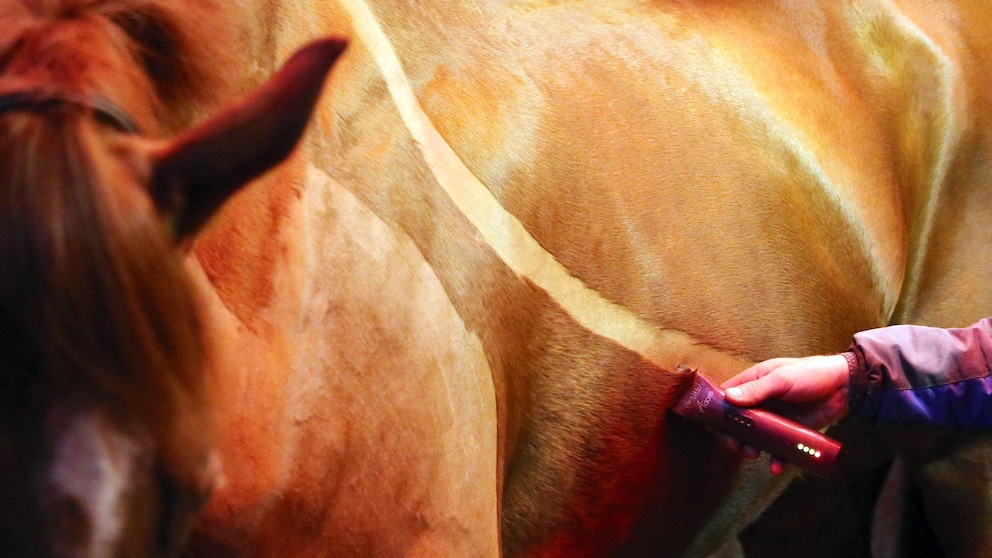
Now the question arises about the appropriate clipping style—because not all clipping is the same. Many owners clip their horses in specific patterns. One thing unites them all: When clipping, it’s important not to clip the entire horse. For example, the kidney area and the eyes, ears, and mouth should never be clipped. The saddle area should also not be clipped, as the saddle could cause uncomfortable chafing for the animal. With my pony mare, I always clipped a kind of rally cut. Only a strip was removed in the areas where she sweated the most.
No Clipping Without Preparation!
However, it’s important to prepare the horse for clipping. A clipper is not very quiet, so the animal should be familiar with the sound. If the horse is losing its winter coat for the first time, you should practice contact before the actual clipping. Turn on the machine and reward every curious reaction from the animal. The horse should develop a positive, stress-free association with the sound. You achieve this best with positive reinforcement.
Once the horse has learned that the machine does not harm it, you can slowly start holding it against the coat, without clipping. Patience and small training steps build trust—making the first clipping a positive experience.

Which Wellness and Care Treatments for Dogs Are Beneficial in Winter

Falabella–Have You Heard of the World’s Smallest Horse?
What to Consider When Choosing a Blanket
When I dealt with clipping, it quickly became clear to me: A suitable blanket is essential. Before you reach for the clipper, the right blanket should already be ready—and finding it is not so easy:
Length of the Blanket
So what should you consider when choosing a blanket? First, the size of the blanket should fit. Measure the length from the withers to the base of the tail. With this length, you can now buy the appropriately long winter blanket.
Sometimes it happens that there is no suitable blanket. Then it can help to measure again: from the center of the chest to the end of the hindquarters. This length helps you better estimate the size of the blanket; some manufacturers include the full measurements of the blanket in their product descriptions.
Filling of the Blanket
Blankets have different fillings—don’t be confused by this. There are fillings between 50 and 400 grams. The gram number refers to grams per square meter. Blankets with 50 to 100 grams are suitable for transitional periods and for horses that are blanketed but not clipped.
When it gets colder, blankets from 200 grams are used. The very thick blankets with 400 grams of filling per square meter are mainly suitable for clipped, cold-sensitive horses.
Winter Blanket and Rain Blanket
Ideally, your winter blanket also has a water-repellent function. Especially in winter, it’s important that if it snows and the horses are outside, the blanket doesn’t get soaked. This increases the risk of the animal catching a cold.
If your winter blanket doesn’t have a rain function, then it’s best to upgrade. Most rain blankets also come with different filling options. There are also combo models—you can interchange the under blanket with the filling and add a rain blanket on top.
If the Neck Was Clipped
Depending on the clipping style, the horse’s neck may be partially clipped. In such a case, you should cover the neck with an additional blanket piece. Many manufacturers also offer combo models for this.
Tear Resistance
The tear resistance of a blanket is a tedious topic for some horse owners. I can’t even remember how many blankets I repurchased or had in reserve—my pony mare never took long to ruin her blanket.
Fortunately, there are now blankets that are almost tear-resistant. Manufacturers provide a textile size for this: denier. Denier describes the thread strength: The higher the value, the more robust the material.
Conclusion: There Is No General Recommendation
In general, the question cannot and should not be answered. Whether a horse should be clipped depends on many factors—from coat condition to training intensity to the animal’s housing and health status. Therefore, there is no general recommendation. After careful consideration and a conversation with the veterinarian, a well-founded decision can be made.
If you decide to clip, ensure proper blanketing, and with the right preparation for clipping, you can ensure that the horse gets through the winter optimally.