

March 23, 2026, 10:17 am | Read time: 6 minutes
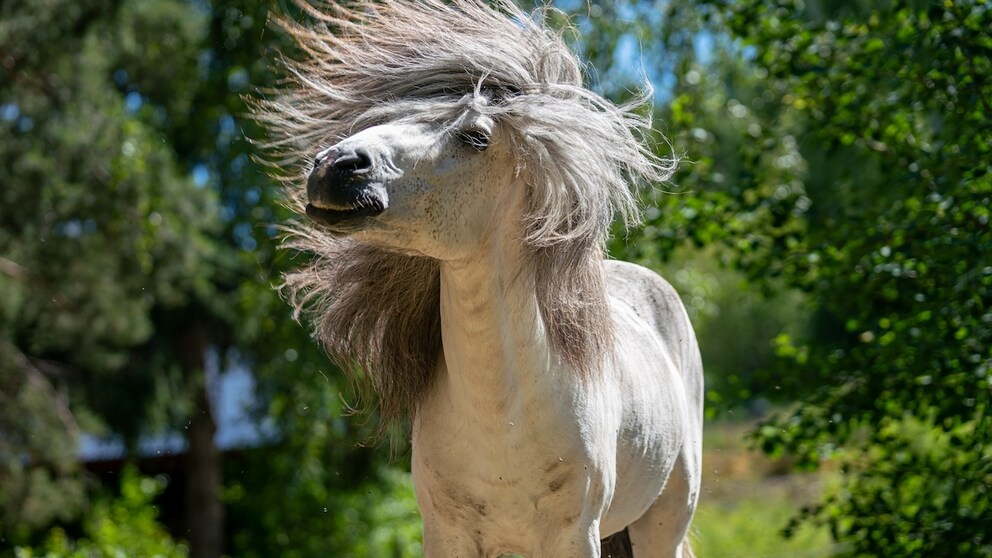
A horse walks calmly across the field—suddenly it jerks its head up, repeatedly tossing it upward. What initially seems harmless occurs more frequently. Many owners first think of restlessness or disobedience, overlooking that there might be more to it. PETBOOK explains why this behavior should be taken seriously and what really lies behind it.
What Happens in the Horse’s Body
The term “headshaking” may sound unfamiliar at first, but it describes a serious problem: The horse suddenly and uncontrollably moves its head without an obvious trigger. This is often due to a disturbance in the processing of stimuli in the head area.
An important role is played by the so-called trigeminal nerve. This nerve is one of the most important in the head, transmitting stimuli like touch, temperature, or pain from the facial area to the brain.1, 2
In horses with headshaking, this nerve appears to be hypersensitive. Experts refer to a “lowered stimulus threshold.” This means even weak stimuli like sunlight, wind, or a light touch on the nose are perceived much more intensely than normal—sometimes even as pain. This misprocessing can lead to the horse suddenly and uncontrollably moving its head.
What This Has to Do With Pain and Current Research
The trigeminal nerve also plays an important role in humans. It allows us to feel facial touches and is involved in severe pain, such as toothaches or certain facial pains.
Veterinary medicine is currently investigating what exactly happens in the nervous system of affected horses. A study from 2025, published in the journal “Equine Veterinary Journal,” focused on a specific messenger substance: the so-called Calcitonin Gene-Related Peptide, or CGRP. This substance helps transmit pain signals in the body.
In horses with headshaking, elevated CGRP levels were measured in the fluid surrounding the brain and spinal cord. This could indicate that nerves are irritated or inflammatory processes are occurring in the nervous system.
However, the significance of these findings is not yet fully understood. Elevated CGRP levels have also been found in other neurological disorders. Whether this messenger substance can aid in diagnosis or treatment in the future is still the subject of further research.
Why Horses “Headshake”
The causes are varied. Generally, two forms are distinguished: Symptomatic headshaking involves an identifiable underlying condition.3
These include:
- Dental diseases
- Diseases of the nose or sinuses
- Air sac diseases
- Eye or ear problems
- Diseases of the jaw joint or cervical spine
These conditions can irritate the trigeminal nerve and trigger symptoms.
In idiopathic headshaking, no clear cause can be found. In these cases, a general dysfunction of the nerve is assumed. Why this occurs is not yet clearly understood.
Additionally, external factors can also be triggers that cause headshaking. These include sunlight, heat, wind, rain, or insects. Many horse owners report that their animals start “headshaking” especially in spring and summer.
Distinguishing Headshaking From Normal Shaking
Occasional head shaking is normal for horses—for example, to ward off insects. However, headshaking is characterized by repeated, sudden movements without an obvious trigger. They often appear uncontrolled and are not clearly related to external stimuli.
The most noticeable symptom is this repeated, involuntary head tossing. The intensity can vary greatly—from barely visible to so pronounced that the horse becomes difficult to control.4
Other typical signs include:
- Rubbing the nose
- Increased snorting
- Noticeable movements of lips and tongue
In severe cases, horses show significant behavioral changes. They suddenly stop, rear, or walk backward. Some animals try to reach the head area with their front legs, which can lead to injuries.
Symptoms can occur during movement but also at rest. They often intensify over time or under certain conditions. It’s important for owners to take frequent headshaking seriously and not blame the animal for sudden behavioral changes.
How the Veterinarian Makes the Diagnosis
For many horse owners, diagnostics can be nerve-wracking. Although headshaking is a serious condition, finding the cause can be lengthy despite all efforts. Therefore, it’s important for owners to document their horse’s headshaking. Often, it is helpful to present video material to the veterinarian. It can also be beneficial to record the headshaking in writing. The following questions may help:
- When does the headshaking occur?
- How long has it been happening?
- Is it seasonal? More frequent in certain months?
- Are there environmental conditions that could have an impact? (Wind, light, rain)
- Is there a change with different equipment? Such as a change in bridle or bit?
If you notice increased headshaking in your horse, it’s helpful to quickly consult a veterinarian. The diagnosis begins with a thorough history taking, clarifying when and under what circumstances the symptoms occur.
Subsequently, the following steps are taken:
- A clinical examination
- A neurological examination of the nervous system
- Observations at rest and under stress
Further investigations may be necessary for clarification:
- Blood tests
- Endoscopies (scoping) of airways, ears, and the oral cavity
- Eye examinations
- Imaging techniques like CT, X-ray, or ultrasound
Since there is no direct test for the idiopathic form, diagnosis often occurs by ruling out other causes.5
What Treatment Options Are Available?
Treatment depends on the cause. If an underlying condition is identified, its therapy takes precedence.
For idiopathic headshaking, various approaches are available:
- Medications
- Surgical procedures
- Management adjustments, such as nose nets or light protection masks
A modern approach is the so-called PENS therapy (percutaneous electrical nerve stimulation). The affected nerve is stimulated by electrical impulses to influence stimulus processing. The treatment is carried out in several sessions and is generally well tolerated. However, the effect can vary. Often, symptoms can only be partially alleviated.
How Horner’s Syndrome Manifests in Cats

Vestibular Syndrome in Dogs–Not a Stroke, but Similarly Dangerous
Can Headshaking in Horses Be Cured?
The prognosis depends greatly on the cause. If an underlying condition is successfully treated, symptoms may decrease or disappear entirely.
For idiopathic headshaking, the prognosis is not clear-cut. The condition often progresses. In many cases, there is a permanent limitation of usability. Whether and how well a horse responds to treatment is crucial for the further course.
What Can Help in Everyday Life
Since the causes are often unclear, targeted prevention is only possible to a limited extent. Therefore, adapted management is all the more important. This includes:
- Reducing known triggers as much as possible
- Consistent protection against insects
- Use of nose nets or light protection masks
- Individual adjustment of housing and use
Early veterinary clarification is important to avoid overlooking treatable causes. Because behind the seemingly “odd” behavior often lies more than it appears at first glance. It can be very distressing for the horse, so it’s crucial to look closely and take changes seriously.