

April 27, 2026, 3:57 am | Read time: 7 minutes
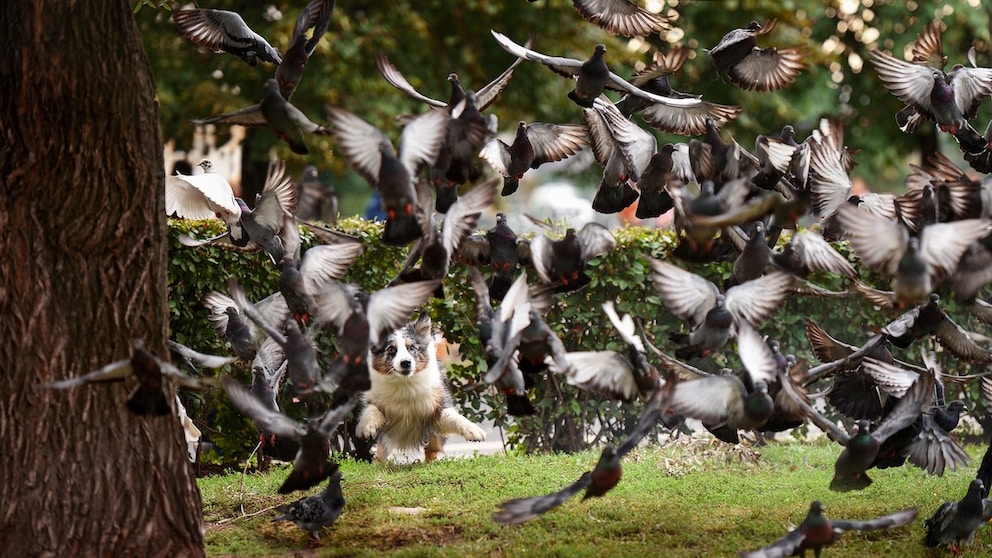
Few topics engage dog owners as intensely and simultaneously as frustratingly as when their dog hunts uncontrollably. The dog runs off, ignores every recall, and reappears twenty minutes later, panting and grinning blissfully—leaving the owner torn between relief and despair. Dog trainer and PETBOOK author Katharina Marioth lists five mistakes that often exacerbate the problem.
Hunting Behavior Is one of the Most Common Problems
In my daily work as a dog trainer, hunting behavior is one of the most frequently mentioned issues. At the same time, it’s a topic where most owners start with the wrong assumptions. Not out of indifference, but because certain explanations are so widespread that they are rarely questioned. That’s exactly what I want to change today. Because those who recognize these misconceptions can stop unintentionally worsening the problem—and finally work on it effectively.
Misconception 1: “My Dog Knows It’s Forbidden”
This is the sentence I hear most often, usually accompanied by a sigh and the addition: “He does it on purpose.” I understand the feeling. But it doesn’t reflect what’s actually happening in the dog. Hunting is not a conscious rule-breaking. It’s a deeply rooted, neurobiologically driven instinct that has changed over millennia of domestication but has never been completely eradicated. When a dog sees a deer and takes off, there’s no internal debate between obedience and temptation. The dog is in a state where the reward system of its brain is running at full speed—pure dopamine, entirely without human intervention.
Guilt, intent, defiance—these are human concepts that we project onto our dogs. And this projection is dangerous because it leads us to the wrong measures. Those who believe the dog “knows better” will sooner or later try to stop the hunting through pressure or punishment. And that leads directly to the next misconception.
Misconception 2: “Punishment After Returning”
This misconception is not only ineffective, but it is also actively harmful. The logic behind it initially sounds plausible: The dog returns, has just done something wrong, so now it gets a clear message. Problem understood, better next time.
In reality, however, the dog does not associate the punishment with the hunting that occurred several minutes ago. It associates it with the last behavior it exhibited—namely, returning. Those who punish their dog after returning, whether through loud scolding, forceful leashing, or physical pressure, actively punish the recall. The result: The dog returns even more hesitantly next time. It learns that returning to the human has unpleasant consequences. And that’s the last thing we want.
The recall must be the best thing in the world—always. Even if you’re boiling inside.
Misconception 3: “More Exercise Solves the Problem”
I hear this advice constantly, even from well-meaning sources: “Your dog hunts because it doesn’t get enough exercise. More movement, and it will stop.” It sounds logical. But it’s not entirely true—at least not universally.
The problem with this assumption is that physical exercise alone does not reduce hunting behavior; in many cases, it even intensifies it. Those who chase their dog through fields and forests for two hours daily train endurance, attention to environmental stimuli, and the conditioning for quick reactions to prey. Exactly the traits that make hunting more effective.
What really helps is targeted hunting-related exercise in controlled ways. Dummy training, for example, offers a legal, safe, and highly satisfying alternative for the dog, where the retrieving instinct can be fulfilled without involving a deer. Rescue dog sports go a step further: They combine scent work, endurance, and close cooperation with humans—creating a bond that is invaluable in everyday life. Such activities address the dog’s hunting motivation but channel it in a direction that neither endangers wildlife nor puts owners in a bind.
Misconception 4: “He Just Doesn’t Listen to Me at That Moment.”
True—but the “just” is the problem. Because this sentence is often formulated as an unchangeable fact, as if it were fate. In reality, it describes a condition that can be understood and specifically addressed.
When a dog hunts, or is in the so-called hunting mode, it is in an altered neurobiological state. The focus on the prey is so strong that external stimuli, such as voice, whistle, or command, simply do not reach the same depth of processing as in the normal state. This is not a decision; it’s neurology.
What this means: Training must take place well below the stimulus threshold. Not at the place where the deer run, and not at the moment when the dog is already fixated.
But beforehand, gradually, with a lot of patience and clear criteria. Good circle training is one of the most effective tools I know. It trains the dog’s attention on the human, even when the environment becomes interesting, and builds step by step an orientation that holds in an emergency. Those who build it systematically work with the dog’s biology—not against it.
Misconception 5: “It Will Settle with Age”
Sometimes that’s even true. Some dogs become calmer with age, the hunting motivation decreases, and impulse control grows on its own. But that’s the exception, not the rule. And relying on it is risky.
Because unaddressed hunting behavior solidifies. Every successful hunt—and successful here means: The dog hunts and has a lot of fun, whether it catches the animal or not—is a practice session. The brain learns: This process is enjoyable, this process works, I will repeat this process. Waiting three years gives a behavior room to solidify three times a day.
Starting early provides significantly more leeway. Not because young dogs are more compliant, but because less ingrained patterns can be changed more quickly.

Your Dog Doesn’t Come When Called? Here’s What You Might Be Doing Wrong

Why the Mating Season in September Can Be Dangerous for Your Dog
Management Is Not a Defeat
I often encounter owners who feel ashamed when their dog is on a long leash. As if it’s an admission of failure. I see it completely differently. The long leash is not a sign of poor training—it’s a sign of responsibility. As long as the training is not yet at the point where the dog is reliably recallable, it belongs on a long leash in hunting-relevant areas.
This applies not only to the dog that hunts and its owner. Hunting behavior has real consequences for wildlife, especially in sensitive phases such as breeding and setting time. A dog that runs unsecured through the forest and flushes out deer, hares, or ground-nesting birds causes damage that extends far beyond its own property. Consideration for wildlife is not a minor matter but part of the responsibility one takes on when owning a dog.
The long leash gives the dog both freedom and security. It allows for building circle training without the risk of uncontrolled hunting. And it protects all parties involved in the meantime–the dog, the wildlife, and the human.
And What Do I Do Now?
Hunting behavior is not unsolvable. It can be influenced, sometimes significantly reduced, and in many cases controlled to the point where a relaxed coexistence is possible again. But only if you stop working with the wrong tools—and start looking honestly: What does this dog really need? How can I channel its motivation sensibly? And what can I do today to protect it and others?
The first step is often the hardest: Accepting that the dog is not driven by malice, but by an instinct that brings it genuine joy. From there, work can begin. With understanding, with structure, with hunting-related exercise in controlled ways—and with a recall that is always the best option for the dog.

About the Expert
Katharina Marioth is the founder of the brand Stadthundetraining and the KEML principle. She is an IHK- and government-certified dog trainer and behavioral assessor for dangerous dogs in the state of Berlin. In her daily business, she works closely with veterinarians, scientists, and other specialists on dog-related topics. With her knowledge and skills, she secured the title of Dog Trainer of the Year 2023 in the Sat.1 show “The Dog Trainer Champion.”