

October 31, 2025, 5:01 am | Read time: 3 minutes
Dogs have favorite toys—that doesn’t sound unusual at first. The reasons, however, can be. This is because sometimes dogs associate them with specific experiences. Kleinspitz Samy, owned by PETBOOK author Manuela Lieflaender, provided a vivid example of this.
Samy’s First Success as a Hunter
Defending prey is normal behavior among dogs. When Samy, as a puppy, “captured” a dead mouse, I wanted to take it away from him—this triggered something in him. The mouse was his coveted and probably the first truly important object of desire in his life.
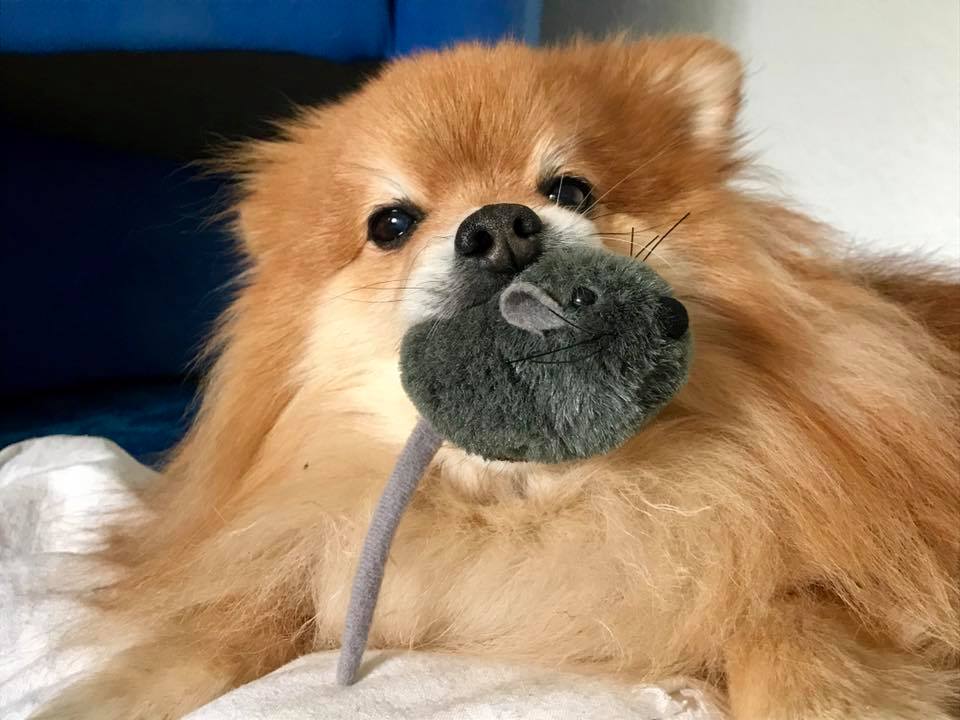
Some time later, when he was being looked after by my neighbor in her apartment, he made a discovery. At the cat owner’s place, there was a brand-new wind-up mouse on the tiles. When my neighbor opened the door for me, Samy grabbed the mouse. He ran with his prize into the stairwell, leaving no doubt that this thing was now his.
Especially when I wound it up and let it “run” through the apartment, the Spitz went wild. I had to regularly take it away from him so he wouldn’t tear it apart and swallow it. For many years, he was completely beside himself and jumped like a rubber ball into the air whenever I took the wind-up mouse out of the cupboard.

Living with a 20-Year-Old Dog: “I Even Take Him into the Bathroom”

Cat Puts Toy in Bowl–Is It Really Trying to “Feed” It?
When Toys Stir Emotions
It really seemed as if the toy mouse reminded him of the real mouse from earlier. Research shows that a toy is emotionally positively linked when the dog has played particularly “successfully” with it, whether by catching, tugging, or searching.
If the wind-up mouse stayed in the cupboard and the dog was allowed to choose from a box of toys, it was a squeaky egg made of latex. It was an Easter egg whose lid opened when bitten, revealing a chick. Although Samy was usually sensitive to noise, he loved this squeaky egg with the chick.
He isn’t alone in this preference: A 2010 study by the University of Bristol examined the favorite toys of shelter and kennel dogs. The researchers found that 76 percent of shelter dogs played twice as long with chewable and squeaky toys as with sturdy, harder objects.1
Why Dogs Are Attached to Their Favorite Toys
Toys have many meanings for dogs. They can be an anchor during stress and uncertainty. Some dogs bring toys or objects when they are unsure because they are being watched or don’t know what their human wants from them.
Dogs often develop a close bond with certain toys—not just because they are fun, but because they are associated with positive experiences. Just as Samy associated the wind-up mouse with his first “hunting success,” toys can trigger emotional memories and provide security.