

September 10, 2025, 9:31 am | Read time: 6 minutes
Not just after a biting incident: In many situations, wearing a muzzle can be sensible or even required–even for friendly dogs. PETBOOK explains when wearing a muzzle is appropriate or mandatory and what owners should definitely know.
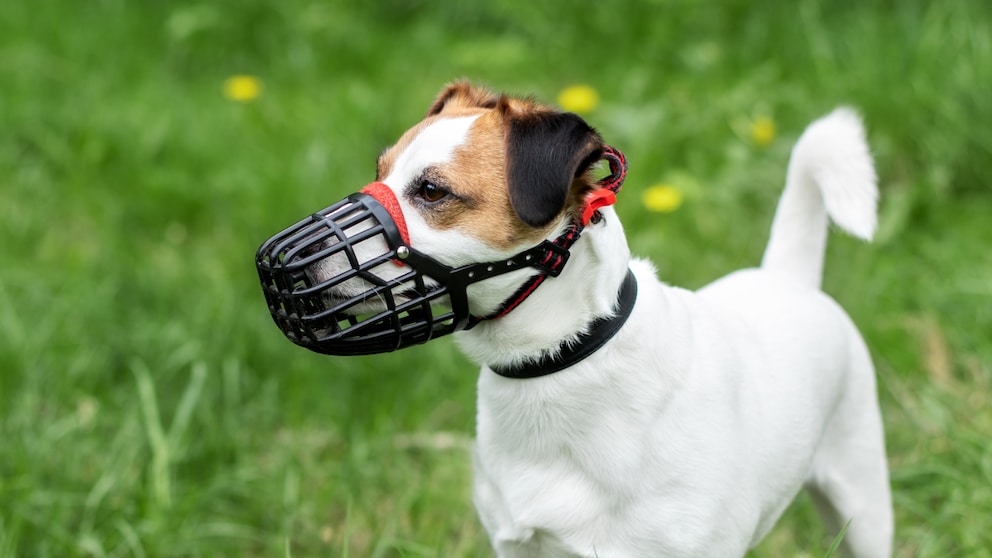
A muzzle often causes discomfort among passersby–and owners frequently face skeptical looks. The suspicion quickly arises: Has the dog bitten someone, or is it a so-called listed dog? However, the muzzle primarily serves one purpose–the safety of humans and animals. In certain situations, it is even legally required, such as on public transportation or when traveling abroad. It can also be very useful during a vet visit or to prevent incidents with poison bait. Therefore, it is all the more important to get the dog used to it early and gently.
Overview
At the Vet (Preventive)
There’s often great excitement in the waiting room: Besides fellow dogs, there are frightened rabbits and defensive cats that can unsettle the dog. Strange smells and sounds often lead to a tense situation. If the dog then has to stand on the smooth metal table in the examination room and be examined (and in the worst case, it even hurts), it can happen that he turns around and snaps. This can happen even with the friendliest dog, which is why a muzzle should be put on preventively. It ensures a safe and relaxed situation during the vet visit.
While Walking, to Prevent Eating from the Street
Most dogs are vacuum cleaners on four paws. A second of inattention, and the dog has swallowed a half-decayed mouse or something unappetizing. In the worst case, he could also pick up a poison bait. With the help of a muzzle, this behavior can be prevented until the anti-poison bait training is securely in place.1 2
On the Train (Sometimes Mandatory)
Many dog owners are unaware that there is a muzzle requirement on Deutsche Bahn. If the dog is not traveling in a transport box on local or long-distance trains, it must be leashed and wear a muzzle. Small dogs (maximum size of a cat) must at least be secured in a carrier bag. Guide dogs are exempt from this regulation.3
While Traveling
In many vacation countries, there are different regulations that require wearing a muzzle. It’s best to inquire in advance, such as on the website of the German Animal Welfare Association, to know where exactly to expect requirements. Here you can find an overview of all EU countries. 4
No Uniform Law on Muzzle Requirement
In Germany, there is no nationwide uniform regulation on the muzzle requirement. Instead, the responsibility lies with the individual federal states and sometimes even with municipalities. Accordingly, the regulations vary. In practice, this means: Whether a dog must wear a muzzle depends on the respective place of residence or stay.
Generally, the muzzle requirement mainly affects so-called listed dogs–breeds that are classified as potentially dangerous under the respective state law. However, not everywhere are only breed-related criteria applied. Some federal states now also consider behavioral characteristics, such as aggressiveness, readiness to fight, or threatening behavior towards people or other animals.5
In many cases, a dog can be exempted from the requirement if a so-called temperament test is successfully passed. Then the dog is considered individually harmless–regardless of its breed.
Additionally, local regulations–such as in public places, pedestrian zones, or at large gatherings–can also mandate a muzzle requirement for non-listed dogs. The same applies to the use of public transportation. Dog owners should therefore always check with local authorities or the relevant agency about applicable regulations.
Fines for Violations
Fines for violations of the muzzle requirement vary greatly depending on the municipality. While fines for leash violations or not picking up dog waste typically range from 20 to 150 euros, not wearing a required muzzle can be significantly more expensive.
The average fines for this offense range nationwide from 45 to 250 euros. In some cities–such as Frankfurt am Main, Munich, or Münster–fines of up to 1,000 euros are possible.
For comparison: Violating the leash requirement usually results in a fine between 50 and 300 euros. 6
Which Muzzle is Right for My Dog?
First, one must distinguish between a muzzle and a muzzle loop. Some owners prefer a muzzle loop because it looks less intimidating. However, it is only suitable for short-term use, such as at the vet, because it usually fits very tightly and the dog cannot pant, making it completely unsuitable, especially on warm days.
Muzzles are now available in many variations and different materials, such as plastic, leather, or metal. The fit is the most important criterion. The muzzle should neither be too tight nor too loose and should not shift. The dog should be able to breathe, pant, and drink. Additionally, you should be able to give him a treat, such as during training.7
Important: A muzzle should not restrict the dog’s basic needs. This means he must be able to breathe, pant, and drink–especially at higher temperatures, this is crucial for the animal’s well-being. For breeds with short snouts, like pugs or French bulldogs, it is often relatively difficult to find a suitable muzzle. Since these dogs can already be extremely restricted in breathing due to their anatomy, they risk experiencing breathing difficulties or overheating when wearing a muzzle. Besides conventional models, some manufacturers now offer models specifically for breeds with short snouts.

Leash Requirement for Dogs in Bremen: Rules for 2026

Leash Requirement for Dogs in Rhineland-Palatinate–Rules for 2026
How to Get Your Dog Used to Wearing a Muzzle
First, let your dog calmly sniff the new muzzle. If you like, you can also reward him with a treat if he, for example, pushes his snout a little into the opening. You can also encourage him by placing a snack in the muzzle. If he now puts his snout in the muzzle for longer periods, you can place the fastening straps behind his ears and hold them. If he allows this, he is rewarded with a treat. Eventually, you close the fastening and walk around the house or apartment with him. If all this works smoothly, go outside. There, too, he gets your full attention and treats, so he associates wearing it with something positive.
In the PETBOOK Dog School, dog trainer Jochen Bendel shows how to gradually get your dog used to the muzzle: More and more dogs have to wear muzzles! Here’s how it works
Conclusion
Not only dogs that have had a biting incident wear muzzles. The muzzle can be a great tool to secure dogs in certain situations where they may be stressed, such as in crowded public transport or at the vet. If they are accustomed to it, they experience no impairment.