

January 24, 2026, 1:36 pm | Read time: 5 minutes
According to the Robert Koch Institute, almost 15 percent of women suffer from migraines, including PETBOOK author Philine Ebert. This is why the topic of migraine alert dogs was of particular interest to the health consultant. How do the animals recognize attacks at an early stage, and can every dog learn to do this? She got to the bottom of these questions.
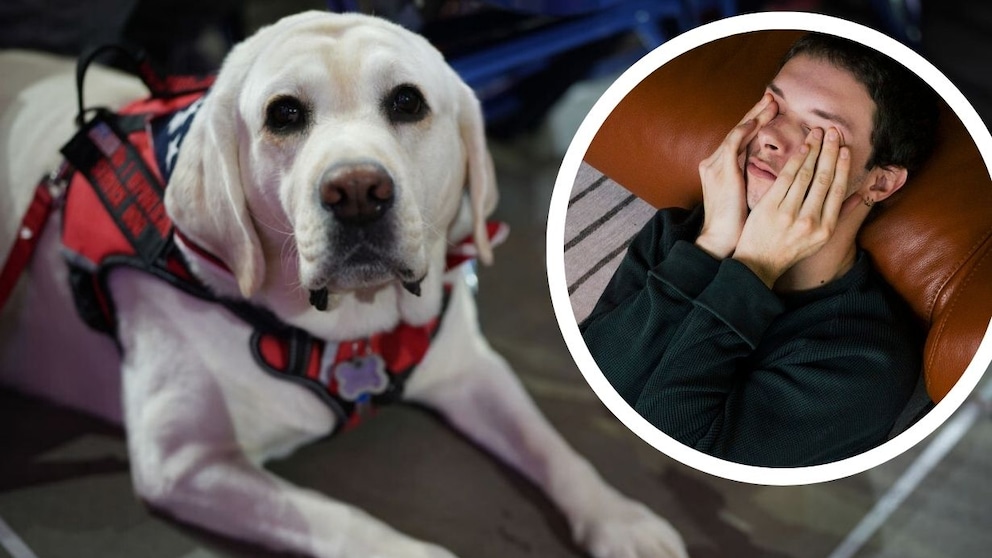
The term ‘assistance dog’ is likely familiar to many. These dogs are specially trained to accompany and support individuals with physical or mental disabilities and illnesses throughout their daily lives. There are many different types of assistance dogs. The most well-known types include guide dogs, diabetes alert dogs, asthma alert dogs, and epilepsy alert dogs. However, there are also migraine warning dogs that have the special ability to warn of seizures, usually before the first symptoms appear.
Since I unfortunately suffer from migraine attacks myself, as a health and nutrition consultant for dogs, I was interested to find out what prerequisites such a dog must have, how a migraine warning dog is trained in the first place, and how it then works for its human.
How Can the Migraine Warning Dog Recognize Attacks?
Migraine warning dogs belong to the category of “medical signal dogs”. This means that they indicate imminent attacks of an illness. These episodes or attacks occur in various disease areas. These include asthma, diabetes, epilepsy, and migraine.
If an attack of such a disease is imminent, the oxygen saturation of the blood changes. Dogs have a much more sensitive sense of smell than humans. The specially trained alert dog is therefore able to detect the slightest changes in its human’s scent. This enables them to recognize an impending seizure and alert their human before the human gets a severe headache or experiences accompanying symptoms such as nausea or sensitivity to light and sound. Changes in the person’s vital signs, breathing, pulse, heart rate, or mental state also play a role.
One study found that even untrained dogs sometimes alerted their owners as soon as something changed. In half of the people, this was the case around two hours before a seizure. A sensitive animal often senses even the smallest changes in the appearance, smell, and behavior of its human.
Also interesting: Social Pedagogue: “an Assistance Dog Can Often Achieve More Than a Person“
Training – The Dog as an “Early Warning System”
There are two ways to train an assistance dog. One option is for the dog to be trained by an assistance dog trainer from the outset. However, it is often more effective for the dog owner to train the dog in collaboration with a trainer from the very beginning, ideally starting in puppyhood. This strengthens the bond between the human-dog team right from the start and is particularly effective for living together.
During training, the dog learns to perceive and react to the smallest changes in the body, mood, or behavior of its sick caregiver. The trained warning signs can be nudging or scratching the leg, putting a paw on it, or licking the hand or arms. In this way, the dog warns you in good time before the seizure occurs, and you can react accordingly. This can occur during the day while the dog is alert, or even at night, allowing the dog to awaken and alert the person.

Why You Should Let Your Dog Sniff During Walks

Asthma in Dogs: When Your Pet Struggles to Breathe
Migraine Alert Dogs Can Also React in Emergencies
For migraine patients in particular, it is often crucial to counteract an attack with medication in good time. Not only can the course and severity of a migraine attack be alleviated, but headaches and side effects can also be reduced or even prevented altogether.
It is also part of the training that the dog knows where the medication is in an acute case and retrieves it when the human is perhaps no longer able to do so themselves. In an absolute emergency, the dog is even trained to press an emergency button to send an emergency call and summon outside help.
Even if these emergencies rarely or never occur in migraine patients, the feeling of knowing that the dog will react correctly in any situation gives the sick person a sense of security and takes away the fear of attacks.
Training to become a migraine alert dog takes between six and twelve months, depending on the type of illness. The costs for training an alert dog are typically the responsibility of the patient, with the exception of guide dogs.
Is Every Dog Suitable as a Migraine Warning Dog?
So far, there is no evidence that specific breeds are particularly suitable for training as migraine warning dogs. The dogs in the study were mostly mixed breeds, hunting dogs, particularly small dogs and terriers. First and foremost, the animal should be willing to learn and be mentally and physically resilient. A good protective instinct can also be an advantage.
In addition, a close bond between dog and human is a prerequisite for a successful human-assistance dog team. A deep mutual understanding, the ability to assess one another, and a constant presence for each other are essential for the dog’s responsible performance in acute or emergency situations.