

September 2, 2025, 3:57 am | Read time: 5 minutes
If you’re looking for a dog that combines charm, energy, and reliability, the Welsh Springer Spaniel offers more than just companionship. The red-and-white spaniel from Wales impresses not only with its striking appearance but also with its lively nature and a great deal of intelligence—a true character dog with hunting roots.
Origin
The Welsh Springer Spaniel is one of the oldest members of the spaniel group, with a history spanning about 400 years. As early as the 16th century, there are references to red-and-white spaniels on the British Isles, particularly in Wales. At that time, the dogs were kept as “gundogs”—flushing and retrieving dogs that drove game from the thicket and then retrieved it. The close bond with the family was a central breeding goal from the start, as the dogs were meant to work and live within the family unit.
For a long time, all spaniel types in Great Britain were classified under the term “Field Spaniels.” It wasn’t until 1803 that a more differentiated classification based on hunting use occurred—into “Springing Spaniels” and “Cocking Spaniels.” The term “Springer” refers to the task of “springing” game, or flushing it out. In 1902, the Welsh Springer Spaniel was finally recognized as a distinct breed by the British Kennel Club. While it remains appreciated and regularly bred in Wales, the breed is rare outside its homeland, such as in Germany or the United States.
Appearance & Coat
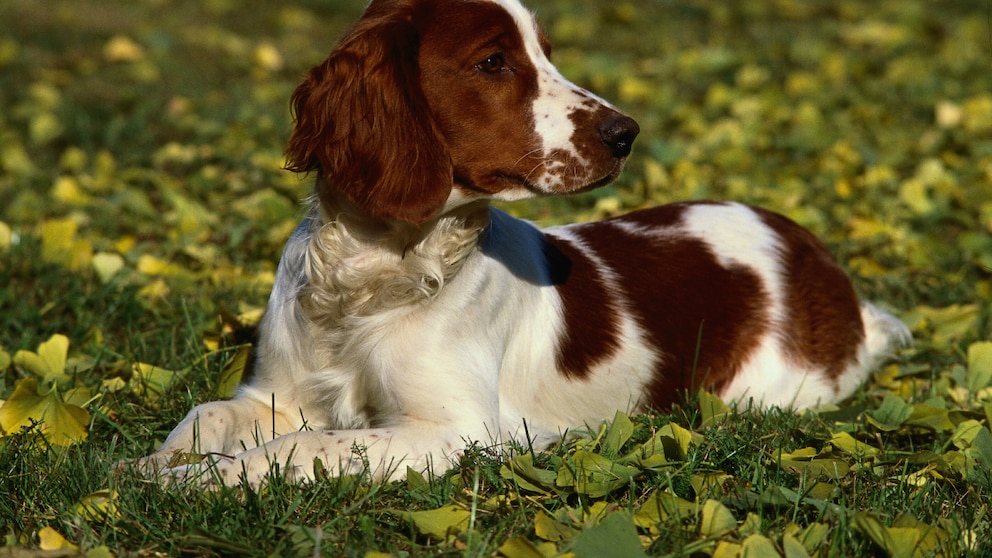
The Welsh Springer Spaniel is a compact, symmetrical dog with well-developed muscles. Its height at the withers is a maximum of 48 cm, and its weight ranges between 16 and 20 kg. Despite its sturdy build, the dog never appears cumbersome. Typical of the breed is the slightly domed skull with a clear stop and almond-shaped, hazel to dark brown eyes.
Notable are the vine-leaf-shaped ears, which are set at eye level and fall close to the head. The tail is moved energetically and should be carried no higher than the backline. Particularly striking is the coat: medium-length, dense, and silky, it repels dirt well. The red-and-white coloring is characteristic—unique among spaniel breeds. Longer hair on the chest, belly, legs, and tail adds extra elegance to the appearance.
Character & Temperament
Cheerfulness, openness, and temperament characterize the Welsh Springer Spaniel’s nature. It is considered exceptionally friendly and people-oriented without being intrusive. By nature, it is playful, curious, and very affectionate—a true family dog with social sensitivity.
At the same time, it has a strong hunting drive, making it an energetic whirlwind outdoors. It loves to use its nose, retrieve, or explore through woods and water. Despite occasional stubbornness, it shows a willingness to learn and cooperate in everyday life. Its “will to please” contributes to good trainability, but experience or willingness to learn is needed to foster these traits.
Training
Training the Welsh Springer Spaniel is generally straightforward if clear rules and loving consistency are provided. Due to its high intelligence and close bond with its people, it learns quickly and reliably. Early socialization, including with other animals, is important, as is training in impulse control and frustration tolerance.
A solid basic obedience helps channel its hunting instincts into orderly paths. Puppy groups and dog schools, where foundational skills are taught playfully, are particularly beneficial. Harshness or inconsistency have negative effects—the Welsh then responds with stubbornness or avoidance behavior.
Proper Care & Maintenance
The Welsh Springer Spaniel is not a dog for the idle. It requires plenty of exercise, mental stimulation, and close family ties. A home with a garden is ideal, but it also feels comfortable in a larger apartment if sufficiently occupied. Daily activities of at least two hours are recommended.
Suitable activities include dummy work, mantrailing, tracking, or dog sports like agility. A balanced approach should be taken to avoid overexertion. Coat care requires regular brushing, especially in the more heavily haired areas. After walks, foreign objects should be removed. Ears, paws, and nails also need regular checks.
Nutrition
The Welsh Springer Spaniel does not have special dietary requirements but should receive high-quality, balanced food. Proteins, vitamins, and minerals must be provided as needed to maintain muscle and activity.
Since some spaniels tend to gain weight, the daily food amount should be adjusted and treats accounted for. Fresh water must always be available. Regular weighing and monitoring of body shape and activity level are recommended for proper weight control.

Why the Boykin Spaniel Excels as an Eager-to-Learn Family Dog

Why the Clumber Spaniel Is Among Endangered Dog Breeds
Susceptibility to Certain Diseases
The Welsh Springer Spaniel is generally considered a robust breed, but certain hereditary diseases can occur. These include hip dysplasia (HD), hereditary eye diseases like glaucoma or progressive retinal atrophy, and breed-specific metabolic disorders such as canine fucosidosis or familial nephropathy (FN).
Responsible breeding excludes affected parent animals through genetic testing. Regular veterinary check-ups, especially in the areas of eyes and joints, support early detection of potential problems. With good care, appropriate living conditions, and healthy nutrition, Welsh Springer Spaniels can live up to 15 years.
The Welsh Springer Spaniel at a Glance
- Temperament: Cheerful, friendly, intelligent, and playful
- Size: Males up to 48 cm, females slightly smaller
- Weight: 16–20 kg
- Coat: Medium-length, silky, red-and-white with longer areas on tail and legs
- Care Level: Medium to high—regular brushing and trimming necessary
- Special Features: Hunting drive, high need for activity, close family bond
- Suitable for: Active families, sporty dog owners, also suitable for beginners