

May 6, 2026, 12:35 pm | Read time: 5 minutes
What happens when you need real pros for your first big dog show but end up with quirky advice? PETBOOK author Manuela Lieflaender dared to take Elvis to the dog groomer for the first time and encountered a bizarre mix of passion and pop psychology. A report on misunderstandings, expertise, and the ‘head held high’ at the end of a long appointment.
Anyone Can Call Themselves a Dog Groomer
Hand on heart: Do you sleep well before your first appointment at the dog groomer? I couldn’t. And it wasn’t just because I don’t like going to the hairdresser’s myself. It was a mix of a bad gut feeling and the worry that the dog groomer simply couldn’t do it.
You can already tell, my opinion of dog groomers is—well, let’s say I’m skeptical. In my mind, they fall into the same category as nutritionists, animal healers, and canine physiotherapists. Not because I inherently suspect them of bad intentions. The problem with dog professions is that there are no binding standards and no quality assurance worthy of the name.
Anyone can call themselves a dog groomer without having any training in the field. This naturally increases the risk that I, as a customer, will end up dissatisfied with the result. Yes, there are good people. But you have to find them first.
Dog Groomers Are Sometimes Booked for Years (!)
Now you’re probably asking: If she thinks so little of dog groomers, why does she go at all? Counter-question: Have you seen my hairstyle? Styling isn’t my thing. Precision isn’t my thing. I brush and comb Elvis daily, but for our “dog show” adventure, I need someone who knows their craft.
So, how do you find a good dog groomer? Check Google reviews, make an appointment. That’s how I imagined it. In reality, I was met with refusals. This profession is sometimes booked for years (!). That surprised me; I thought, of course, they were just waiting for someone to call. Eventually, I got lucky.
The Appointment: A Rocky Start
Even the phone call was an experience.
- Dog Groomer: “What needs to be done?”
- Me: “Everything except washing and blow-drying.”
- Dog Groomer: “What do you mean by that?”
- Me: “I need a get-to-know-you appointment. Just for brushing. There are a few spots where he doesn’t comb well. For example, in front of the chest.”
- Dog Groomer: “Why? What does he do then?”
- Me: “Nothing. He lowers his head.”
“You canceled,” I’m greeted upon entering. “Australian Shepherd, 1:30 p.m.?” Yes, that’s my appointment, I reply. “You canceled,” the dog groomer repeats. What? “Yes. Australian Shepherd, 1:30 p.m.” I’m completely perplexed. Should I leave? Is that what she’s trying to say? In the end, we proceed with the task.
“This Will Be Difficult”
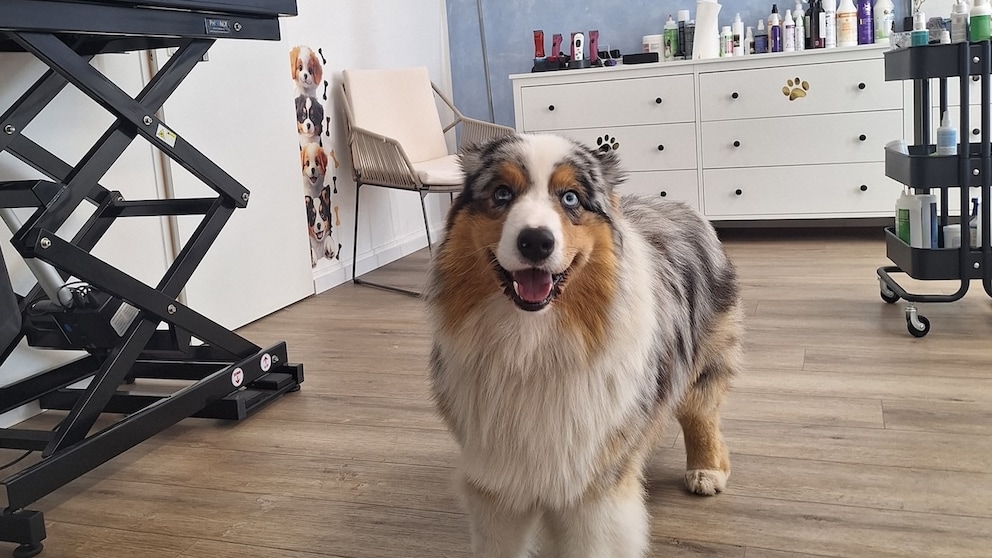
We start by letting Elvis roam freely in the salon. After this misunderstanding, I’m even more tense inside. This, of course, transfers to Elvis. He’s not comfortable with any of this. Yet the salon is actually nice: flooded with light, white furniture, sky-blue walls. And ribbons from dog shows hang everywhere.
“Yes, hello. Yes, who are you? You’re a fine one!” the groomer calls out loudly and in a shrill voice. Accompanied by thigh-slapping as an invitation to come closer. She means well and is obviously trying. But how do I explain that she’s making everything worse in Elvis’ eyes? “He’s scared,” she concludes. “This will be difficult.” She tries with a treat. No chance.
Loud, Overbearing Behavior Isn’t His Thing
What the groomer calls “scared” is seen differently in the professional world. In modern behavioral research, caution is not considered fear per se. Many dogs exhibit so-called avoidance or appeasement behavior to assess situations first. Studies from ethology and applied behavioral biology show that loud voices, quick movements, and direct commands tend to increase stress levels rather than reduce them.
Therefore, I’m not at all surprised by Elvis’ reaction. Loud, overbearing behavior isn’t his thing. Plus, he’s not dumb: He senses that something is happening here that doesn’t look like fun. We’re similar in character. I also need time to warm up to the dog groomer and the situation itself. But I’m optimistic: I know that after this phase, Elvis is stable enough to engage in what’s coming next.

How E-Bikes Turn Dog Walking Into a Test of Nerves

Elvis Goes Wild on the Leash! How TV Dog Trainer André Vogt Helped Us
The Result Is Impressive
I bring out my best treats, and step by step, we approach the grooming table and then the brushing. I’m positively surprised by how much time the groomer takes for Elvis and how lovingly she does her work. We chat on the side. I mention that Elvis is preparing for a dog show, and I learn that the groomer was once an enthusiastic exhibitor herself.
The result is impressive: The coat is brushed and combed, slightly trimmed in some areas, rounded at the paws, and trimmed under the pads.
Suddenly, the Dog Groomer Just Grabs Elvis
I’ve already put on my coat and leashed Elvis again when the groomer grabs the Australian Shepherd and starts the show training. “Come on, Elvis!” She enthusiastically trots through the shop with him. And Elvis? After initial skepticism, he listens to her and eagerly participates in the little training.
I’m happy to see someone rediscovering their passion. Although I find it somewhat overbearing that she grabs my dog without asking. Well, it is what it is. She’s a very different person from me.
She apparently sees it the same way: “You need to come out of your shell more.” Curious, I think. You go to the dog groomer and get free advice like that. “Just walk through the pedestrian zone with Elvis with your head held high. Then he’ll lift his head more, too.”
Yes, I will do that. Without looking back.
Can’t get enough of Elvis and his owner? Visit dog journalist Manuela Lieflaender on Instagram.

About the Author
Manuela Lieflaender is a certified dog psychologist and horsewoman. Her portfolio includes guide texts as well as reports on pet-friendly travel destinations and in-depth experience reports.