

March 26, 2026, 7:00 am | Read time: 7 minutes
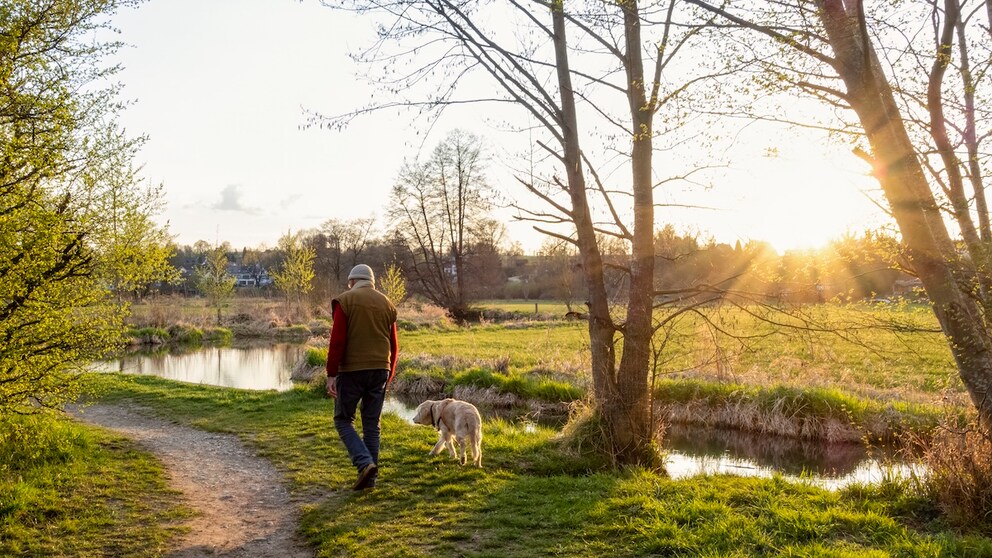
Whether in the city park, the forest, or on the country path, anyone walking their dog in Saarland must adhere to specific leash laws. However, there is no uniform law. Instead, cities and municipalities decide for themselves where and when dogs must be leashed. This ranges from general leash requirements in public green spaces to prohibiting dogs from defecating in vegetable-growing areas.
Anyone walking their dog in Saarland must be prepared for municipal-specific leash regulations. Saarbrücken, Neunkirchen, and Völklingen each have their own rules—mostly for public facilities, streets, and sensitive areas such as playgrounds or cemeteries. Saarlouis is particularly strict in the Lisdorfer Aue vegetable growing area. Additionally, special regulations apply throughout Saarland for dangerous dogs and a leash requirement during the breeding and setting season. Our overview shows what specifically applies and where dogs can still run free.
Is There a General Leash Law in Saarland?
There is no general leash law in Saarland enacted by legislation or ordinance. Therefore, all municipalities can decide for themselves where and for which dogs a leash requirement should apply. The following applies in the largest cities:
Saarbrücken
In the green spaces and residential and traffic areas of the state capital Saarbrücken, a leash requirement exists, as can be seen in a brochure from the city. A leash requirement applies, for example, on public streets and in public green spaces such as:
- the Stadenanlage
- the Netzbachweiher
- the Burbacher Waldweiher
- the Echelmeyerpark
- from the end of Mettlacher Straße in Burbach to the height of the power plant
- in front of the St. Arnualer Saarwiesen “Daarler Wiesen” (nature reserve)
Furthermore, dogs must be leashed on playgrounds. They must also remain leashed at public events with crowds, in restaurants, and on public transportation.
Neunkirchen
In Neunkirchen, the leash requirement is regulated by a police ordinance. Paragraph 14 states: “Animals must be kept in such a way that third parties are not endangered. In particular, animal owners and those responsible for their care must prevent neighbors from being disturbed in their sleep by prolonged barking, howling, or similarly loud noises.”
Paragraph 14 also regulates the keeping and handling of dogs. They may not roam freely without supervision. On public streets and in public facilities, dogs must be kept on a leash no longer than two meters. Anyone walking one or more dogs must be physically capable of safely holding the animals on a leash, and “the leash must be suitable for this task.”
Bringing dogs onto lawns, playgrounds, publicly accessible sports facilities outside designated usage times, as well as onto municipal schoolyards, municipal facilities of preschool institutions, and daycare centers, is prohibited. Exceptions exist for service, assistance, and hunting dogs on duty.
Völklingen
Here, dogs are also not allowed to roam freely without supervision, according to the police ordinance. On public streets and in public facilities, dogs must be leashed unless signage allows exceptions specific to streets, facilities, or neighborhoods. Entry bans apply to:
- playgrounds,
- lawns,
- swimming pools,
- bathing areas,
- sports facilities,
- schoolyards and other facilities of preschool institutions
- as well as cemeteries and burial sites.
Saarlouis
The city of Saarlouis informs in a Facebook post about a leash requirement in public facilities. This affects green spaces such as
- the Stadtgarten,
- the Ludwigspark,
- the circular path around the Saaraltarm,
- the Mittelweg, and
- the Zirkuswiese on the Steinrausch,
- playgrounds,
- soccer fields,
- municipal schoolyards,
- parking lots not dedicated to public traffic in front of municipal cultural and sports halls,
- public restrooms,
- and bodies of water with their banks.
According to a separate police ordinance, special rules also apply in the Lisdorfer Aue vegetable growing area. This concerns the agricultural areas between Ensdorfer Straße, Fort Rauch Street, Von-Lettow-Vorbeck-Straße, and Saar, where letting dogs roam freely and walking them off-leash is prohibited. Leashed dogs may only be walked on the field paths.
Furthermore, dog handlers are prohibited from allowing dogs to defecate in the Lisdorfer Aue vegetable growing area. If defecation occurs, the handler must immediately remove the feces.
Are There Special Regulations for Listed Dogs?
The police ordinance on the protection of the population from dangerous dogs in Saarland (HuV SL) mandates a leash requirement for certain dogs. Paragraph 5 states: “Dangerous dogs must be kept in such a way that people, animals, or property are not endangered.”
They must also be kept within the secured property of the owner so that they cannot leave it. “A warning sign with the clearly legible inscription ‘Caution—dangerous dog’ in a minimum size of 15 by 21 cm must be placed at every entrance to the property or apartment.”
Dangerous dogs must be leashed outside the secured property and in multi-family houses (access paths, stairwells)
- and must wear a muzzle (or an equivalent device),
- The leash must be short and firm, and
- no more than one dangerous dog may be walked at the same time.
This applies to all dogs that have proven to be dangerous. It also applies to dogs of certain breeds according to Paragraph 6:
- American Staffordshire terrier
- Staffordshire bull terrier
- American pit bull terrier
If a dog of these breeds proves through a behavioral test that there is no increased aggressiveness and danger to people or animals, it is not considered dangerous under the ordinance. The test must be conducted by a recognized, knowledgeable veterinarian. The certificate must be renewed every three years.

Leash Requirement for Dogs in Rhineland-Palatinate–Rules for 2026
Leash Requirement for Dogs in Bremen: Rules for 2026
Is There a Breeding and Setting Season in Saarland?
Unlike many other federal states, the forest law of Saarland does not contain a special regulation on a leash requirement. However, this is regulated in the hunting law of the federal state (SJG).
Paragraph 33 mandates compliance with the breeding, setting, and rearing season from March 1 to June 30. Accordingly, during this time, it is prohibited to let dogs run off-leash in a hunting district outside fenced areas that they cannot leave. An exception exists if they reliably do not leave the path area.
The prohibition does not apply to shepherd, hunting, guide, rescue, search dogs, and service dogs of dog-holding authorities that are on duty or in training and are appropriately marked.
Further Regulations on the Leash Requirement in Saarland 2026
The Saarland Nature Conservation Act (SNG) provides an empowering provision for municipalities. Accordingly, municipalities and individual nature reserves can establish regulations on the leash requirement for dogs by statute. Some areas, such as the Holzhauser Wald near Türkismühle, allow dogs to run free if they are on existing paths or within sight and in the actual area of influence of the owner or supervisor.
The ordinance on the Jägersburger Wald/Königsbruch also includes a prohibition on use that leads to disturbance or impairment of the area, particularly disturbing or removing wild animals.
This implicitly means that uncontrolled free running can be considered a disturbance, which in practice amounts to a de facto leash requirement—at least outside of paths and in sensitive areas. It is best to keep your dog on a leash in Saarland nature reserves.
Currently, there is no need to prepare for a separate leash requirement regulation for African swine fever in Saarland. However, the risk of spread is constantly reassessed due to cases in Rhineland-Palatinate and Hesse.
Do you live in Saarland and/or miss a municipal or current regulation on the leash requirement 2026 in this article? Write to us at redaktion@petbook.de.