

November 23, 2025, 2:58 pm | Read time: 5 minutes
The Lagotto Romagnolo is considered a true insider tip among dog enthusiasts: an intelligent curly-haired dog with charm, energy—and an astonishing talent for sniffing out underground delicacies. As a globally recognized truffle-hunting dog, it impresses not only with its keen nose but also with its family-friendliness and adaptability. But what truly makes this rare Italian breed special?
Origin
The origins of the Lagotto Romagnolo lie in the wetlands of northern Italy’s Romagna, particularly around the lagoons of Comacchio and the marshlands near Ravenna. The existence of this sturdy water dog can be historically traced back to the 16th century. Its primary tasks initially included assisting in waterfowl hunting and helping fishermen lay and retrieve nets. The Lagotto was valued for its robust constitution, water-resistant coat, and endurance in water.
With the advancement of industrialization and the draining of many wetlands, the Lagotto lost its original workplace. However, it quickly found a new role: thanks to its excellent sense of smell, it was retrained specifically for truffle hunting—a task that has earned it international acclaim today. As one of the few specialized truffle dogs, it was selectively bred for this ability over decades. The breed was provisionally recognized by the FCI in 1995 and fully recognized in 2005.
Appearance & Coat
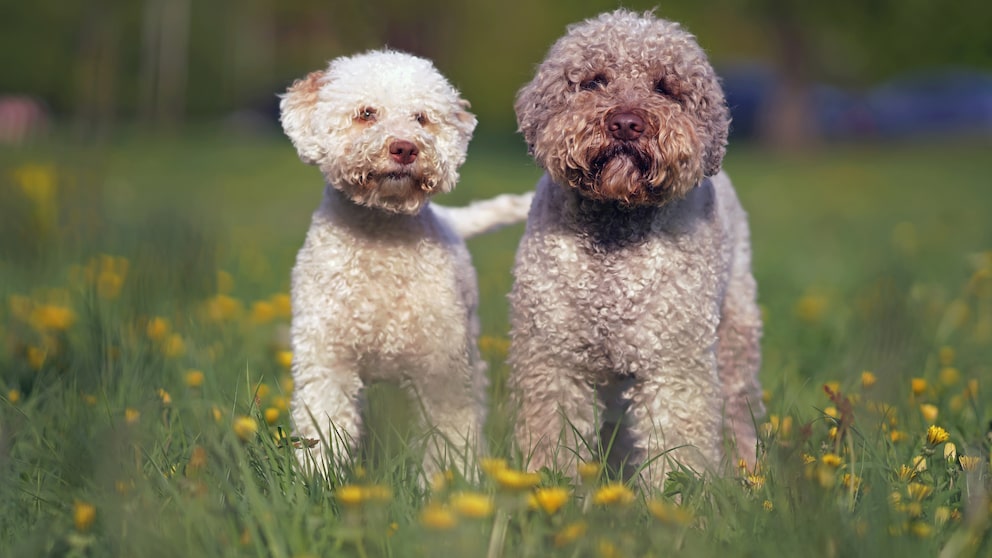
The Lagotto Romagnolo is a medium-sized, well-proportioned dog with a sturdy build and rustic appearance. Males reach a shoulder height of 17 to 19 inches and weigh 29 to 35 pounds, while females are 16 to 18 inches tall and weigh about 24 to 31 pounds. Its body shape is compact yet elegant and athletic.
Particularly striking is its dense, curly coat with a woolly texture and pronounced undercoat, which reliably protects it from water and weather. The coat is evenly distributed over the body, forming dense eyebrows, a beard, and hairy cheeks on the face. The coat color is varied: from solid off-white to orange, brown in different shades, and roan. Combinations with spots are also allowed—but black is not permitted. The striking brown eyes and bushy tail complete its distinctive appearance.
Character & Temperament
The Lagotto Romagnolo is described as a friendly, intelligent, and lively dog. Its nature is alert, eager to work, and playful. Due to its long history as a working dog, it has developed a high need for activity, which must be considered in family life. Despite its eagerness to work, it is balanced, affectionate, and adaptable.
Notably, it has a low hunting drive—a trait intentionally bred into it, making it ideal for truffle hunting. Stimuli like the scent of game hardly distract it. In everyday life, it is people-oriented, sociable with other dogs, and rarely aggressive. With sufficient activity, it is a balanced, peaceful companion that seeks a close bond with its “pack.”
Training
Thanks to its high intelligence, social competence, and willingness to cooperate, the Lagotto Romagnolo is easy to train. It learns quickly and forms a deep bond with its caregivers, which facilitates training. Beginners, in particular, benefit from its obedient and balanced nature, though they should proceed consistently and lovingly.
Early socialization is important, complemented by mental stimulation such as search games, scent work, or dog sports. It is also well-suited as a rescue or detection dog. Even if not used for truffle hunting, regular mental and physical activity should be provided.
Proper Care & Maintenance
The Lagotto Romagnolo is not a dog for kennel living—it needs close family contact and regular activity. An ideal home includes access to a garden or nature and daily exercise. Walks, agility, or tracking work are meaningful activities, as is swimming, which many Lagotti love.
Grooming is essential for the Lagotto but manageable with routine. The coat should be trimmed to about one-eighth inch twice a year. In between, spot trimming is usually sufficient—regular brushing is not recommended as it damages the curl structure. Additionally, the fine hairs in the ear canal must be removed monthly to prevent infections.
Nutrition
In terms of food, the Lagotto Romagnolo is largely uncomplicated. An important factor is a high-quality dog food with a high meat content and without artificial additives such as sugar or grains, which can harm health in the long term.
BARF is also possible, but it should be discussed with a veterinarian to ensure a balanced nutrient supply. Due to its activity, the Lagotto requires energy-rich but easily digestible food. A diet tailored to its needs supports its endurance and health.

Why the Boykin Spaniel Excels as an Eager-to-Learn Family Dog

Mountain Cur: This Hunting Dog Belongs Only in Experienced Hands
Susceptibility to Certain Diseases
Although the Lagotto Romagnolo is considered a robust and long-lived breed, certain hereditary diseases can occur. These include primarily hip dysplasia (HD) and various eye diseases. Regular veterinary check-ups and purchasing a puppy from responsible breeders with health certificates are therefore crucial.
The life expectancy is ideally around 14 years. Proper care, appropriate grooming, and a suitable diet significantly contribute to the health and quality of life of this breed.
The Lagotto Romagnolo at a Glance
- Character: intelligent, alert, friendly, people-oriented
- Size: Males 17–19 inches, Females 16–18 inches
- Weight: Males 29–35 pounds, Females 24–31 pounds
- Coat: dense curls, woolly, water-repellent, with pronounced undercoat
- Special Features: excellent sense of smell, low hunting drive, suitable for truffle hunting and family life