

August 25, 2026, 2:44 pm | Read time: 6 minutes
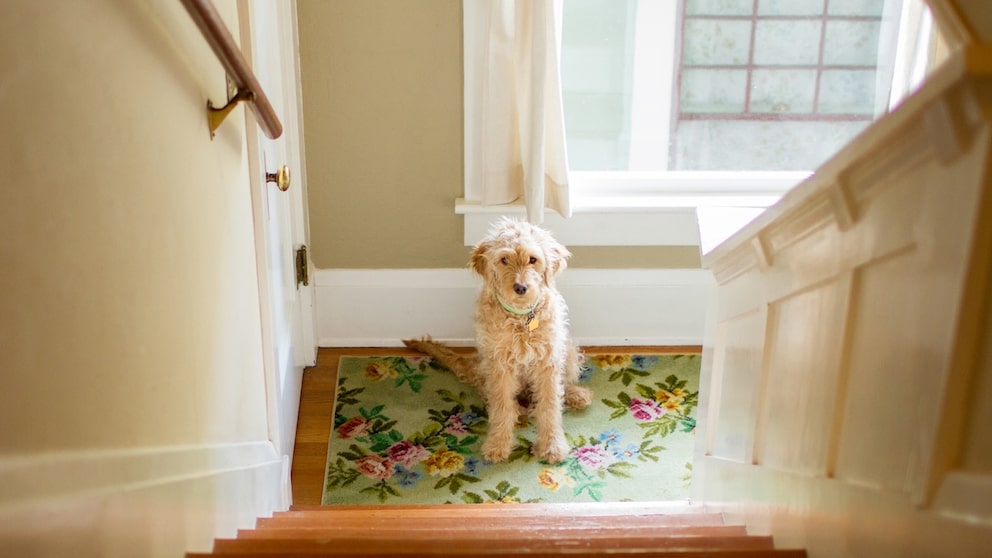
I hear this question surprisingly often in my consulting practice, and it usually sounds harmless at first. The dog, who has been going up and down the stairs to the apartment for years without any issues, suddenly stops, hesitates, presses against the wall, or refuses altogether. For many owners, this is initially puzzling, as nothing has changed about the stairs themselves. This contradiction–a familiar environment but suddenly completely new behavior–is the most important clue to investigate.
The First Step Is Always the Same: Rule Out Pain
When a dog suddenly refuses a previously routine behavior, the most obvious and common cause is physical. Climbing stairs puts stress on joints, the spine, and muscles in a way that is not required on flat terrain. Early arthritis, hip dysplasia, a torn cruciate ligament, or a disc problem in the back can make each step suddenly painful, even if the dog shows no signs of discomfort when walking on flat ground.
Even a small injury to the paw, such as a cracked pad or a splinter, can be enough for the dog to instinctively avoid the strain of climbing stairs. That’s why a visit to the vet is the first step in any assessment, no matter how clear the situation may seem. Only when organic causes are ruled out or specifically treated does a behavior-oriented approach make sense.
Reasons Why the Dog No Longer Climbs Stairs
A dog avoiding stairs doesn’t always have the same cause. In addition to obvious triggers, there are also some reasons that many owners might not initially consider:
Vision Problems Are Often Overlooked
Especially in older dogs, declining eyesight is a common but easily overlooked cause. Cataracts often develop gradually, as does a reduced ability of the eyes to adapt to changing light conditions. A staircase in dim light or with low-contrast step edges can quickly become a challenge for dogs with impaired vision. Depth perception is particularly important for accurately assessing steps. If you notice your dog seems unsure, especially in the evening or in low light, it’s time to pay attention. In such cases, a veterinary examination can be helpful.
Balance Organ as a Possible Trigger
Another cause, especially common in older dogs, is the so-called vestibular syndrome, a sudden disturbance of the balance organ. Typical accompanying symptoms include a tilted head, unsteady, staggering movements, or rapid, jerky eye movements.
Climbing stairs requires precise assessment of height, distance, and balance. That’s why balance problems often become apparent here earlier than when walking on flat ground. The good news: Many cases of idiopathic vestibular syndrome improve on their own within a few days to weeks. Nevertheless, the dog should be monitored by a vet to rule out other, more serious causes.
Bad Experiences and Sudden Fright
In addition to physical causes, there is also another explanation: The dog had a bad experience on these stairs. Perhaps it slipped, fell, or was startled there. Dogs quickly and strongly associate such experiences with the place where they occurred. Sometimes a single unpleasant incident is enough for the stairs to be considered potentially dangerous from then on, even if the owner barely noticed the incident or has long since forgotten it.
Changed Appearance and Slippery Surfaces
Even seemingly minor changes can play a role. These include a new carpet runner, changed lighting conditions, freshly painted steps, or a slippery floor where the dog cannot find secure footing. Dogs with little fur on their paws or older animals with declining muscle strength are particularly sensitive to slippery surfaces. The resulting caution often appears outwardly as sudden fear. In reality, however, it is a reasonable reaction to genuine movement stress.
Cognitive Decline in Older Dogs
A cause that is often overlooked because it is difficult to distinguish from mere anxiety is the onset of cognitive dysfunction in older dogs, sometimes colloquially referred to as dog dementia. Affected animals appear increasingly disoriented, seemingly losing routine behaviors like safely navigating their own home, and reacting to familiar situations with sudden uncertainty or fear, even when no clear external cause is apparent.
The stairs are often one of the first places where this confusion becomes apparent, as they require clear spatial orientation and accurate assessment of depth and distance. A veterinary examination, ideally with a focus on neurological and cognitive aspects, should be the first step before labeling the behavior as “fear” and addressing it solely from a behavioral perspective.

Is Your Dog’s Gait Changing? It Could Be a Warning Sign of Dementia

Can Exercise Prevent Dementia in Dogs?
What Specifically Helps Now
Once a veterinary examination confirms that there are no acute pains or serious medical issues, the actual training can begin. This also applies if treatment has already been initiated. Patience is especially important. The dog should never be pulled, pushed, or even carried up the stairs to quickly “overcome” the fear. This usually reinforces the negative association.
Instead, it has proven effective to work in very small steps. First, reward approaching the bottom step, then touching it with a paw, and only then climbing the first step. Every small progress is rewarded with food or another valuable reinforcer, while pressure and coercion are completely avoided in the exercise.
Non-slip mats or stair runners provide additional security and relieve the dog’s fear of slipping. For the transition period, a ramp or a carrying aid with a belly strap can be useful. This is especially true for larger or heavier dogs that cannot easily be carried. It is important to understand these aids as support during training and not as a permanent solution that bypasses the actual problem.
In practice, such training often looks like this: Initially, the goal is simply for the dog to relax near the stairs. He doesn’t have to touch a step or even climb it yet. Once the dog shows no more tension, the next step is to reward voluntarily touching the bottom step with a paw. If necessary, this step can be spread over several short training sessions a day.
Only when this is done confidently and without hesitation is climbing individual steps practiced. The dog should always be able to turn back without this being considered a setback. Setbacks are part of this process and do not mean that the training has failed. Often they are simply an indication to slow down the pace again.
When Professional Support Is Useful
If the uncertainty persists for several weeks or even worsens, an outside perspective from an experienced behavior consultant is worthwhile. This is especially true if the behavior extends to other stairs or similar situations. Sometimes a short exchange is enough to identify the decisive trigger. In everyday life, such details are easily overlooked because one is often too close to the problem.
And yes: This issue affects many dogs and their owners in practice. Whether you are officially asking “for a friend” or directly for your own pet, the good news is that in the vast majority of cases, stair anxiety can be effectively managed with the right combination of medical assessment, patience, and incremental training. Many dogs subsequently master their stairs just as confidently as before.