

December 17, 2023, 9:56 am | Read time: 4 minutes
For dogs that love to fetch or chase after every ball, Flyball is ideal. This team dog sport encourages the animals’ enthusiasm for movement, self-confidence, and social behavior–and it’s a lot of fun for both dog and owner. Curious? PETBOOK summarizes what you need to know about Flyball.
Walking around the block three times a day? That’s not enough for many dogs. Active four-legged friends want to be physically and mentally challenged. They need training that goes beyond leisurely walks. Dog sports are a great option for this. Some sports, such as agility, are now widespread, but Flyball is still relatively unknown. PETBOOK explains how this dog sport from the U.S. works.
What is Flyball?
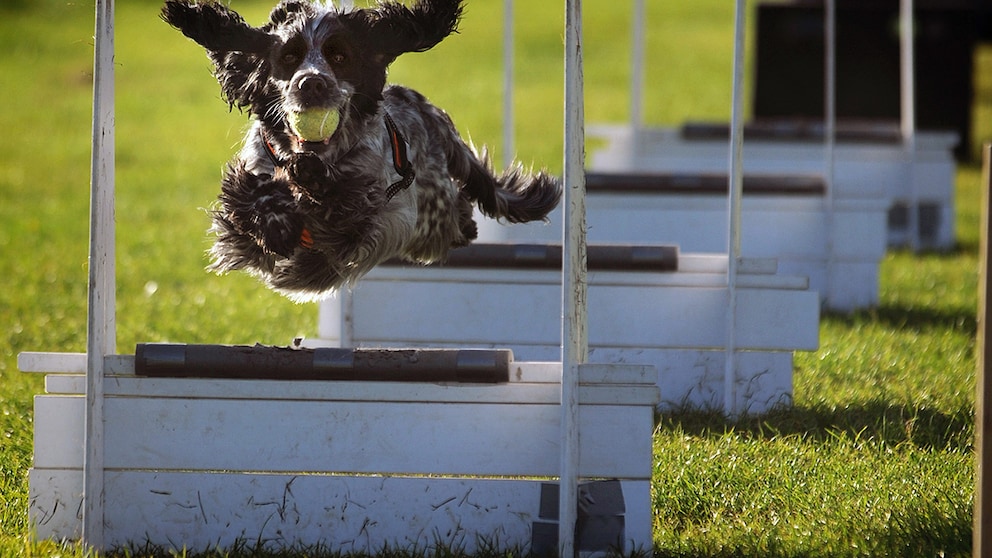
Flyball is a fast-paced dog sport where two teams compete against each other. Each team consists of four dogs with their handlers. Flyball is a relay race where the dog must first jump over four hurdles and then use its paws to activate a ball-throwing machine. The dog then performs a swimmer’s turn and runs back over the obstacles to the start-finish line with the ball in its mouth. The handler loudly cheers the dog on.
Once the first dog reaches the finish line, the next one can start the course and return with the ball in its mouth. When all four dogs on a team have successfully completed the fetching exercise, the time is stopped. If a dog makes a mistake, it must repeat its run at the end of the relay. Mistakes include not jumping all the hurdles or dropping the ball. A false start by the next dog is also considered a mistake.
Also interesting: What to consider when doing sports with older dogs
Which dogs are suited for Flyball?
In general, Flyball is suitable for all adult, healthy dogs. The size and breed of the participants do not matter, as the height of the obstacles is adjusted to the size of the smallest dog on the team. It ranges from 17.5 to 35 centimeters.
This fast-paced dog sport offers a great way to physically and mentally engage agile, willing dogs. It also strengthens the bond between dog and owner. For training, it’s beneficial if the canine athlete is enthusiastic about movement and “ball crazy.” The dog should also be sociable, as it will encounter not only dogs from its own team but also unfamiliar ones at competitions.
Flyball competitions are often loud and cheerful. In addition to the barking of the dogs, the handlers’ cheers can be heard. Winning is secondary, though. The focus is always on the play instinct and the joy of fetching. By the way, Flyball is also an exciting dog sport for spectators, as the high pace ensures there’s never a dull moment.
Germany’s Fastest Dachshund

Why Dog Dancing Is More Than Just Trick Training for Dogs
Where does Flyball come from?
Flyball is a relatively young dog sport from the U.S. It likely originated in California in the 1970s. The fetching exercise was initially used for training greyhounds that were to compete in dog races. The first Flyball event in the U.S. took place in the early 1980s.
Subsequently, the enthusiasm for Flyball spread mainly to Canada and the United Kingdom, and later to continental Europe. The first German championship was held in the fall of 2008. If you’re now interested in trying out this trendy dog sport, you should look for beginner courses. These are regularly offered by various organizations, such as the German Association of Working Dog Sports Clubs.
Sources
- German Association of Working Dog Sports Clubs, “Flyball – Just Fun Sport or the Modern Form of Fetching” (accessed on 12/15/2023)
- vdh.de, “Flyball” (accessed on 12/15/2023)
- Bavarian State Association for Dog Sports, “Flyball…” (accessed on 12/15/2023)