

May 12, 2023, 4:03 am | Read time: 8 minutes
Training a young dog should begin immediately–socialization, such as in a puppy playgroup, is crucial. Often, leash aggression and play addiction can be traced back to poor group management.
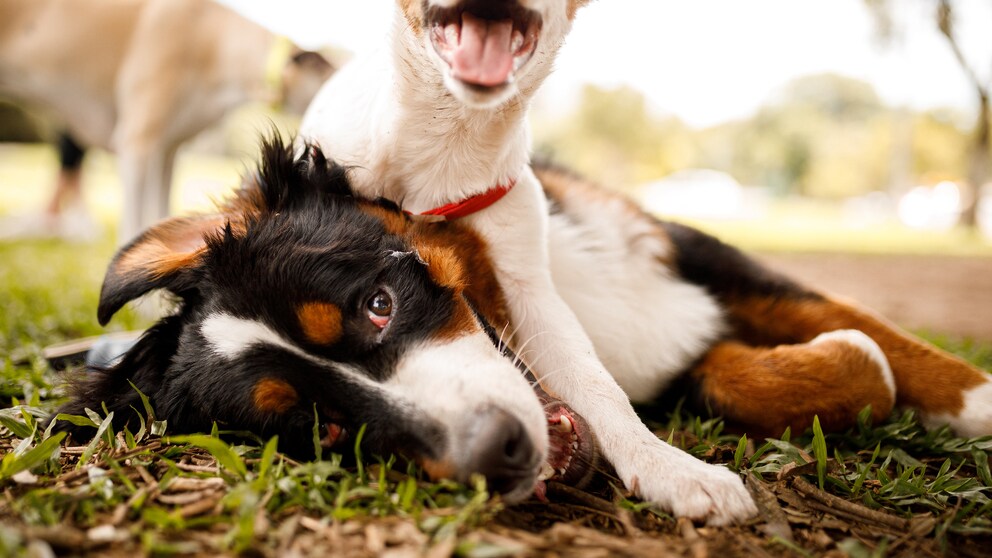
It’s Friday evening. The puppy playgroup is taking place at the dog school. Six puppies take turns playing with each other on the field. Initially, the play is harmonious. After about 15 minutes, the Cane Corso puppy Henri is on his back, with Golden Retriever puppy Milow on top. Both repeatedly pretend to bite each other’s muzzles. The trainer senses danger and asks the dog owners to form a circle around the two dogs and keep the other puppies with them. She then instructs Henri and Milow’s owners to call the two troublemakers while clapping their hands. The loud calls and claps from the owners can be heard from 30 meters away. However, the effort is unsuccessful. Finally, the trainer intervenes and separates the puppies. Was this the right approach?
“First Impressions Count and Last Impressions Last”
Leash aggression and increasingly “play-addicted” dogs. Poorly managed puppy playgroups can quickly turn a puppy into a problem dog. PETBOOK spoke with dog expert Thomas Baumann about the issues in puppy groups and what dog owners should consider when choosing one.
The author of specialized books is familiar with the situation: “When both dogs frequently pretend to bite each other’s muzzles, it’s usually no longer play but a conflict that can increase stress levels. It shouldn’t be allowed to escalate like that. If it gets out of hand like with Milow and Henri, the only option is to go in and remove both puppies from the situation.” Baumann advises giving both dogs a break and later assigning them different play partners that are a better fit. “It’s important not to leave the area when the puppies are separated. First impressions count and last impressions last.”
Also interesting: What Happens During a Puppy’s Teething
https://oembed/petbook/affiliate/8361187cea03a58cfc280b4a5bdcb587b7f634cbfaa9977592a9c595212c270c/5cfe814a-868f-47cf-a245-7ec02dfaf9cd/embed
Puppy Playgroups Must Be Well Managed
After the incident with her puppy, Milow’s owner left the field. At the next play session, the young Golden Retriever refuses to follow his owner onto the field. The interaction with Henri and his owner’s agitation have unsettled the puppy. The owner is at a loss. When should she or the trainer have intervened in the dogs’ confrontation?
“It’s a matter of intuition,” says Thomas Baumann. “If both puppies are still engaging in a social exchange of ‘give’ and ‘take’ and are responsive, everything is fine. However, if we notice things getting hectic and one of the puppies is no longer comfortable, it’s time to act. This can’t be judged solely by learning theory; you need to develop a feel for it.”

Why There Is No Such Thing as Puppy Protection

When Dogs “Play”–What Really Lies Behind Wild Running and Chasing
The “Play-Addicted” Dog
Thomas Baumann is concerned about another trend: more and more young family dogs only want to play and can no longer communicate with other dogs. They are drawn to “excessive running games” that release endorphins in the brain.
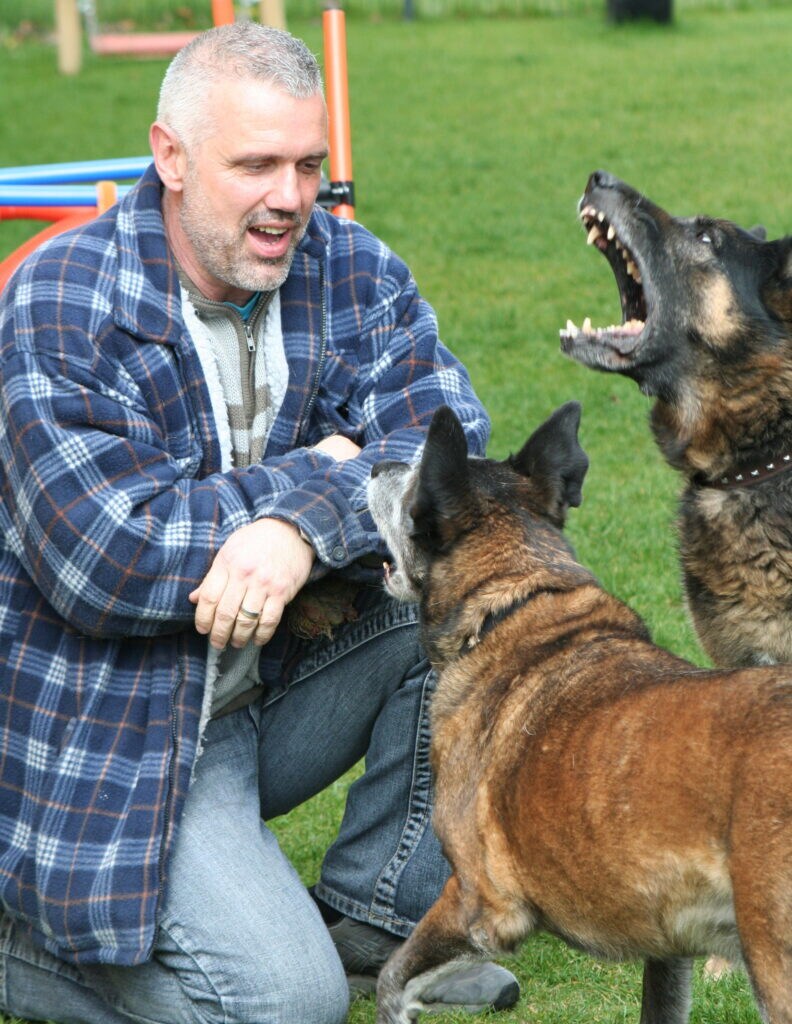
Why is this concerning? “Because there are more and more ‘play-addicted’ dogs lacking social skills. These are dogs that whine, tremble, and scream on the leash during dog encounters because they can’t get to their fellow dogs quickly enough. The problem worsens when educational control is inadequate–which is often the case. Such dogs can become increasingly aggressive or even bite on the leash, even towards their owners, because they suffer from social deprivation. They don’t reach the state of euphoria they crave, leading to frustration. This, in turn, creates a breeding ground for aggression.”
How to Recognize a Good Puppy Playgroup
To prevent anxiety, aggression, or play addiction from becoming a problem, Thomas Baumann answers the most important questions about puppy playgroups below.
PETBOOK: How large should a puppy playgroup be?
Thomas Baumann: “A puppy playgroup should have no more than 5 to 6 puppies per dog trainer. These are empirical values with a scientific background. Mammalian research has studied group mechanisms. Applied to dogs, science aligns with practice: groups with more than 10 dogs are more restless due to more social dynamic processes. For puppies just beginning to develop social skills, that’s too much. Generally, no more than 5 dogs should interact at once, and even then, individual contacts should be allowed first.
Science suggests that when we communicate in pairs, it takes about 5 minutes to receive certain information. With three partners, it takes four times as long for the same information. So, if two puppies play together for 5 minutes, each can focus on the other without additional social distractions. They can communicate and interact in a controlled manner.
Then they pause, and the next two puppies are brought together. A third puppy would constantly disrupt because it also wants to play, interrupting the communication between the other two. Communicating with multiple unfamiliar dogs simultaneously is not a problem for socially established dogs, but it is for puppies still developing socially. After about 30 to 40 minutes, 4 to 6 puppies are brought together after a preselection. By then, the mutual acquaintance has already occurred.”
Is it dangerous to let Chihuahua puppies play with Great Dane puppies?
“Not fundamentally! There are sensitive Great Dane puppies that are cautious and use their paws gently with small dogs. If such a puppy plays with a Chihuahua, I see no problem. It can also happen that a Chihuahua bullies a Great Dane puppy. Smaller breeds like the Jack Russell or West Highland White Terrier tend to exhibit such behavior. There are giants that are chased away by much smaller puppies. A bold Great Dane puppy has no place in a puppy group; it belongs in the young or adult dog group. That’s why we don’t have strictly defined age limits in our dog school, but behavioral limits.”
How large should the play area be for puppies?
“The area should be no more than about 30 square meters for initial contact to prevent excessive and thus sprawling running games. If the area is larger, the puppy play area is marked off. At 30 square meters, I can act much more consistently than if it’s 1,000 square meters. Such large areas promote prey-catching behavior. If one runs off, the other chases. Then there’s often a shift from social behavior to prey-catching behavior. This doesn’t typically happen in a small area. Instead, they communicate more, romp on the ground, etc. With fast movement stimuli from running, social partnership is often sidelined, and we don’t want that. Once puppies have learned socially competent behavior with increasing age, running games are no longer taboo. But you shouldn’t start with them!”
How does a good dog school handle a puppy’s first time in a playgroup?
“The puppy should primarily observe during the first hour rather than play immediately. This way, it can learn through imitation. It gets smaller contacts repeatedly to gradually get a sense of what it can do and where its limits are. At the same time, the trainer develops a feel for each puppy. If it’s very restless in the first hour, it is calmed by gentle and consistent holding. Once it’s a bit calmer, there’s nothing against a treat in between, so it perceives the proximity to its human as not only positive but also attractive.”
How often should one attend a puppy playgroup?
“It depends on the quality of the puppy playgroups. With 3 great playgroups in three different schools, you can go three times a week. However, I doubt all 3 groups are really good. Generally, once a week is enough. It’s still a difficult question because if a puppy only meets other dogs in a playgroup, it can be too one-sided. It may still be overwhelmed in everyday social interactions with other dogs. Therefore, it’s good to know other dog owners who, for example, have a well-socialized adult dog that can handle puppies well.”
How useful are treats in training a puppy?
“If you always give treats, that’s the first step toward alienation. You become a vending machine, and social value is pushed to the background. This means the dog’s willingness to cooperate with the human without treats decreases. The excessive use of treats is harmful, but complete abstinence is also limiting your options. Treats can be a bridge at the beginning to achieve desired behavior. However, they should be given according to the slot machine principle, meaning the treat is the cherry on top, in addition to praise and petting. There are also dogs that are so socially bonded with their humans that training without treats is conceivable. Then there are dogs that are reserved and socially distant from their humans. In that case, I use the treat as a bridge.”
Should puppies be allowed to romp at the end of the play session?
“No. A relaxation exercise at the end and a subsequent several-hour break at home are much more beneficial for the puppy to process what it has learned. Brain research shows that after learning, we need about 4 hours of rest for the learned material to be optimally consolidated in the brain. Therefore, it’s fatal to teach puppies content and then let them run again. They will primarily remember what was most fun, and a final run has a higher priority than a previously learned ‘sit,’ ‘down,’ ‘stay.'”