

September 26, 2025, 1:07 pm | Read time: 4 minutes
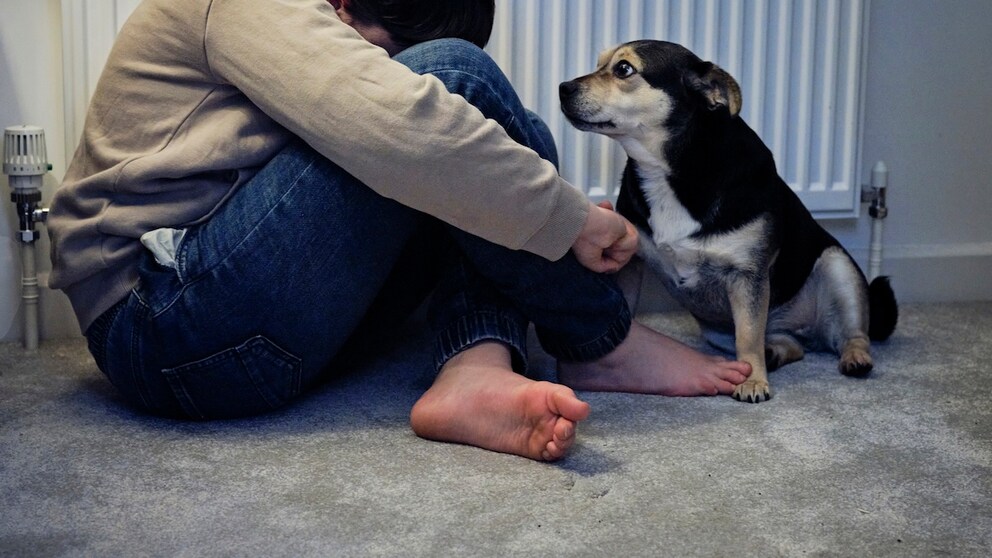
Dogs are famously known as “man’s best friend” for a reason. Dog owners often feel their pets understand them intuitively. In situations of fear, some dogs seem to pay special attention to their humans, as a study shows. They even react differently to human fear. PETBOOK reports on what’s behind this.
Dogs React Differently to the Scent of Fear
Dogs are considered sensitive companions—they sense when we’re not well. This is especially evident with fear: a feeling that can paralyze not only us but also affect dogs. But how exactly do dogs perceive human fear, and how do they react?
Previous studies have already shown that dogs react to their owners’ fear. They sought more closeness and protection from their owners. Additionally, increased heart rates were observed. However, the study has a gap: whether the dogs reacted to the scent of fear sweat or to their humans’ facial expressions and gestures was not deciphered.
This is where the study from the Institute of Ethology at the University of Veterinary Medicine Vienna comes in. Researchers Svenja Capitain, Friederike Range, and Sarah Marshall-Pescini aimed to exclude, for the first time, that dogs react to human body language or unconscious reactions, focusing solely on the scent itself. The results are astonishing and change the perspective on dogs’ emotional perception. The study was published in the journal “Frontiers.”1
61 Dogs Sniffed
The study examined how dogs react to fear chemosignals in human sweat—specific scents that humans do not consciously perceive. The research group presented 61 dogs with two different scent samples. The dogs were previously divided into a control group and an experimental group: one received two neutral samples, while the second group received a neutral and a fear scent sample.
The samples came from two unfamiliar women and were obtained under controlled conditions by wearing underarm pads during film screenings. A nature film was shown for the neutral scent samples, while horror scenes were shown for the fear samples.
The dogs were trained to approach a target object on command. The test was conducted outdoors (Clever Dog Lab, dog school, or at home) to minimize distractions.
Also interesting: Did You Know? That’s Why Dog Poop Used to Be So Often White
How Dogs React to Fear
The experimental groups of dogs showed clear behavioral differences compared to the control group. They stayed closer to the test subjects, often had a lower tail posture, and usually took longer to approach the scent target.
In the control group, the choice of scents was the same. In the experimental group, it was quite different. Some dogs approached the fear scent quickly, while others hesitated. The number of commands needed and the reaction times varied significantly among the individual dogs. Age and gender had no influence. Notably, ten dogs in the experimental group completely abandoned the test; only one did so in the control group.

“If You Blink, I’ll Blink Back!” How Dogs React to Other Dogs
Cats Use Right Nostril to Identify Humans by Sweat Scent
Are Dogs Empathetic?
The study demonstrates that dogs directly react to the human scent of fear—independent of facial expressions or body language. This finding could support the assumption that dogs recognize emotions through scents and react to them unconsciously.
From the individual differences in reactions, the researchers deduced that some dogs tend to avoid fear, while others are more drawn to it. This observation challenges the hypothesis that dogs are genetically predisposed to avoid the scent of fear. The researchers believe that life experience, upbringing, training, or breed may influence the respective reaction.
However, a limitation of the study is that the dogs’ facial expressions and gestures were not analyzed.
Conclusion
The keen sense of our four-legged friends should not be underestimated. Those who correctly interpret their reactions can respond more effectively to their behavior, such as in training, behavior therapy, or when selecting therapy and assistance dogs.