

July 17, 2026, 3:13 pm | Read time: 8 minutes
Many owners completely pause dog training in the summer. Whether this is really sensible and what alternatives exist for hot days is explained by dog trainer and PETBOOK author Katharina Marioth.
Why Dog Training Doesn’t Have to Pause in Summer
As soon as temperatures hit double digits, many dog owners face the same question every year: Does dog training need to completely pause in the summer? Does it harm the dog to continue training in the heat? And what to do with a young, eager-to-learn dog in the middle of an important training phase when it’s 86 degrees in the shade outside?
The clear answer: No, dog training doesn’t have to stop in the summer—it just needs to be smarter. Heat is no reason to put training on ice; rather, it’s a good opportunity to rethink your training approach. Learning happens in the mind, not necessarily on the training field in the blazing sun.
Why Heat Is a Bigger Problem for Dogs Than for Humans
A brief but important note upfront: Dogs are much less efficient at dissipating heat than humans. They barely sweat through their skin. Instead, they regulate their temperature mainly through panting and to a lesser extent through their paw pads. This means that physical exertion in the heat is much more taxing on a dog’s body than on a human’s.
Additionally, many dogs will continue to work out of sheer motivation and obedience even when they’re too warm. They often show exhaustion very late and very clearly, such as through heavy panting, staggering, or reluctance to get up. That’s why the responsibility to stop in time lies entirely with the owners, not the dog.
Time of Day Is the Key Factor
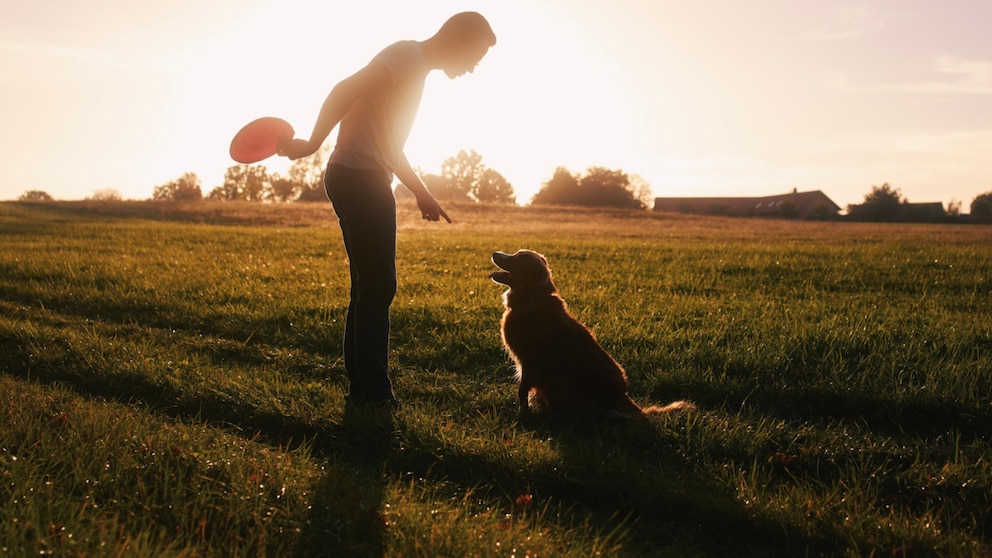
The simplest and most effective trick to continue training despite the heat is simple but often overlooked: change the time of day. Early morning or late evening hours are the windows in the summer months when both air and ground temperatures are less problematic.
The ground is often underestimated. Asphalt and paving stones heat up so much in the midday sun that they can cause burns on paw pads. A simple test helps here: Hold the back of your hand on the ground for a few seconds to quickly determine if it’s too hot. If it’s too hot for your hand, it’s definitely too hot for the dog’s paws.
Those who want to train outside—such as leash walking, recall, or basic obedience in everyday life—should consistently move these sessions to the cooler parts of the day. For everything else, move it indoors.
Training Indoors—Is That Possible?
The good news is that a surprisingly large part of what truly benefits a dog in everyday life can be done in the cool indoors. Basic commands like sit, stay, or eye contact can be reinforced excellently in the living room. They can also be expanded with increasing difficulty, such as distractions, longer wait times, or practicing in different rooms. Even recall benefits greatly from indoor training. Here, you can work specifically with distance and temporary visual blocks.
Particularly valuable for hot days is anything that engages the dog’s nose. Nose work is surprisingly taxing for the brain without heavily taxing the body. Treats can be hidden and sniffed out in the house, a sniffing mat can be used, or a small search game with several cups can be set up. Ten minutes of intense nose work can mentally tire a dog as much as a significantly longer walk.
Specific Indoor Exercises
If you’re looking for practical ideas for your own home, here is a small selection of proven exercises that can be implemented without much space or equipment:
- Stair Training for Sit and Stay: Stairs are great for working on clean positions because the steps naturally make the dog more attentive. Each step can become a short training station.
- Threshold Exercise: At the apartment or room door, impulse control can be excellently trained—the dog waits until given a signal to go through, instead of rushing out automatically. This can later be applied one-to-one to the front door.
- Room Change with Recall: When the dog is called from another room, it must follow the voice without visual contact. This strengthens recall much more effectively than a recall in an open field, where visual contact already exists.
- Distinguishing Objects: Place two or three different objects on the floor and have the dog bring the named object—an excellent precursor for later search games or rescue dog basics.
- Reinforcing the Blanket Command: Introduce a fixed blanket or mat as a “place” spot and repeatedly send the dog there throughout the day. This can later be used in a restaurant or waiting room.
- Balance and Coordination Exercises: An overturned sofa cushion or a stable pillow as a wobbly surface promotes body awareness and concentration without straining the body.
- Staying Calm Amid Distractions: While the TV is on in the background or family members walk through the room, the dog should remain on its blanket. This exercise is often more valuable in everyday life than spectacular tricks.
These exercises can be combined and spread out in short five-minute blocks throughout the day, so even on particularly hot days, there’s no boredom.
Mental Exercise Instead of Movement: Brainwork as a Heat Alternative
In addition to classic obedience exercises, hot days are perfect for incorporating cognitively demanding tasks into daily life. Intelligence toys, where the dog reaches food by pushing, turning, or pulling, train patience and problem-solving skills.
Learning new tricks—such as targeting a specific object with a paw, a clean “stay” for several minutes, or distinguishing different objects during fetch training—can be completely worked on in the cool indoors and also advances the relationship work between dog and owner, which forms the basis for any further training.
Young dogs or particularly active breeds benefit additionally when summer dog training is divided into several very short sessions. Each session can be five to ten minutes long. Short, intense sequences with clear success experiences mentally tire the dog without physically overburdening it.
Using Water as a Training Partner
If the dog likes water, cooling off can be cleverly combined with training. A shallow kiddie pool in the garden or on the balcony can become the setting for retrieval exercises, where the dog simultaneously learns to enter and exit the water on command. Also, specific signals like “water” or “drink” can be playfully incorporated here.
It’s important not to view water as the sole form of exercise—wild play in the kiddie pool can strain the body in the heat just as much as a walk in the midday sun. Short, controlled sessions with subsequent rest periods are the better choice.
Warning Signs That Should Be Taken Seriously
As sensible as creative continued training in the summer is, there are clear limits where every exercise should be immediately stopped. Heavy, labored panting with a protruding tongue, pale or bluish gums, staggering, extreme reluctance to move, or vomiting are clear signs of beginning overheating and require immediate action: stop training, move to the shade or a cool room, cool the paws and belly with lukewarm—not ice-cold—water, and seek veterinary care if symptoms persist.
These situations are rare if the mentioned rules are followed, but every experienced dog owner should know them to react correctly in an emergency.

Expert Warns Against Dog Training in Summer: “It Becomes Critical at Just 68 Degrees”

Why air conditioners and fans are dangerous for dogs and cats
Not Every Dog Is Equally Sensitive to Heat
How much training is still responsible in the heat depends greatly on the individual dog. Short-nosed breeds like pugs, French bulldogs, or boxers have a significantly reduced ability to cool down through panting due to their anatomy. Therefore, they reach their limits even with moderate exertion and relatively mild temperatures. For these breeds, even light training during midday should be completely avoided, while a well-conditioned, heat-tolerant dog might be able to handle a bit more.
Very young, very old, or overweight dogs, as well as animals with heart or respiratory conditions, require significantly larger safety margins in the heat. If unsure about what level of exertion is still acceptable in an individual case, a brief conversation with the veterinary practice is worthwhile.
Conclusion
Heat is no reason to pause dog training in the summer; rather, it’s a good opportunity to expand your training repertoire. Exercise and obedience belong in the cool morning and evening hours, while the hot daytime hours are ideal for brainwork, nose games, and short trick sessions indoors. With this division, the dog doesn’t miss any important learning phase in the summer. Many dogs develop remarkable concentration skills through more intensive brainwork on hot days, which benefits training in the fall.