

December 30, 2025, 3:07 pm | Read time: 9 minutes
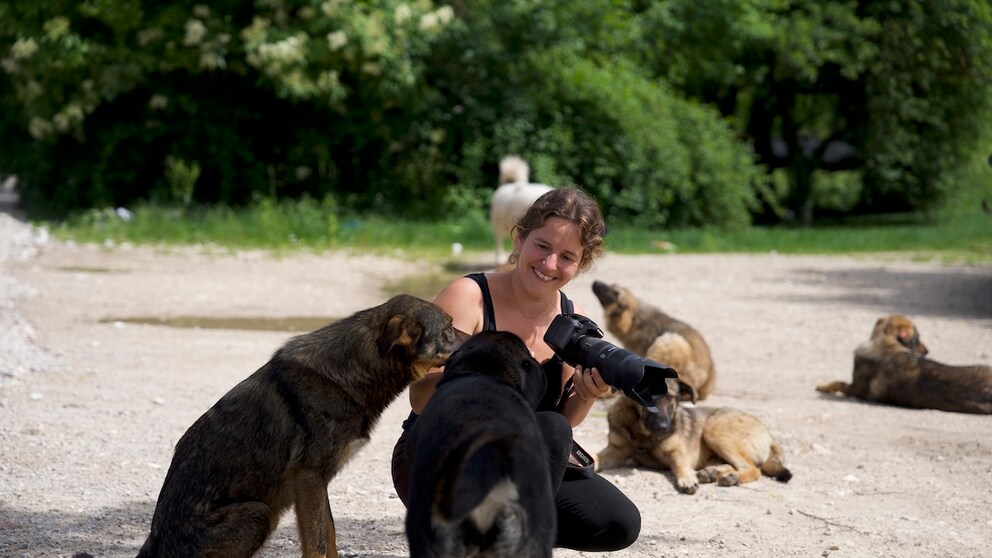
Dog trainer Sarah Fink has been observing street dogs across Europe for years. She equipped various strays with GPS activity trackers to find out what these dogs do all day. Her findings, as Fink herself says, are so surprising that several assumptions about the behavior of dogs in the wild need to be revised, and puppy books need to be rewritten.
Sarah Fink: “We Often Observed Street Dogs and Followed Them”
PETBOOK: Ms. Fink, what originally motivated you to observe street dogs over such a long period?
Sarah Fink: “I have always been very interested in the natural behavior of dogs, and even as a child, I spent a lot of time in countries with street dogs like Romania or Bulgaria. When COVID-19 hit and I couldn’t work for months—at least in Austria—many clients asked if we could film training instructions or online seminars. This led to the idea of going abroad and filming with unadoptable shelter dogs.
This benefited the shelter dogs, as they became adoptable through training, our clients could see the training with difficult cases, and the COVID restrictions were not really present in Croatia, Romania, Bulgaria, and similar countries. Naturally, there were also many street dogs in these countries.”
When did the GPS trackers come into play?
“We often observed street dogs and followed them, but it usually didn’t take long before the dog ran through private property or was simply too fast for us to keep up. And then the question always arose: Where is this dog now? What is he doing? What does he do at night? And then we said: Let’s put GPS trackers on street dogs.”
Also interesting: Dog Trainer: “Shelter Dogs Are Not a Gratitude Project!”
“The Biggest Challenge for Our Project Was the Animal Welfare Activists!”
What special challenges are there in equipping street dogs with GPS trackers, especially in different countries in Europe?
“Overall, we successfully tracked 27 free-roaming dogs. The biggest challenge for our project was the animal welfare activists! Which was actually really nice to see because every dog we tracked had people who cared for them. But for us, it wasn’t always pleasant.
In what way?
“Once, for example, an old lady in Romania yelled at me because I put a collar with a tracker on ‘her’ dog, and she thought I wanted to take the dog away. At the time I put the collar on, the dog was about four kilometers away from her house in front of a supermarket, and all the locals assured me it was a street dog that belonged to no one.
Another time, we were interrogated by state shelter employees in Greece about why we had equipped a dog with a GPS collar. We had previously been in contact with another animal welfare organization in the same city, which said we could put GPS trackers on the street dogs without any problems.”
What was the most surprising insight about the dogs’ behavior compared to the recommendations of dog schools or guides?
“The most surprising thing was how different dogs are! We tracked dogs that on some days only walked from A to B for 15 minutes. But we also tracked dogs that were out with hikers for eight hours a day! Not because they were hungry—there were feeding stations in the village that were filled around the clock.”

Sarah Fink: “In Countries Like Portugal or Spain, There Are Very Rarely Real Street Dogs”
Have you been able to identify cultural or regional differences in the behavior of street dogs—for example, between dogs in Southern Europe and Eastern Europe?
“In countries like Portugal or Spain, there are very rarely real street dogs. There are dogs that are allowed to roam freely but actually belong to someone, and there are abandoned hunting dogs. It’s quite different in Turkey, Greece, Romania, or Bulgaria. Here, there are many dogs that have lived on the streets for generations. The dogs also have people who care for them, but usually, it’s not one person who says, ‘That’s my dog!’ but many people in a place who say, ‘Yes, I often feed this dog.’
Differences between countries are mainly in the breeds. Of course, they are mostly mixed breeds, but in Romania, you see many dogs that strongly resemble the Ciobănesc Românesc de Bucovina. In Turkey, you see countless Kangal mixes.”
How do people in different countries react to street dogs—and what impact does that have on their behavior?
“In every country, there are people who love dogs and people who don’t like them. It’s always interesting to talk to different animal welfare activists on-site about the same dog. Often, one person says they want to find a home for the dog, that it should have a warm, wonderful home, and is so poor on the street! Then other locals, who also feed the same dog daily, tell us they think the dog should stay on the street—after all, it has enough food and has the freest and most beautiful life here. So, the animal lovers often don’t agree on what’s best for the dogs.”
“Already Upon Arrival, We Saw That a Dead Puppy Was Lying in the Grass”
How does the dynamic among street dogs in groups change—are there role distributions, hierarchies, or recurring behavior patterns?
“Most street dogs live with several dogs, for example, in the same village, but rarely form a group that is constantly together. Not because dogs wouldn’t do that in principle—there are indeed such groupings. However, such larger groups usually disturb the locals, and the dogs are taken to shelters.
More often, you see ‘best buddies,’ as I call them. Two street dogs that are completely inseparable and do nothing without each other. But there are also street dogs that have nothing to do with each other during the day, are in different parts of a city, but always meet up for communal car chasing.”
Was there a dog or an encounter that particularly touched or left a lasting impression on you emotionally?
“In Turkey, we tracked a mother dog—we named her Naira—and a puppy in front of our apartment. Already when we arrived at the apartment, we saw that a dead puppy was lying in the grass. In the evening, the mother dog usually slept under the porch of the neighboring house, and the puppies huddled together under the roof by the grill in front of our apartment.
“Even the Next Day, the Mother Constantly Groomed and Carried the Dead Puppy Around”
When I wanted to read the data from the activity tracker again in the evening, I saw that the mother dog had placed the dead puppy with the other puppies. Even the next day, she constantly groomed and carried the dead puppy around. It was very sad to see.”
Your findings suggest a high level of individuality among the dogs. What does this say about our previous understanding of ‘typical’ dog behavior?
“I think there is little ‘typical dog behavior’ that is the same for every dog. There are over 340 dog breeds recognized by the FCI. A reserved Galgo behaves completely differently from a Labrador that loves everything and everyone, and a Labrador behaves very differently from a Kangal, which was bred for guarding.”
Have your research findings also led to conclusions about the behavior of household dogs?
“Street dogs are, of course, not a separate species, but simply free-living household dogs—and many household dogs are imported dogs that were formerly street dogs. I think our work clearly shows once again how different dogs are and how important it is to find a dog that suits you.

Is the New “Smart GPS & Health” Tracker from Tractive Worth It for Dogs?

How Much Exercise Dogs Really Need
Sarah Fink: “Several Puppy Books Need to Be Rewritten!”
Regarding puppies, it was very eye-opening for me that several puppy books need to be rewritten. Someone once proposed the thesis that puppies sleep 20-22 hours a day. This is actually in almost every dog book, and I must admit—I used to tell my clients that too! In reality, we see the highest activity in puppies. Walking, running, and playing for six to ten hours from A to B is completely normal for puppies. And then I come to clients who, on the advice of a trainer, keep their puppy in a box in a darkened room for 21 hours a day because it is supposed to learn to rest.”
What can nervous dogs learn from street dogs?
“Many street dogs are very active, but there are rarely specific, extremely exciting situations. They simply walk around for a large part of the day. Our household dogs often lie around for hours, have hardly any stimuli, nothing to observe—and then, suddenly, we go for a walk, and the excitement is huge. I think we can learn that an hour of walking in the park is simply far too little for some breeds and characters, and on the other hand, I think we can gain a different perspective on activity and rest training from street dogs. Both are important—but it always depends on the implementation.”
“I Was Really Surprised by the High Activity of Many Dogs!”
What could you personally learn from street dogs?
“I was really surprised by the high activity of many dogs! Since we did the project, I have tried to do much more with my own dog, a Border Collie. But I don’t mean things like agility or playing ball, which push her extremely high, but essentially the same as street dogs do: long walks, sitting together somewhere, and letting her observe. Sometimes I take my laptop on a walk to answer emails and let her observe. Afterward, she’s really tired—and for me, it makes little difference where I answer my emails (laughs).”
What is your conclusion after all this: Do street dogs really want to be rescued?
“Some definitely need help, some also love having a person to bond with—but definitely not all. As with almost everything, there is no black and white, but a lot of gray in between!”