

June 17, 2026, 12:37 pm | Read time: 4 minutes
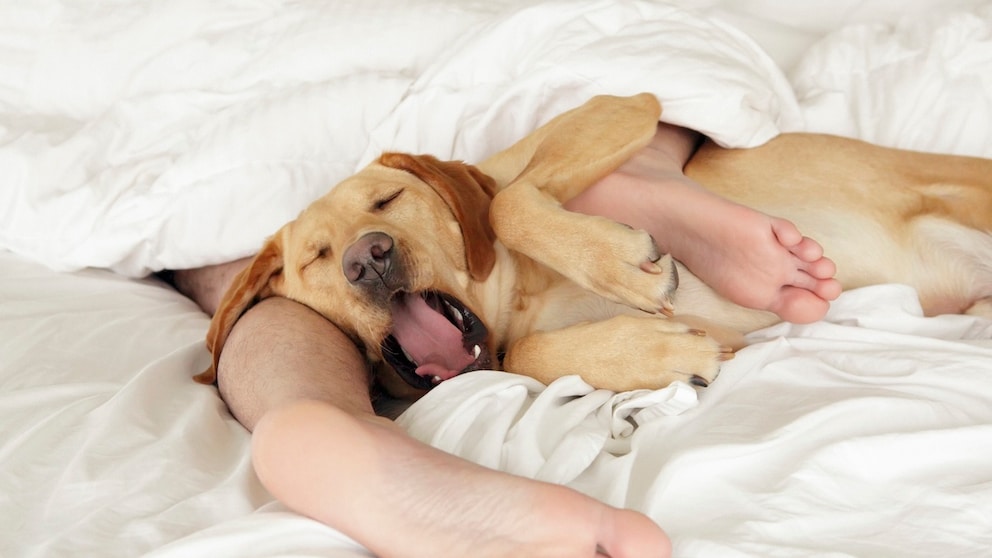
For many dog and cat owners, having their pet in bed is a given. The closeness to a dog or cat can be calming and help with falling asleep. However, a U.S. study suggests that these four-legged companions can also become a problem at night. According to the study, pet owners suffer more frequently from sleep disturbances, especially dog owners. PETBOOK examines the symptoms observed by the researchers and why the results should be viewed with caution.
How Pets Affect Their Owners’ Sleep
Sleeping with a pet in bed has many positive effects on human psychology and well-being. However, this is no longer the case when the dog snores in our ear or the cat refuses to leave the pillow. A U.S. study by authors Kayla Medlin and Lauren Wisnieski from the Richard A. Gillespie College of Veterinary Medicine in Harrogate, Tennessee, examined the connection between pets and the disruption of their owners’ sleep.1
A pet has many positive effects on human health. For instance, dog owners are generally more active than people without pets due to regular walks and fall asleep faster with the dog in bed. Pets also positively influence mental and physical well-being—with dogs and cats, people experience less stress, anxiety, or depression. The purring of a cat is even very relaxing when falling asleep. Yet, science is divided on whether we actually sleep better or worse when we sleep with animals.
Different Rhythms Can Lead to Pets Disrupting Sleep
Contrary to popular belief, cats are not nocturnal but crepuscular. This means that when we go to sleep, the animal gets a burst of energy and prefers to play rather than sleep. When we are still tired in the morning as the sun rises, our house cat feels the exact opposite: For them, it’s time to be active—and they naturally want food. However, many cats can adapt to their humans’ rhythm.
Dogs, on the other hand, do not have a clear activity pattern and orient themselves to humans. Depending on age and health, these animals can sleep up to 22 hours a day and very deeply. Therefore, it can happen that they move in their sleep, make noises when dreaming, or startle awake to check on things.

Why Dogs Dnore and What Helps Prevent It

Why Many Cats Prefer Sleeping on Their Left Side
Symptoms When Pets Disrupt Sleep
Medlin and Wisnieski examined 5,499 data sets from people aged 18 to 53. They equally evaluated data from dog and cat owners as well as from people who reported not having pets. It was found that dog owners suffered more frequently from sleep problems than people with cats or without pets. The most common symptoms among dog owners were:
- general sleep problems,
- persistent sleep disturbances,
- sleep apnea,
- feeling unrested,
- sleepiness,
- not getting enough sleep,
- needing pills to fall asleep
- and suffering from nocturnal leg jerks.
Cat owners also showed changes in sleep behavior, but these were comparatively less frequent than among dog owners and not as varied. These included symptoms such as:
- increased snoring frequency,
- problems during sleep,
- difficulty falling asleep,
- and again, nocturnal leg jerks.
Furthermore, all pet owners took on average longer than 15 minutes to fall asleep and more frequently slept less than six hours compared to participants who did not have pets.
Connection Between Sleep Disorders and Pets Unclear
However, the researchers acknowledged that the data they referenced was from 2005 and 2006, and more current data is needed for further studies. Yet, it is unlikely that the connection between pet ownership and sleep quality would change over time. The researchers also could not determine whether the animals and owners slept together, as this was not recorded in the survey at the time.
“Future studies would also benefit from measuring the human-animal bond so that we can understand how the strength of the bond affects sleep quality,” the researchers contextualize their study’s results. However, due to the pure data situation, no causal connection between pet ownership and sleep quality could be established. The study does provide additional evidence that owning pets could have negative effects on sleep quality and sleep disorders.