

August 13, 2025, 4:17 am | Read time: 10 minutes
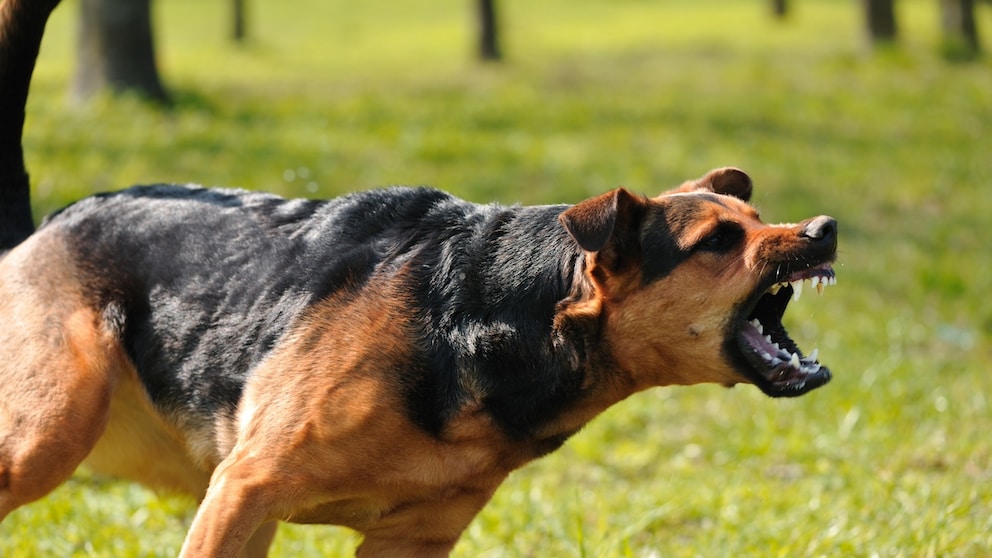
There are frequent reports of dogs being shot by police because they were allegedly aggressive. The public outcry afterward is usually significant, especially on social media, where many question whether there were other options. But when are police officers allowed to use their weapons and shoot a dog? What conditions must be met, and how is a shot at animals evaluated? PETBOOK asked trainers and the police union.
Recent Cases Show Why Police Shoot Dogs
A couple was walking their dog on the beach of the vacation island Sylt at the end of June this year. The owner and dog were playing, the play became rougher, and suddenly the dog bit off the tip of its owner’s finger. The wife called an ambulance and the police. Shortly afterward, the dog was dead, shot by the arriving officers. The animal was said to have been aggressive and ran toward the police, according to media reports. The dog’s owner, the wife of the bite victim, disputes this. She said she had moved with her dog to the side by the water so her husband could receive medical attention. Then the police called out to her to move away from the dog. Then the shot was fired. The owner now blames the police: If the officers hadn’t called the dog, it would still be alive. The dog was her “everything.” 1
A few weeks later, a Rottweiler had to lose its life at the Ratzeburg train station (Schleswig-Holstein)—also dying from police gunfire. Previously, passersby had reported an apparently intoxicated man who could hardly control his large, muzzled, and leashed dog. When the officers arrived at the station, they apparently wanted to take the animal, which the owner disagreed with. Instead, he wanted to board a train with the dog. 2 3
Dogs That Attack Are Shot
The man was “uncooperative,” and the officers had to use pepper spray, according to a press release. The “heated atmosphere” during the operation, according to police and prosecutors, eventually affected the dog, “so that it allegedly managed to free itself from its collar and muzzle.” When the animal then tried to attack an officer, the officer shot the dog.
In Salzwedel (Saxony-Anhalt), an officer fired six shots at a dog in December 2023, which had previously protected its owner’s corpse, as reported by the Mitteldeutsche Zeitung. The officers were unsure whether the woman might still be alive. However, the dog did not let them approach to check, the police explained afterward, according to media reports. The officers had previously rejected the help of animal rights activists, which later sparked sharp criticism from the public. 4
Police Shoot Dogs When They Pose an Immediate Threat to Human Life
But not only when animals are deemed aggressive can the police use their weapons. Danger from a dog can also arise in other situations. In February 2020, an operation made headlines nationwide, first resulting in a closed highway in Lower Saxony and then a shot dog.
On the A29 highway between Rastede and Jaderberg, officers had previously been alerted to a loose dog. To prevent the animal from running in front of cars and possibly causing serious accidents, officers initially tried to capture it. A section of the highway was temporarily closed because the animal was also running on the opposite lane. Up to ten officers reportedly tried to capture the animal—unsuccessfully. After a shot from a tranquilizer gun also failed, an officer finally used a submachine gun to kill the still wandering animal.
Emotions Run High When It Comes to Animals
The outrage, especially on social media, was significant in this case as well. Many asked if it was necessary. “Despite the highway closure, it could not be ruled out that the animal could have caused a serious accident. Please understand. No police officer likes to do this, and we are truly sorry for the dog,” the police wrote on Facebook in a post that was soon deleted, as reported by the ARD magazine “Brisant.”
Anyone familiar with the tone often found on social media can imagine the reasons for this. Especially when it comes to animals, emotions often run high. “The topic is very emotionally charged,” says the spokesperson for the police union GdP in conversation with PETBOOK.
Also interesting: Who Shot at Cat Nando? Police Close Investigation Despite Evidence
Shots at an Animal Only When There’s No Other Option
Whether people consider a dog dangerous often depends on personal experiences. Particularly fearful individuals hardly dare to enter a store if a dog is tied up outside. Others, however, approach the animal and pet it without asking. Neither is advisable, yet it shows: Fear of dogs is very individual.
For officers on duty, however, personal fears alone should not be the deciding factor in using a weapon. “It doesn’t matter what operation is currently underway,” says a spokesperson for the police union (GdP) in response to PETBOOK’s inquiry. “To be allowed to shoot a dog, there must be a specific threat, and the police must contain it.” Essentially, the proportionality for using a firearm must be given, because after firing a shot, the officer may have to prove “that they did everything right,” according to the GdP.
Police Dog Handlers Can Defuse Situations
Using a weapon is always the last resort. Initially, other methods must be attempted to control an animal, such as capturing it or using a tranquilizer gun. “If there is enough time, a police dog handler can also be called in,” the spokesperson further shares. Sometimes the presence of another dog and an experienced handler can help calm and capture an animal.
This apparently happened during an operation in Berlin-Marzahn. There, a Belgian Shepherd died in December 2024 after it charged at officers, prompting a policeman to use his weapon. Previously, the officers had called in a police dog handler and animal catcher for support, but they were unable to intervene. That evening, the police were initially called to Marzahn for domestic violence. During this operation, the dog that was shot had bitten a policewoman in the arm. Nevertheless, the animal initially remained with its owner, according to media reports. 5
Shortly afterward, the police had to return to the property. Neighbors had reported an aggressive dog tied up in the yard. It was the same animal, which—likely startled by distant firecracker noises—could not be calmed. Eventually, the dog broke free and ran around. Even a called-in dog handler and animal catcher could not calm the dog. After it ran toward an officer, the officer used his weapon and fatally shot the animal. 6
Serious Consequences for Officers
Apparently, the police tried everything before the fatal shots to calm and capture the dog. Ultimately, the use of a weapon could not be avoided. “Unfortunately, it can eventually come to shooting an animal,” says a spokesperson for the police union in a PETBOOK interview. “But that really only happens when there’s no other option.” Only if a threat to involved officers or other people cannot be averted can shooting be the last resort.
In 2019, this happened at a playground in Krefeld (North Rhine-Westphalia). There, a Belgian Shepherd had already attacked and bitten several children when the police were called. “When an emergency call is made, it’s often the case that the dog has already injured someone,” says the GdP spokesperson. But even then, shooting is not immediate. Depending on the situation and circumstances at the scene, a decision is made on what to do. If necessary, the dog can first be contained to prevent attacks, or a veterinarian with a tranquilizer gun can be called in.
“No Police Officer Likes to Shoot a Dog”
In Krefeld, the Belgian Shepherd could not be captured or calmed even after a long time, so an officer eventually fired two shots at the animal. A veterinarian then euthanized the injured dog. Such an operation does not leave officers unaffected, according to the GdP.
“No police officer likes to shoot a dog; many have one themselves,” says the spokesperson. Shots at animals also have “sometimes serious consequences for officers. They are heavily scrutinized and attacked, especially on social media, and sometimes even in their private lives.”
Severely Injured Animals Must Be Shot
Police shooting dogs doesn’t happen as often as media reports might suggest. However, shots at animals are not extremely rare either. In Berlin, 211 animals were shot by police officers in 2023. This was revealed in a response from the Senate and police to a Green Party inquiry. 7
Most of these were wild animals like foxes (109) and raccoons (74). But four dogs and three cats also lost their lives to police gunfire. The shot animals were “aggressive, injured, sick, or elderly,” a police spokesperson explained at the time in response to media inquiries. And only if owners or responsible authorities could not intervene in time would the officers react. As the “Institute for Civil Rights & Public Security e.V.” of the law faculty of Berlin’s Humboldt University reports on its website, police used their weapons against animals 16,778 times nationwide in 2024.
Suffering Animals Are Also Shot
In North Rhine-Westphalia, there were 1,921 shots against animals in 2022, and by September of the following year, 1,668 shots were fired at animals. However, these numbers do not provide a breakdown of which animals were affected, how many died, and why shots were fired. It’s important to know: The police must also intervene if an aggressive or injured, suffering wild animal is found and the responsible hunting authority, as it’s called in administrative language, is not promptly available.
Since a suffering animal must not be allowed to suffer longer, the police must relieve the animal in such cases. However, it depends on the individual case, as was stated after the publication of the shooting statistics for Berlin. This is confirmed by the spokesperson for the State Office for Training, Further Education, and Personnel Affairs (LAFP) North Rhine-Westphalia to PETBOOK.

Who Shot Cat Nando? Police Close Investigation Despite Evidence
Found a Lost Dog? Why You Should Call the Police
Always a Case-by-Case Decision
And this is emphasized from other sources as well: “Police officers may shoot an animal as soon as it poses a threat to the public, meaning the people in its vicinity,” Andreas Ackenheil, an animal rights lawyer, shared on the industry portal Anwaltsauskunft back in 2015. Whether a shot is ultimately the only way to avert a looming threat from an animal depends on the individual case.
The LAFP North Rhine-Westphalia also shares in writing about the conditions for using firearms against animals: “The police use of firearms is regulated in the Police Act of North Rhine-Westphalia (PolG NRW) in §§ 63 ff and the associated administrative regulations. These regulations state that the police use of firearms against animals is only permissible if they pose a threat and the threat cannot be eliminated in any other way.”
An automatic investigation of the operation does not follow in such cases. “A review of the legality of the use of firearms against animals only occurs if there are indications of illegality or if the owner of an animal has the legality reviewed in court.”
Police Often Have to Make Serious Decisions in Split Seconds
Shooting injured or sick animals is also regulated. “Injured or sick animals may only be killed if there is a fear that they would otherwise die in agony and neither the owner nor a veterinarian or hunting authority can be reached quickly,” says the LAFP. After a “mercy shot” against wild animals injured in an accident, the hunting authorities must be informed to take over the dead animal. However, it must necessarily be animals according to the federal or state hunting law of North Rhine-Westphalia.
How to use the weapon is learned by aspiring police officers during their training, where “the use of firearms against animals” is also practiced, according to the LAFP. However, the decision they must make in an emergency cannot be easily trained. “Each situation with its respective circumstances differs from one another,” the LAFP spokesperson shares. “Our police officers often have to make the serious decision of whether to use a firearm in split seconds.”