


September 17, 2026, 12:14 pm | Read time: 5 minutes
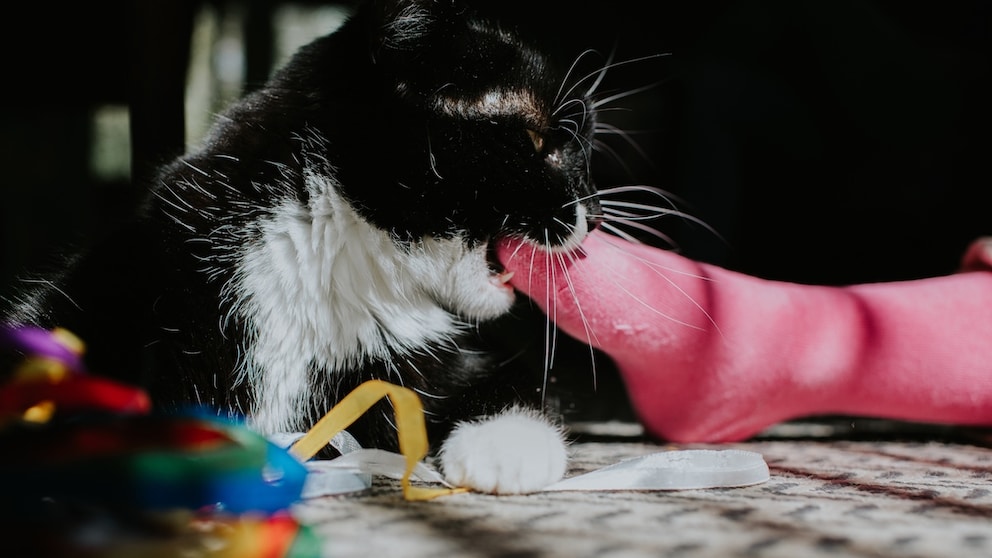
Is my cat still playing, or is it already aggressive? Many owners ask themselves this question, especially when it comes to their socks and feet. Some cats particularly like to attack these. Why there might be more behind this seemingly funny behavior and what cat owners can do about it is explained by PETBOOK author and Ph.D. biologist Dr. Saskia Schneider.
Play Behavior
Especially young cats love to attack anything that moves. Our feet are the perfect target for them. They move frequently and are at the cat’s eye level. It gets even more exciting when they move under the blanket.1
You can usually tell it’s a game because the cats make very exaggerated movements when attacking. They hop around with widely spread arms, launch mock attacks, and have wide-open eyes and a funny facial expression. Unfortunately, not all cats use their claws and teeth gently, so the attacks, even if meant playfully, can still be painful.2
Boredom
Cats that are bored like to find their own entertainment. Feet that suddenly move through the little hunter’s field of vision are just right. Some cats have also learned that if they bite their human’s toes or socks, suddenly there’s action in the room.3
So the cat attacks our feet to initiate a game. However, boredom can also lead to frustration, which brings us to the next reason.
Frustration
Similar to humans, frustration can also lead to aggressive behavior in cats. This can also be directed at their humans. For example, my neighbor’s cat bit her in the heel after her 2-year-old grandson had visited.4
For the cat, these visits meant high noise levels and little attention, regularly causing frustration that eventually erupted. A cat usually attacks feet because they are within reach.
Fear
For fearful cats, feet can seem very threatening–especially if they belong to strangers. It can happen that cats that are insecure or scared try to keep anything that comes too close at bay, not just by hissing but also by swatting with their paws.
Our cat Maja, whom my parents found on the street when she was just a few weeks old, was shy all her life and afraid of strangers. During birthdays or parties, she often sat under the sofa and attacked the guests’ feet.
Also interesting: 7 appropriate games to keep cats entertained
Overstimulation
When cats receive too many stimuli, it leads to what is known as overstimulation. Then the animals can react quite impulsively and suddenly scratch or bite. This happens, for example, when cats are petted very intensely for a long time.
But also, if the animals are exposed to one or more stimuli such as loud noises or intense smells, they can become overstimulated. It can then happen that the cat, due to overstimulation, attacks its human’s feet when they are nearby.
Hunting Instinct
Cats are born hunters. This behavior is so deeply ingrained in them that cats can get a kind of tunnel vision when they focus on a hunting object. This hunting mode is triggered by suddenly moving objects, which can include feet.
Attention
Especially indoor cats need a lot of engagement, which they often demand themselves. The animals quickly learn which behaviors get their human’s attention. It may be that the cat initially attacks its owner’s feet out of play behavior and then learns: Whenever I bite a toe, there’s action.
It doesn’t matter whether it’s positive (the human laughs and initiates a game) or negative attention (the human scolds, stands up, and chases the cat away). The main thing is that it livens up the place!

Cat Attacks Out of Nowhere? Here’s What’s Behind It

Cats Bite When Stroked for These 4 Reasons
How to Stop the Attacks
Most cats attack their human’s feet out of play or because they are bored. Rarely is aggression behind it. However, even playful attacks can be painful, and especially if the cat also attacks guests’ feet, this behavior should be stopped.
Depending on what is behind the behavior, there are various options:
- Ignore the behavior: Especially if cats want to grab attention with this behavior, it should be ignored or not reacted to, and the cat should not be given the opportunity (e.g., by sitting on your feet)
- Regular play sessions: If the cat regularly gets playtime with its humans, it doesn’t have to create its own action
- Redirect behavior: Often, it’s a play invitation when the cat attacks feet. Here, the playful hunting instinct should be redirected to more suitable objects, such as a play wand.
- Create resting places: If the cat attacks feet to keep them away, it should be provided with retreats and resting places that are elevated
- Keep the cat appropriately occupied: When cats are mentally and physically occupied, it not only boosts their confidence but also prevents frustration and boredom. In addition to regular play sessions, puzzle boards or clicker training are suitable here.
- Observe and learn to read behavior: Only those who can correctly interpret their cat and its body language can react before something happens.
What to Do if the Cat Has Bitten?
If your cat has bitten, you should clean and disinfect the wound immediately. Even if the bite looks harmless, the sharp teeth can transport bacteria deep into the tissue and cause severe infections. Therefore, a cat bite is considered a medical emergency and should be checked by a doctor the same day if possible.
Checklist after a cat bite:
- Thoroughly rinse the wound with water
- Disinfect the wound
- Check tetanus vaccination status
- Seek medical advice the same day
- Watch for swelling, redness, pain, or pus
If fever, nausea, or a general feeling of illness occurs, you should immediately visit an emergency room.