


May 20, 2026, 10:58 am | Read time: 4 minutes
Cats can purr for minutes on end, and quite loudly at that. It makes you wonder: Isn’t that exhausting? Yet the animals usually seem relaxed, which has puzzled researchers for a long time. For decades, it was believed that cats had to actively tense their laryngeal muscles to purr. However, new research paints a different picture. PETBOOK editor and cat expert Saskia Schneider explains what really happens in a cat’s body when it purrs.
As Loud as a Kettle
There’s hardly a sound cat owners love more than that deep, vibrating purr right next to their ear. Our cat Kila always purred so intensely that we had to turn up the TV. We affectionately called her “our coffee machine.” The nickname isn’t far off. After all, cats can reach purring volumes of up to 54 decibels—as loud as a kettle.
But the loud purring never bothered us. Like almost all cat owners, this sound immediately evokes a sense of coziness and contentment. Pure relaxation sets in. But what exactly happens in the animals’ bodies? And isn’t this constant purring eventually tiring for cats?
Do Cats Have to Actively Purr?
For decades, scientists believed that cats had to actively use their muscles to purr. The theory was that small muscles in the larynx contract rhythmically about 20 to 30 times per second, creating the typical sound. Essentially, like a tiny motor that is constantly turned on and off.
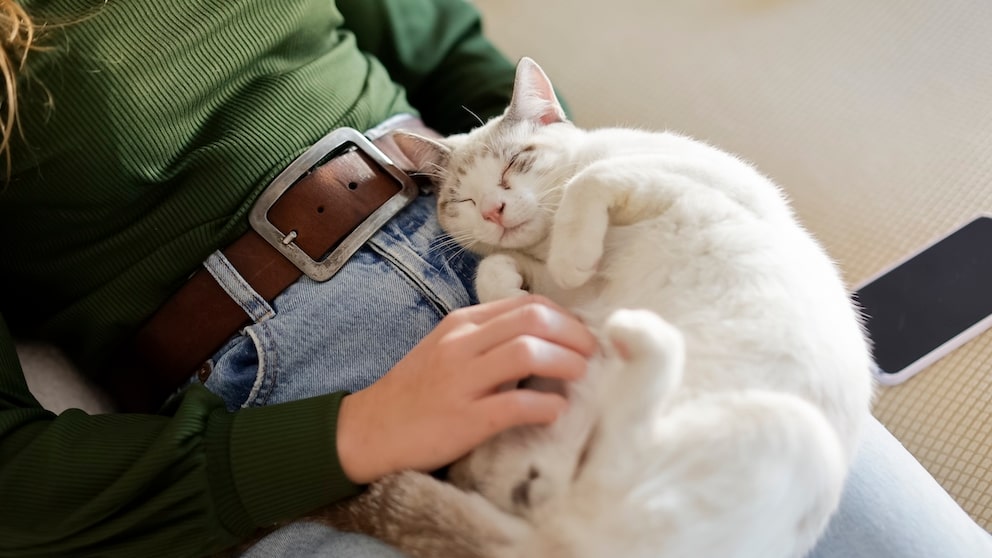
However, this would mean that purring cats have to work actively all the time. And that seemed somewhat odd. After all, cats often purr during the most relaxed moments of their lives: curled up on the sofa, half-asleep on a lap, or comfortably lying in the sun.
Purring Occurs Without Muscle Activity
In 2023, researchers at the University of Vienna re-examined this old theory with an unusual experiment. They studied the larynxes of deceased house cats. So, without brain activity, nerve impulses, or muscle movements. The results of the study were published in the journal “Current Biology.”
And yet something astonishing happened: The larynxes could still produce purr-like sounds. All without active muscle work.
The researchers discovered small soft connective tissue pads in the cats’ vocal cords. These apparently act like built-in vibration cushions. When air flows past them, the vocal cords almost move on their own—similar to a guitar string that continues to vibrate after being plucked.
This means that the cat probably doesn’t have to actively create every single purr movement. The airflow from normal breathing does most of the work.
Purring Costs Little Energy
That’s precisely why cats can often purr for minutes without appearing exhausted. Purring seems to be more of a natural resonance state than actual muscle work.
Of course, it doesn’t work entirely without energy. The cat continues to breathe, and the larynx must be finely tuned. But according to current research, purring likely requires very little additional effort.
Additionally, the involved laryngeal muscles are specifically designed for endurance. So even if they are involved in purring, they are made for such fine, consistent movements.

Can Tigers and Other Big Cats Meow?

Purring Reveals More About Cats Than Meowing
Purring Has a Calming Effect–on Cats and Humans
What’s particularly fascinating is that cats don’t just purr when they’re happy. Many owners know this from the vet or in stressful situations. Some cats even purr when in pain or after injuries. That’s why researchers today suspect that purring isn’t just a “happy sound.”
Rather, it seems to be a form of self-soothing for cats.
And perhaps that’s also why purring has such a calming effect on us humans. The deep, consistent vibrations feel calm, safe, and familiar. Many cat owners even report that they feel more relaxed or sleep better when their cat purrs.
Little Effort, Big Effect
Whether cats actually produce healing effects with their purring, as is often claimed, has not been scientifically proven. But one thing is certain: The frequency of purring is indeed in a range that is studied in medicine for regeneration and relaxation.
Perhaps that’s why purring fascinates us so much. Because it sounds like a real feat, yet also evokes pure comfort.