


December 8, 2025, 3:46 pm | Read time: 7 minutes
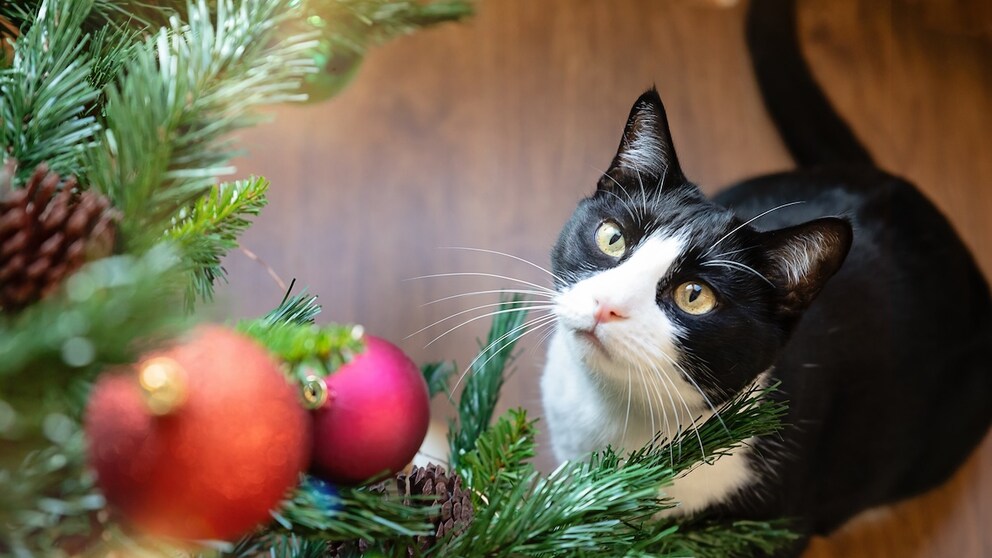
Christmas trees fascinate not only small children–they also have a magical attraction for cats. Ornaments become toys, and the tree itself becomes a climbing adventure–until everything crashes to the ground. But that’s not the only reason to keep your cat away from the Christmas tree. PETBOOK editor and cat expert Saskia Schneider shares how to do this in a pet-friendly way.
Cats Are Fascinated by Christmas Trees
Colorful, shiny ornaments that move, glittering tinsel, all on a real tree in the living room. With scents from outside and so much to sniff and discover. For cats, the Christmas tree is an adventure playground. I would even go so far as to say: You should seriously worry if the Christmas tree leaves your cat completely indifferent.
The extent to which the animals go on an exploration varies. Some are more cautious, only sniffing or perhaps initially finding the tree intimidating. Others jump right into the branches–with consequences. But even if cats initially seem unimpressed by the Christmas tree or just walk around it, rest assured: The day will come when your pet tries to climb in or up the tree, or discovers tinsel and ornaments as toys.
These Dangers Lurk in the Tree
One of the biggest dangers is that the cat might topple the tree and injure itself. For instance, other items might be pulled down with it. The animal could panic, get caught somewhere, and tear out a claw or even break a bone.
Broken glass ornaments or decorations also pose an injury risk. Tinsel is even more dangerous. While traditional metal tinsel is rarely used today, plastic tinsel strands can cause intestinal blockages and, in the worst case, lead to the cat’s death if ingested. Then there are string lights, which are often chewed on, toxic pine needles, and even the tree’s water can be highly toxic to cats if they drink it. In short: A cat has no place near a traditionally decorated, real Christmas tree.
Also of interest: What Dangers Exist for Cats During Advent
How to Keep Your Cat Away from the Christmas Tree
I know many cat owners are now hoping for simple tricks to quickly keep the cat away from the tree so everyone can enjoy a relaxed Christmas season. But I have to disappoint you: If you choose a real Christmas tree in a cat household, you must also commit to the necessary effort. There is no quick and easy solution if you want to ensure the cat’s well-being.
Observe and Intervene
Cats are naturally curious. Therefore, you should closely observe your pet–consciously. Not: Set up the Christmas tree, take out your phone, and wait for something to happen. You should not take your eyes off your pet at first–just as we would with a toddler exploring a Christmas tree for the first time. And with the cat, it also means: Intervene immediately if the animal shows signs of jumping or climbing.
On one hand, you signal: This behavior is not okay. On the other hand, you are immediately on hand and can at least prevent worse. Because sometimes cats are quicker in their exploration than we think.
Stay Consistent
So what do you do if the cat ends up in the tree and you have to pick it out? Simply put: Set it down and then stay consistent, meaning repeatedly remove it from the tree or keep it away. Please remain calm: Don’t scream or panic when the animal jumps. Act quickly and decisively, but without harshness or aggression. This impresses many cats, as it shows you are confident and that it matters to you.
However, this is no guarantee that the cat will leave the tree alone. You need patience and persistence. Some cat owners find this quickly exhausting–understandably. Therefore, I would always recommend a middle ground with the following measures:
Management
Of course, you can also make the Christmas tree more cat-proof. For example, by using only plastic ornaments at the bottom and avoiding tinsel or other dangerous decorations. To prevent cats from being tempted to chew on toxic needles or drink the water, an artificial tree might be a good idea. However, there’s still the risk of plastic parts being chewed. It always depends on the individual cat and its behavior.
Another option is to set up the tree on the balcony or in the garden–or in a place where the animals have no access. However, most people want to admire the tree indoors and place Christmas gifts underneath. So here are a few tips for trees that must be indoors.
Secure the Tree if Necessary
Especially for cat owners with kittens or young cats, it might be worthwhile to secure the tree additionally so it can’t fall over. Especially if several animals suddenly decide to jump into the branches. Securing can be done with two ropes stretched from the tree to the wall. Major downside: You usually have to install hooks and holes in the wall. Or you choose an extremely sturdy stand.
Close Doors
It sounds simple, but to really ensure the Christmas tree is still standing the next day, you should not allow cats access when they can’t be supervised. At least not if the animals are still young or new. Older cats, familiar with the concept of a Christmas tree for years and whose behavior can be predicted, don’t need to be shut out.
Create Alternatives
In cat behavior therapy, it is said: “If you say no, you must also say yes.” Meaning: If the tree is off-limits as an adventure playground, you should provide your cat with an appropriate alternative. For example, a play area with colorful plastic balls hanging from the scratching post. Or an exciting food toy made from colorful toilet paper rolls, from which the cat can fish out treats.
Some cat lovers even go so far as to set up a separate–cat-friendly–Christmas tree for their pets. There are now scratching posts decorated like Christmas trees. For cats, this is, of course, the ultimate highlight. But everyone must decide for themselves how far they are willing to go for their pet.
One thing is important: An alternative does not automatically ensure that the cat leaves the real tree alone. It remains attractive, and management and patience are still required. But it prevents frustration, as your pet can still explore and satisfy its play and hunting instincts if there are reasonable alternatives.

Tinsel Garlands Can Be Dangerous for Cats

Christmas Tree Can Cause Life-Threatening Allergic Reaction in Dogs
Avoid Repellent Scents, Water Sprays, and the Like
Advice is often found to keep cats away with a water spray or to use essential oils as repellents. The questionable social media trick of threatening the cat with the tree circulates every year. And yes: These methods can be successful, but they have a significant downside: They unsettle or frighten cats. Because suddenly this huge thing appears in their territory, and then the cat also has negative experiences: It gets wet, or it suddenly smells very strong. This can lead to insecurity and uncleanliness.
Yelling at the animal or even chasing it away when it approaches the tree is not an option, as it can permanently damage the cat’s trust and bond. You can certainly raise your voice and be more serious–but please do so at the moment the cat goes a step too far, not when the tree is already on the ground.
Conclusion: Have Patience and Create Alternatives
Almost all cats are fascinated by Christmas trees. Have understanding for this and consider it from the start–ideally before you even get the tree. Most major dangers can be prevented through simple management. But this requires considerable effort at first, as the animals should never be left unsupervised near the tree initially. However, the effort is worth it, as it can make the Christmas season something special for our cats as well.
About the Author
Dr. Saskia Schneider is a biologist with a Ph.D. During her studies at the Free University of Berlin, she focused primarily on zoology and animal behavior. In addition to training as an editor, she completed training as a behavior consultant with a focus on cats.