

September 16, 2026, 2:46 pm | Read time: 5 minutes
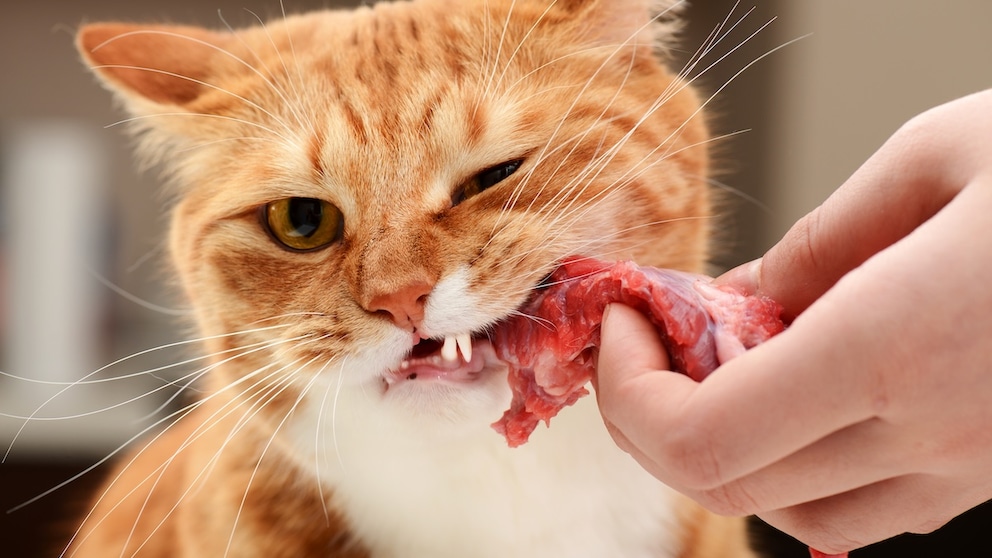
Does your cat also always sneak around you curiously and interestedly when meat is being prepared in the kitchen? You’ve probably given her some before, and she devoured it greedily! But should I feed my cat raw meat at all? What amount and which types are suitable? PETBOOK author and cat health consultant Philine Ebert explains what to consider when feeding raw meat.
Can Cats Eat Raw Meat?
Yes, cats can eat raw meat. It’s in their nature. As diligent hunters, even house cats catch additional “fresh meat” like mice or birds when they roam outside and usually eat their prey completely.
Common types of meat such as poultry (chicken, duck, goose, or turkey), beef, game, lamb, rabbit, or horse are generally suitable for cat nutrition. For those with allergies, exotic meats like kangaroo and ostrich are also recommended.
Why Should I Feed My Cat Raw Meat?
Since cats are carnivores, meaning they are pure meat eaters, they require a protein-rich diet with essential amino acids like taurine and arginine, making raw feeding (BARF) particularly natural.
In the wild, a cat catches an entire prey animal and eats it completely raw. Not only do the muscle meat and organs provide many important nutrients in their original highest concentration, but important enzymes, vitamins, and minerals also come from the intestinal contents. A prey animal consists of about 70 to 80 percent water. This is the most natural form of cat nutrition, as nutrients are unfortunately always lost once meat is processed.
How Much Raw Meat Can Cats Eat?
The recommended amount of raw meat depends on the animal’s body weight. It is recommended not to feed more than 40 grams of raw meat per kilogram of body weight. The optimal composition for a cat meal generally consists of 95 percent meat (muscle meat), organs, and blood, cartilage, and bones. Only five percent is the plant-based portion (contents from leaf stomach, green tripe, vegetables, fruits, or herbs).
What Are the Specific Characteristics of Different Types of Meat?
You can feed your cat various types of meat. However, there are special differences depending on the type that owners should be aware of:
- Beef: It has more calories than, for example, poultry, but is rich in high-quality protein, zinc, iron, and taurine, which is essential for cats.
- Poultry (chicken, turkey, duck, goose): Chicken and turkey are suitable for a low-fat and low-calorie diet, as well as for animals with sensitive digestion. Both types are well-tolerated, which is why raw chicken is often recommended as a gentle diet. Goose or duck, on the other hand, are fattier but provide a lot of protein. They are an excellent energy source for active cats. Duck, in particular, is very tasty due to its high-fat content, but should therefore be fed in moderation.
- Game (deer, stag), horse, kangaroo, ostrich: These types of meat are hypoallergenic, making them suitable for those with allergies. They are lean and protein-rich. Rabbit meat has the lowest taurine content.
- Lamb: It is rich in protein and iron, relatively high in calories, but well-tolerated and hypoallergenic.
Depending on the cat’s needs, the meat composition can be individually adjusted.
What About Raw Fish? Better Not to Feed!
Raw fish does provide valuable omega-3 and omega-6 fatty acids, but it should only be fed as a supplement (not as a main food source). It is especially important to note that certain fish species, such as herring or carp, contain an enzyme called thiaminase, which destroys the essential vitamin B1 in a cat’s body. This can lead to a deficiency, resulting in severe nerve disorders.
Additionally, raw fish can cause severe gastrointestinal diseases due to the possible transmission of worms, bacteria, salmonella, or E. coli. It should also always be considered that swallowed fish bones could cause injuries in the gastrointestinal tract.

No More Cat Food in the House? Here Is an Alternative You Could Feed Your Cat

Does Premium Dry Dog Food Measure Up? Expert Compares Nutrients
What Should Be Considered When Feeding Raw Meat?
Please do not feed raw pork! It should never be fed raw, as it can contain the Aujeszky virus, which is deadly for cats. This virus can only be killed by intense heating.
Better not to mix feed! If a cat is accustomed to a certain feeding method (BARF, home-cooked food, dry or wet food), its body and digestion have adapted to it. Switching between different feeding methods disrupts digestion. Therefore, it should either be fed entirely raw, or raw meat should only be an occasional treat or special reward.
For long-term raw feeding of a cat, a good knowledge of nutrients and the balance of ingredients is needed to ensure optimal supply and prevent deficiencies. A nutrition and BARF consultant can help with this.
Pregnant cats, young or chronically ill animals can also be fed raw meat. However, this should always be discussed individually with the veterinarian.
Especially Important–Basic Hygiene Measures in the Kitchen:
When handling raw meat, it is particularly important to pay attention to hygiene to avoid fecal-oral transmission of certain viruses, bacteria, or salmonella. Kitchen hygiene is especially important.
Especially important:
- Do not wash meat under running water, as bacteria could remain on work surfaces, in the sink, or on hands and be unknowingly spread.
- Use different tools like cutting boards, knives, or bowls for different types of meat and do not use them for other foods like salad or bread.
- Thorough cleaning after processing: Hands, work surfaces, dishes, and knives should be cleaned immediately after contact with raw meat under hot water with dish soap to kill possible bacteria or viruses.
- Observe the cold chain: Raw meat should be well-packaged and stored in the designated area of the refrigerator at below 4°C (39°F).
If you decide to feed your cat raw meat, it is advisable to approach the desired amount gradually. A radical change can cause gastrointestinal issues in the cat. Prior consultation and agreement with the veterinarian is therefore quite sensible.