


October 25, 2024, 4:09 pm | Read time: 6 minutes
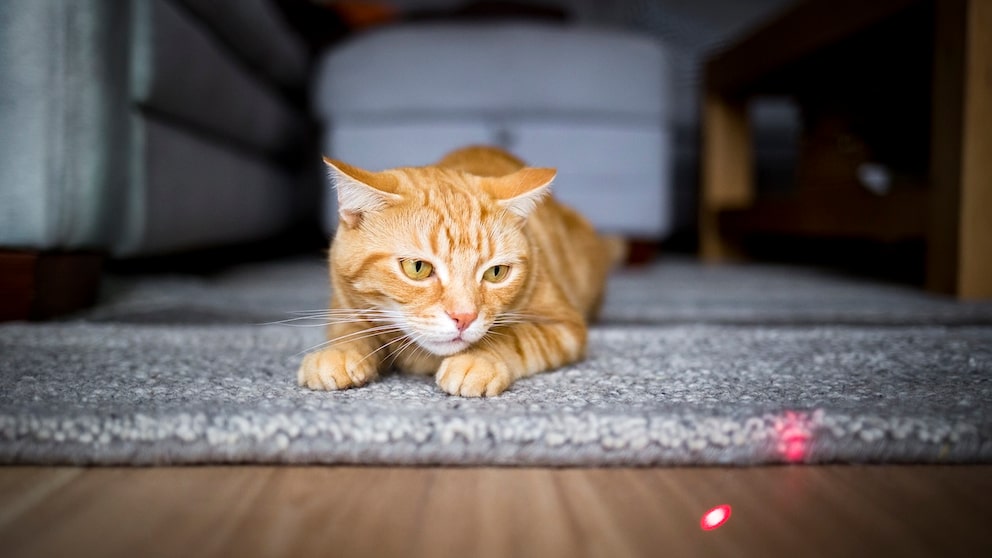
Why run around the apartment with a fishing rod toy when you can entertain the cat from the sofa with a laser pointer? But be careful! PETBOOK editor and cat behavior expert Saskia Schneider warns against such interactive games. They can be extremely frustrating for the animals and even lead to aggressive behavior.
Playing with a cat can be exhausting. How easy it is, by contrast, to grab the laser pointer and let your pet chase wildly around the apartment. Or you can set it in front of a tablet, where there are now special games for cats featuring a mouse running across the screen. Many owners believe they are doing their pet a favor. Finally, the cat gets to really let loose in its attempt to catch the small, glowing dot. But you should be cautious with such behavior. A lot of tension builds up in the cat during the wild chase, which eventually needs to be released. Normally, this happens when the prey is caught–but that never occurs in a game with the laser pointer.
Why Cats Play
In nature, cats primarily play with each other, usually with their littermates. They practice–and perfect–important movements that they will later need for hunting prey. These include things like stalking, ambushing, pouncing, chasing, grabbing, and even killing.
Many of these movements are also practiced by kittens with objects like leaves, branches, or pebbles. Additionally, their mother brings them dead and later live prey to test their hunting skills.
Our pets exhibit playful behavior well into old age. For one, because our cats generally don’t have to spend as much time hunting prey and securing their territory, leaving more capacity for social interactions like playing. Studies also suggest that cats retain much of their juvenile behavior when living with humans–including playing.
Moreover, cats have a natural hunting instinct. They must satisfy this urge–it’s practically in their blood. That’s why cats hunt mice or birds even when they’re already full. If they don’t have the opportunity, their human must provide exciting hunting games to satisfy the hunting instinct.
Hunting Is More Than Just Chasing
When observing how cats play with each other or with objects, various sequences of hunting can be seen. These include:
- Fixating on the prey
- Stalking
- Ambushing
- Pouncing
- Chasing
- Catching
- Holding
- Biting or killing
All these behaviors stem from the hunting behavior cycle and are practiced by kittens during play. Which sequences are played more or longer changes over a cat’s life. Young animals tend to chase wildly after anything that moves, while older cats often spend more time targeting and ambushing prey. The latter is often misinterpreted by humans as a lack of interest in play. You can read more about this in this PETBOOK article: These 8 Mistakes Almost Everyone Makes When Playing with Cats
Laser Pointers and Co. Cause Frustration for Many Cats
In a game with an object–ideally moved by a human–a cat can experience all elements of hunting. Games with a laser pointer are different: Here, the cat chases the glowing dot but can never catch it. The same goes for so-called “cat TV” or cat games on a tablet.
Such activities can lead to frustration in some cats over time, as they never catch the mice or birds–or the laser pointer dot. For animals, hunting games involve more than just chasing “prey.”
There is still too little research to truly explain what happens in a cat’s body during play with objects. However, observing cats’ behavior shows that catching and killing are important elements for satisfying the hunting urge in play.
Also interesting: 7 Species-Appropriate Games to Entertain Cats

Dangerous! Expert warns against new cat toy

Warning: This Game Can Lead to Compulsive Disorders in Dogs
Games with Laser Pointers Can Lead to Aggression in Cats
If a cat doesn’t calm down after playing with a laser pointer, nervously searches for the dot, or even starts growling or hissing, these are clear signs of frustration. This can turn into aggression. I know animals that were so frustrated after the game that they attacked nearby companions or lashed out at their humans–even minutes later.
However, there are also animals that genuinely enjoy playing with the laser pointer and then lie down contentedly and start grooming themselves. A sign that the cat is relaxed. And then there are those that don’t react to such “digital” prey at all. As if to say: if you can’t smell it or touch it, it’s not worth hunting.
So, you need to observe your cat closely. When does it show signs of frustration? How does it react when the game ends? In my experience, a sure sign that a cat is building up too much energy and thus potential for frustration in such games is its reaction to the “click” when the laser pointer is operated. If the animal starts searching wildly for the small glowing dot just at the sound, it’s better to avoid such games.
How to Play Properly with Your Cat
If you really want to entertain your cat with a laser pointer, you should allow the animal to not only chase the dot but also “hold something in its paws” at the end. For example, by ending the dot on a treat that the cat can then capture and eat.
Or you can tire your pet out afterward with a fishing rod toy. However, some cats may not accept this because they prefer to keep chasing the dot. The glow of the pointer seems to have a special fascination for some, similar to light reflections. Here, as an owner, you should weigh whether it’s better to generally avoid such games with the animal.
By the way: If you have a die-hard laser pointer junkie, you should give your cat time to adjust and initially offer as many different toys as possible. For cats, it also matters that their human actively participates in the game. Simply setting the animal in front of a tablet or screen is at most a nice addition or change–but it’s not a game.