

May 12, 2026, 6:26 am | Read time: 4 minutes
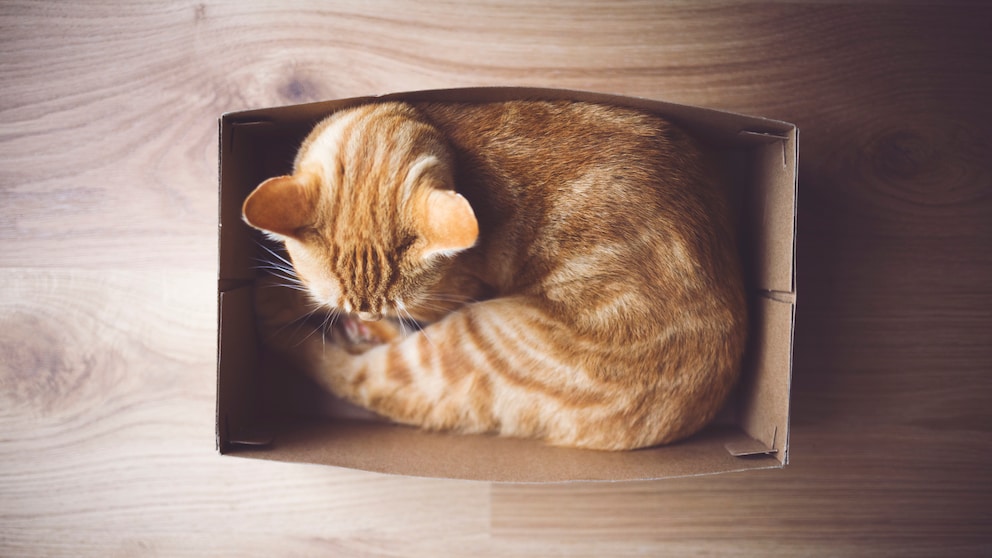
Almost every cat owner knows the phenomenon: You buy a cozy cave or a cat basket for your feline. But instead of making themselves comfortable in it, the cat jumps into the empty box on the floor. Cats like to choose their favorite spot themselves. They often opt for a square structure like a box. But why do cats love boxes so much? PETBOOK explains the behavior behind the phenomenon.
Overview
Boxes as a Safe Retreat
Anyone who takes in a cat, whether from a shelter or a breeder, should definitely offer it a small, enclosed space to snuggle into. The walls should be high, and the ceiling as closed as possible. A cat cave—or even a simple box—is an important retreat for these sensitive animals.
Especially for insecure cats, it helps them feel safe in an unfamiliar environment and settle into their new home by observing everything from their secure spot and getting to know the new surroundings.
Cats Prefer Tight Hiding Spots
Nicholas Dodman, a former professor at Tufts University in Massachusetts, suspects that manageable spaces like square cardboard boxes provide cats with a sense of security. The contact with all four walls gives the animals a feeling of safety, as their bodies are protected from attacks.
Dodman also suspects that the close body contact with the box’s interior walls leads to the release of endorphins, as he writes in an article on “CBS News.” It is also conceivable that sitting or lying in a tight, square box triggers feelings of happiness in the cat’s brain.
This also explains why cats like to squeeze into boxes that are actually too small for them. In such cases, there is particularly close body contact with the box’s walls. But why do the animals still sit in containers where only one or two paws fit? The next explanation might help here.
Also interesting: Why so many cats have a hanging belly and what it means

Why Many Are Now Buying a Concrete Block for Their Cat

Why Cats Love to Lie on Paper and Other Documents
Even Squares Made of Tape Fascinate Cats
The preference for square things goes so far for some cats that they particularly like to sit on a rectangular rug or a stack of paper. Even if the square is only suggested with tape on the floor, it seems to exert a great fascination on the animals, as numerous photos and videos on social media with the #Catsquare prove.1
These likely have a similar, albeit somewhat weaker, effect on the cat as real boxes. While squares on the floor or rectangular rugs are not a substitute for a cozy box, they may simply pique the cat’s curiosity to examine the square on the floor more closely.
An experiment by animal psychologist Gabriella E. Smith showed that many cats find squares irresistible even when they are only virtual: The researcher used rugs with images of the so-called Kanizsa illusion. Here, four geometric shapes resembling the video game character Pac-Man together create the optical illusion of a square. And lo and behold: Even a square that doesn’t really exist—but is an optical illusion—attracted many cats.2
Circles Also Magically Attract Cats
It doesn’t always have to be squares. Round rugs or chalk circles also seem to interest many cats. What’s behind this? Again, limited or enclosed spaces that are barely larger than the animal itself give the cat a sense of security and safety.3
Other factors may also play a role when cats attentively inspect circles or squares on the floor. Perhaps the material used, like tape, sisal, or wool, simply smells interesting and needs to be thoroughly sniffed.
And the following is also conceivable: Those inspired by social media trends like #Catsquare or #Catcircles who set up their own “experiment” with squares or circles in their living room may unconsciously influence their cat. By giving so much attention to the shapes on the floor, they also become interesting to the cat.