

September 22, 2025, 2:55 pm | Read time: 7 minutes
Rabbits and cats belong to different species—yet they often share the same space in many households. But how can these two animals be accustomed to each other? First of all, a true friendship cannot be forced. However, there are strategies to achieve at least a peaceful coexistence, as PETBOOK editor Louisa Stoeffler, who kept rabbits and a cat together for a long time, knows.
First Encounters–Caution and Retreat
A rabbit and a cat, peacefully side by side on the sofa—a cute image that excites many pet lovers. But how realistic is this picture? Anyone considering letting a cat live with smaller animals such as guinea pigs, hamsters, birds, or rabbits must primarily consider the cat’s natural hunting instinct. With the right preparation and realistic expectations, peaceful coexistence is still possible.
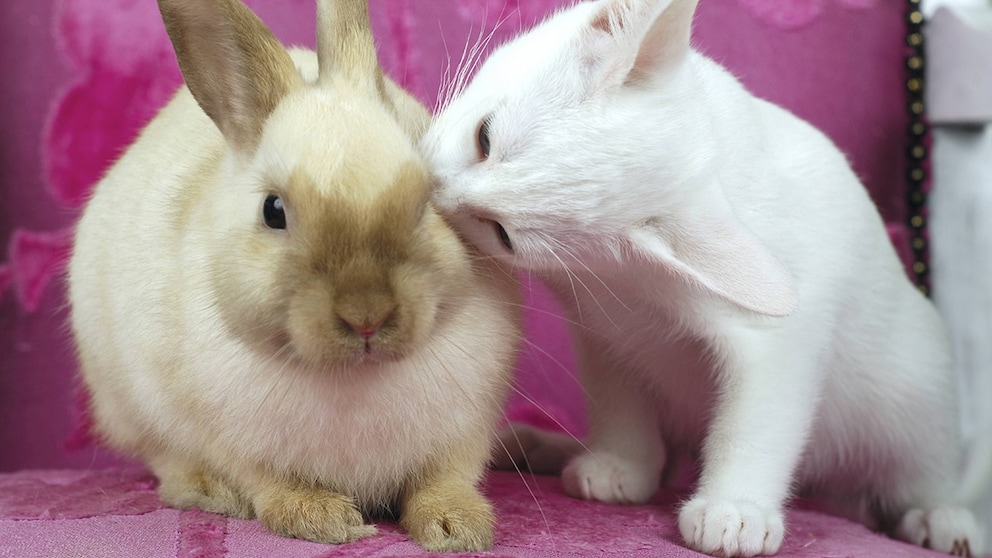
I have kept small animals for many years, especially guinea pigs and rabbits. Later, a white cat named Minka joined my animal menagerie. By that time, the dwarf rabbit ladies Nina and Lola were already there. So how do you bring together predators and prey animals? Two lively long-eared rabbits that liked to hop around the apartment in the afternoon and a curious, traumatized rescue cat initially sounded like chaos. And at first, it was a bit chaotic.
The first meetings between the different parties were quite cautious. Minka, who had learned to hunt on the street, scrutinized the two closely. Lola and Nina, on the other hand, preferred to keep a safe distance—or disappeared into their house. That was the key: the rabbits always had a retreat where they felt safe and that the cat respected. And no movement occurred without supervision, so one could intervene if the cat wanted to initiate something other than a friendly introduction.
Caution Is the Mother of the Digging Box
Therefore, I can especially recommend bringing in cats when the rabbits are already accustomed to their living situation. Because, especially at the beginning, the animals shy away from any touch, which may be necessary if you need to take them to the vet, for example. Tips on how to train this can be found in this article: How to Acclimate Rabbits and Guinea Pigs to Humans.
A spacious cage or a well-structured enclosure with enough space is essential for proper rabbit care—especially if a cat also lives in the house. It is important—I emphasize again—that the rabbits always have a safe retreat. The rabbits need a suitable living space where they can feel comfortable, even if the socialization does not go ideally.
Accordingly, the saying here is not “Caution is the mother of the porcelain box,” but rather the digging box. Cats and rabbits can get used to each other, but a suitable social partner does not replace the foreign species for them. The rabbit is not a substitute partner for the cat, and conversely, the cat cannot replace a fellow rabbit!
Even if a cat lives in the household, rabbits must still be kept in pairs at least, and indoor cats that do not have outdoor access need a companion of their own kind unless they are adopted as a single pet. Both species are very social and rely on companions of their own kind.
Step-by-Step to Successful Integration
Successful socialization should be conducted in several phases. First, the animals should become familiar with each other through scents. It is important to respect the needs of all animals. It may be tempting to pick up the rabbit and present it to the cat so that both can take in the scent of the other animal. However, this is wrong! Rabbits can easily panic if they lose the ground under their feet and then smell a predator. In the worst case, this signals to the animal: “My last hour has come.”
A safe scent exchange can occur by presenting blankets or cloths. These are gently rubbed over one species and then presented to the other. Subsequently, they should meet with a safe barrier, such as a cage. Ideally, this is done when the cat has just had a delicious meal and is very relaxed. One should always observe how the animals react. As soon as signs of aggression or hunting behavior are noticeable, direct contact should be interrupted.
If the first meeting proves calm and interesting, a cautious direct contact can follow: If the cat shows friendly interest at the cage and one decides on a first contact in the open, it is advisable to let the rabbits run while holding the cat.
Extreme caution is required. The animals must be closely observed, and the rabbits, especially, always need a retreat option. As soon as signs of aggression or hunting behavior are noticeable, direct contact should be interrupted. If both parties remain calm, treats can be used. Rabbits are calmed by munching, and cats associate it with: “If I leave the rabbits alone, I get something good.” This is how I repeatedly showed Minka: “The two belong here. They are family—not prey.”
Best Chances with Young Cats and Adult Rabbits
Over time, an astonishingly relaxed everyday life developed. Minka refrained from hunting games, but she also became calmer with me as she realized she no longer had to fend for herself on the street and became one of the most relaxed cats I have ever known. She even tolerated “petting” from my younger brothers without ever raising her paw when it became too much with the toddlers.
The rabbits also realized: This cat is serious about being calm. Soon all three were sitting in my room—side by side, without drama. When the rabbits started grooming each other, the cat also licked them. They even eventually slept next to each other.
Ideally, socialization begins at a young age. If a cat grows up with rabbits from an early age, the likelihood increases that it will later accept them as equal roommates. If you get the cat at 12 weeks old, the rabbits may already be larger than the cat, which additionally commands respect.

How to Make Dogs and Cats Get Along

Why Cat Owners Should Know the 3-3-3 Rule
Not Every Cat Is Suitable for Socialization with Rabbits
Whether a harmonious relationship develops strongly depends on the animals’ characters. A calm cat like Minka, who also has a low hunting drive, is often much better suited than an outdoor cat that regularly returns home with mice. Body size can also play a role: A very large tomcat will rarely accept small and delicate rabbits as playmates or partners.
The older the cat, the more difficult it can be to redirect its predator instincts with treats and keep it with rabbits. Rabbits also react more tolerantly if they meet cats early on—and they sometimes even confidently fend off unwelcome advances with a kick of the hind legs or a decisive hop away.
A later integration is certainly possible, but requires a lot of patience and finesse. Especially in indoor settings, when rabbits and cats use the same resources, one sometimes has to be creative. For example, Minka had her retreat on the scratching post, where the rabbits did not bother her. The rabbits, in turn, knew: “If I’m in the house, I have peace,” which reduced potential conflicts.
Clear Tips That Helped Me
- Retreats: Rabbits need their domain where the cat is not allowed. This ensures safety.
- Start Slowly: First, just let them observe, then cautiously sniff—always under supervision.
- Use Scents: Acclimate animals to each other initially through scent exchange with cloths.
- Assess Character: If the cat is very hunting-motivated, socializing with rabbits is probably not a good idea.
- Acceptance Over Friendship: The goal is not for everyone to be cuddly but to live peacefully side by side.
Keeping a cat and rabbits together is possible–provided one proceeds patiently, gently, and attentively. Whether a friendship develops ultimately depends on the individual nature of the animals. Forced closeness rarely leads to success, but with the right environment and smart behavior from the owner, harmonious coexistence can be achieved.