

May 16, 2023, 4:03 am | Read time: 3 minutes
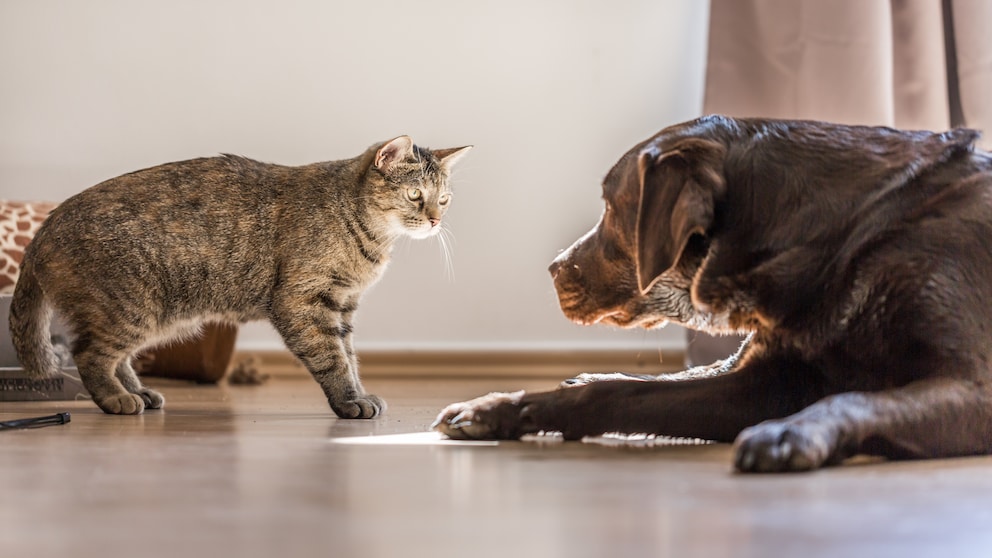
When two people are said to “fight like cats and dogs,” it means they often clash. This well-known saying is not without reason, as dogs and cats are different species–and they don’t always get along. Why is that: Why don’t dogs and cats get along? And is there a chance they might one day reconcile? PETBOOK investigates.
Among pet owners, there are not only dog lovers or cat enthusiasts. Many people have a heart for both animals and want to share their lives with both dogs and cats. But is that even a good idea? After all, you often read that they simply don’t understand each other, which can complicate daily life together. What’s the truth behind this rumor?
Why don’t dogs and cats get along well?
The fact that dogs and cats often have issues with each other is due to their different ways of communicating. Misunderstandings are inevitable: While a wagging tail usually indicates a friendly dog, a twitching tail in a cat signals nervousness and aggression. It’s the opposite with purring: A cat’s deep rumble usually expresses contentment, whereas a dog might interpret the sound as aggressive growling.
Another example of differences in body language is the so-called pawing. When two dogs meet and one raises its front paw, it’s seen as a gesture of appeasement by the other. However, if a dog approaches a cat and the cat raises its paw, it is not expressing submission. Instead, the cat is trying to tell the dog to stay away.
Also interesting: The most beautiful sayings about dogs and cats
https://oembed/petbook/affiliate/9721fb9218901c534459190fd4efe80f416b83d44307abc03d511c1d94d1d55a/5cfe814a-868f-47cf-a245-7ec02dfaf9cd/embed
Can cats and dogs learn to understand each other?
While both are popular pets, our beloved animal companions are completely different species. Evolution has instilled a certain mistrust of each other in them–after all, as a four-legged creature, you never know if the other might be a predator. Additionally, they naturally compete with each other because they have similar prey.
But here’s the good news: Dogs and cats can indeed learn to understand each other. The younger the two fundamentally different animals are, the better. The best chances for harmonious coexistence are when dogs and cats grow up together. Especially in puppyhood, both can still learn to correctly interpret each other’s body language.
If the animals are a bit older when they are introduced, they may have already had bad experiences: The cat might have been chased by a dog, the dog scratched by a cat. In these circumstances, patience is required to get them used to each other–unfortunately, there is no guarantee of success.

How to Make Dogs and Cats Get Along

Cat breeds that are particularly child-friendly
Which dog breeds get along well with cats?
Breeds considered particularly cat-friendly include the Labrador and the Golden Retriever. But smaller dogs like the friendly Bichon Frisé or the Bolonka Zwetna often get along well with purring companions.
On the other hand, hunting dogs like the German Jagdterrier and the German Wirehaired Pointer can be problematic: A fleeing cat can trigger their hunting instinct, making peaceful coexistence nearly impossible. And even if a dog has been accustomed to a feline companion from puppyhood, it doesn’t mean it will automatically accept every cat. A strange cat roaming outside can still be seen as prey and chased.
Sources
- “Br.de,” “Can dogs and cats become friends?” (accessed on 05/16/2023)
- “RP-online.de,” “Why the conflict between dogs and cats?” (accessed on 05/16/2023)