

March 25, 2026, 4:53 am | Read time: 4 minutes
Can cats swim? Many cats are considered water-shy—but is that really true? While some cats recoil at the slightest drop of water, others are noticeably less timid. PETBOOK explores whether cats can swim and what to consider when they come into contact with water.
Why Don’t Cats Like Water?
Most cats steer clear of water. Although cats are naturally curious, their exploratory drive often stops when it comes to water. This is evident in everyday life: During rain, outdoor excursions are reduced to the essentials, with the path back to dry ground usually being the most important. Many cats also prefer to avoid lawn sprinklers in the garden.
A typical behavior, familiar from the internet, is a cat balancing curiously on the edge of a bathtub or pool, suddenly losing its grip, and ending up in the water. What follows is pure instinct—frantic paddling and a quick attempt to find solid ground again.1
Why do cats avoid water so strictly? One reason lies in their fur. While it is dense and temporarily protects the skin from moisture, once it becomes completely soaked, it loses its insulating effect—the cat cools down faster and finds this uncomfortable. Additionally, the fur becomes heavy, which can restrict movement and hinder escape. Moreover, the ancestors of domestic cats came from drier regions where large bodies of water played little role. Thus, contact with water is not a natural part of their behavior. 2
Can Cats Swim?
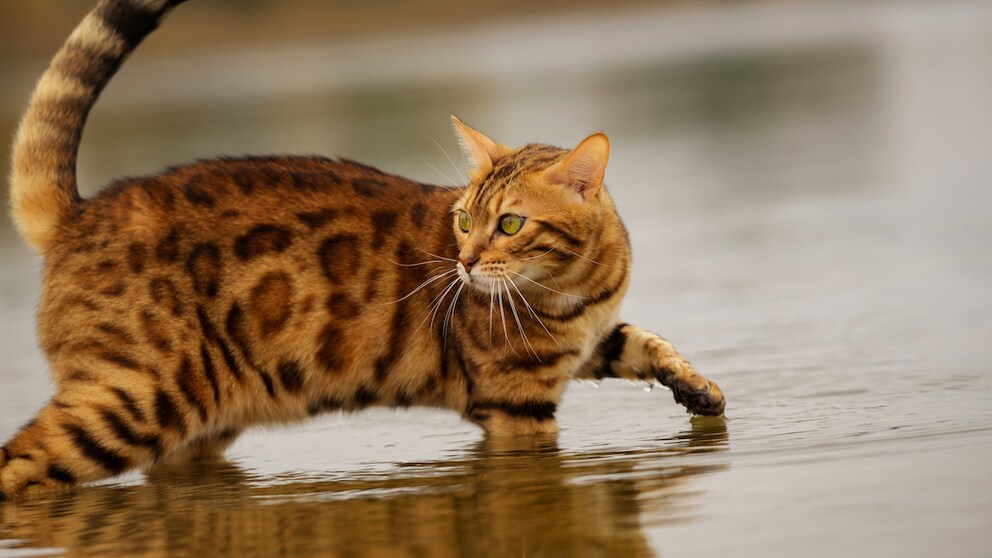
Although many cats wouldn’t voluntarily dip a paw into a lake, they are indeed capable of swimming. There are even some cat breeds that enjoy playing with water or even taking baths. Anatomically, they are good swimmers. However, they would generally prefer not to cover long distances.
Many cat owners might rightly wonder how it can be that cats are good swimmers, yet most are perceived as water-shy.

Why Some Cats Love Water–and Others Hate It

Summer Water Hazards – Tips for Pets and Insects
Which Cats Like Water?
While cats can swim, whether they like water depends heavily on the individual animal. Curiosity is a key factor. Dripping water or a sprinkler can seem like an exciting game to many cats—but only as long as they can choose to engage with it. If they are forced, rejection quickly follows.
Positive experiences, especially at a young age, also play a role. Cats that are introduced to water playfully early on often find it less threatening and handle it more calmly. Sometimes, the behavior is simply driven by hunting instincts—such as when cats paw at movements on the water’s surface.
And lastly, there are breed differences: Maine Coon, Bengal, or Turkish Van are considered particularly fond of water, although this doesn’t apply to every individual.
Safe Interaction with Water for Cats
Even though most cats tend to avoid water, there are indeed some that enjoy playing with it or even swimming. For these “water fans,” it’s important to ensure controlled and safe access. Even curious cats can overestimate their abilities or become stressed.
Cats should never have unsupervised access to open water sources like pools, rain barrels, or bathtubs. Instead, it’s advisable to provide them with secure access—such as under supervision or in a controlled environment. This also means ensuring the ground near the water isn’t slippery, so the cat has enough grip to get out. This way, the cat can satisfy its curiosity without endangering itself. It’s also important that the cat doesn’t become exhausted in the water and can always get out on its own. Appropriate exit options should always be available.
Checklist for water-loving cats:
- Allow access to water only in a controlled manner and under supervision
- Secure or make open water sources inaccessible
- Do not force the cat into contact with water
- Watch for signs of overwhelm or exhaustion
- Provide safe exit options
This way, the enjoyment of water can be combined with the necessary safety.