


April 24, 2026, 1:12 pm | Read time: 7 minutes
A cat from the farm–that sounds so romantic. But the experiences of PETBOOK editor Saskia Schneider paint a different picture. The expert in cat behavior explains why these animals can bring not only some health issues but also behavioral challenges for cat owners. For her, it’s clear: A kitten from the farm is not an option again.
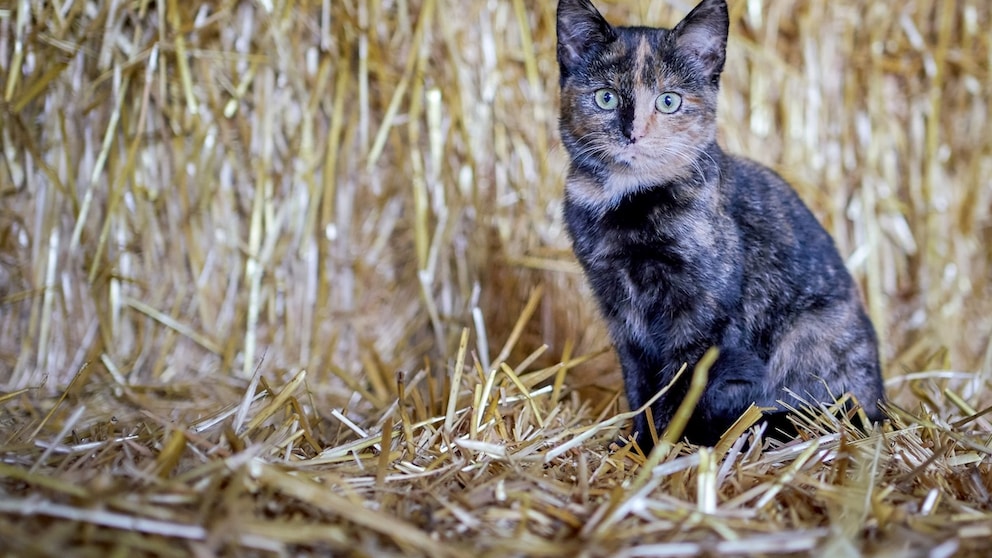
Most cats lead an independent life on the farm. Their main task is to catch mice or other rodents. Their daily life often has little in common with the comfortable life of a house cat. And despite regulations already in place in many regions, most farm cats are not neutered. This often results in unwanted offspring. So, it’s not hard to come by cats.
This is how I got my first two kittens. Both were born as unwanted offspring on a riding farm and were supposed to be killed with a spade. Instead, two of the four kittens were caught for me. When I asked if the animals had been dewormed, the answer was yes. Later, it turned out: These cats had little to no human contact until they were picked up and were far from parasite-free.
Kittens are often poorly socialized
Not only does mating often occur without the owners’ control in rural areas, but the offspring are usually born unnoticed. Mother cats choose remote and well-hidden places for this. Only later, when the kittens are a bit older, does the animal family addition become apparent. This also means: Until this age, the kittens had no contact with humans, which can lead to them retaining a certain shyness later on.
The imprinting phase in cats, also known as the socialization phase, mainly occurs between the second and seventh week of the kittens’ lives. During this time, they should get to know everything important for later life. This usually doesn’t happen in rural areas. None of the people spend active time with the kittens. This was also the case with Kim and Kila, my two farm cats. Both were initially very shy and hardly allowed themselves to be touched.
For the first vet visit, I had to trick the cats into the carrier. Once there, they shot out of the container. It took the staff half an hour to catch both animals again with the help of a towel and examine them. This revealed the second major problem…
Farm cats are often not well cared for health-wise
Although I was told the animals had been dewormed at least once, the condition of the kittens made the vet seriously doubt it. Both were very thin and emaciated–a sign of intestinal parasites. But before we could do a stool examination, the next shock came: Both had fleas. For farm animals, this is not unusual. But naively, we had already let both kittens explore the entire apartment for two days. Since worm eggs can survive up to six months, this meant: a major cleaning for the apartment.
Next came the look into the ears. But the vet didn’t get that far because the ear canals were almost completely blocked by mite droppings. So, in addition to flea treatment and deworming tablets, we were also prescribed ear drops to be applied three times a day. How practical–with cats that hardly allowed themselves to be touched.
Survey confirms: Farm cats often neglected
When this article was first published on May 16, 2025, many readers complained about the claim that farm cats are sick, neglected, and often not neutered. Certainly, there are farmers and farms that value animal welfare, love their cats, and take care of their health. But my two cats are not an isolated case, as shown by a survey by the German Animal Welfare Association.
In this survey, veterinarians across Germany were asked about the veterinary care of farm cats as part of data collection for the “Great Cat Protection Report.” It was found that in 40 percent of agricultural operations, no one takes care of the veterinary care of the resident cats. The result is untreated diseases and injuries–and great animal suffering, as noted by the German Animal Welfare Association.
Cats are used to roaming free
Farm cats usually enjoy a lot of freedom. Life in an apartment is a big adjustment for most animals, especially if they are no longer allowed outside. They also have to learn–and accept–that they can no longer mark their territory with scratching or urine. This training is a real challenge for cat owners.
I have also found that cats used to roaming free demand it or miss it greatly. Kim and Kila constantly wanted to go outside. It often happened that they escaped when we were walking in the backyard, or a neighbor forgot to close the front door. And although Kimmie was neutered and over ten years old, she still got into fights with the neighborhood tomcat across the street. I don’t know such “wild” behavior from my current two cats, who both grew up in an apartment.

My traumatic experience with farm cats
“At 11 years old, I spent a few weeks on a farm during the holidays. Besides dealing with cows and chickens, I unfortunately also learned how unwanted kitten offspring were handled there. I was tasked with finding the kittens of the 17-year-old (!) farm cat, who produced young two to three times a year.
Naive as I was, I searched the bushes for the kittens and found them. Together with another girl, I was supposed to bring the animals to the house. When I asked what would happen to the kittens there, she only replied: ‘They will be killed.’
My shock at this news was so great that I–as clumsy as I suddenly was–immediately dropped the few days old animals, giving the mother cat the opportunity to hide them again. I then refused to ‘search’ for them again. This experience has never left me, even though the kittens I took from the mother survived–the rest of the litter did not.”

What is the difference between castration and sterilization?

Recognizing and Alleviating When Cats are in Heat
Cats can develop behavioral problems
Cats used to going outside often have too little stimulation in a purely indoor environment. Especially young kittens want to explore the world. If they come from a farm, they know that this exciting world is behind the windows and doors of the apartment. Out of frustration at not being allowed outside, behaviors can develop that we humans consider problematic, such as
- increased scratching
- increased meowing
- restlessness at night
- aggression
Therefore, it is important to either provide such animals with regular outdoor access or keep them well occupied.
Farm cats lead an independent life
In summary, one could say: Farm cats are a handful! And they have to be. Life outside is tough. Only the fittest kittens make it through. And even then, their life expectancy is not particularly high. Diseases or traffic are among the most common causes of death.
Anyone who wants to adopt a farm cat should be aware that the animals lead an independent life there. This doesn’t mean that such cats can’t form a close bond with their humans. But there is a likelihood that animals used to a lot of freedom will be unhappy–even depressed–in a purely indoor environment, especially if the cat is older than twelve weeks. Therefore, in my opinion, it is a prerequisite to at least provide such an animal with access to a garden.
One should also consider the health aspect and have the animals checked by a vet as soon as possible–preferably before they spread fleas throughout the apartment.
About the author
Dr. Saskia Schneider is a biologist with a Ph.D. During her studies at the Free University of Berlin, she focused on zoology and animal behavior. In addition to training as an editor, she completed training as a behavior consultant specializing in cats.