

September 22, 2026, 12:55 pm | Read time: 5 minutes
Cats can also get bored. While for us humans, it often shows with a tired yawn, in cats, it can manifest in various ways. The problem: Many owners don’t initially recognize the signs. Cat behavior therapist and trainer Helena Becker, founder and owner of “Stubentiger Berlin,” explains how cat owners can identify when their pet lacks stimulation.
These Behaviors Can Indicate Boredom
Boredom in cats can sometimes be very obvious and other times only noticeable if you look closely. “Boredom in cats can manifest in very different ways,” explains cat behavior therapist and trainer Helena Becker, founder and owner of “Stubentiger Berlin.”
While some cats express their boredom by scratching wallpaper or sofas, others get the zoomies and race through the house. Some cats also meow persistently at their owners. According to Becker, boredom can also manifest in “behavioral abnormalities of all kinds.” These include conflicts in multi-cat households or so-called “hypervocalization,” which is excessive meowing.
Boredom doesn’t always have to be loud: Some cats sleep much more than usual or groom themselves excessively. Becker also mentions “complete withdrawal or apathy,” where a cat “only sleeps” and “doesn’t want to play.” The expert also cites “excessive eating out of boredom” as another possible sign.
Important: These signs can also indicate health problems in cats. For diffuse changes, it’s often helpful to have them checked by a veterinarian to ensure the animal doesn’t suffer in silence.
Which Cats Are Particularly Prone to Boredom
In principle, any cat can be affected by boredom. According to Helena Becker, however, “many cats in apartment living are affected.” She cites a “tension between under- and overstimulation” and the fact that many cats are often alone as reasons.
Another misconception is the assumption that older cats no longer have a great need for activity. “All cats want to play and be engaged well into old age,” says Becker. Many owners simply don’t know how. While kittens are often “quite undemanding and very stimulus-affine,” it becomes increasingly important later to specifically promote their hunting and play needs.
Even in multi-cat households, the problem doesn’t automatically disappear. “Playing together doesn’t replace solitary play, it only complements it,” emphasizes Becker. Therefore, “more cats don’t mean less work for the owner, but individual offerings for each cat.”

These Training Tricks Can Seriously Confuse Cats

Everyone Thought Lilly Was Unclean–yet She Was Silently Pleading for Help
With These Tricks, Boredom Won’t Arise
To prevent boredom, both physical and mental stimulation are important. Helena Becker mentions “training, cat-friendly play options based on prey preference, puzzle boards, clicker training, medical training,” or even brushing as meaningful activities.
Additionally, according to the expert, cat-safe balconies and windows can provide extra stimuli. Walks on a leash are possible but “require a lot of preparation.” As an alternative, Becker recommends regularly introducing “new exciting elements” at home and “engaging all the cat’s senses.”
Often, expensive toys aren’t even necessary. Many cats enjoy playing with simple items like paper balls, ping-pong balls, or small plush mice. Playing fulfills numerous important functions. It “reduces boredom, stress, frustration, is fun, and strengthens the bond,” says Becker.
PETBOOK Tip: Entertainment with Cardboard Rolls
Empty kitchen or toilet paper rolls can be turned into cat toys with just a few simple steps. I regularly use them for my cat Ivy. For this, the rolls are set up and filled with a few pieces of dry food or other snacks.
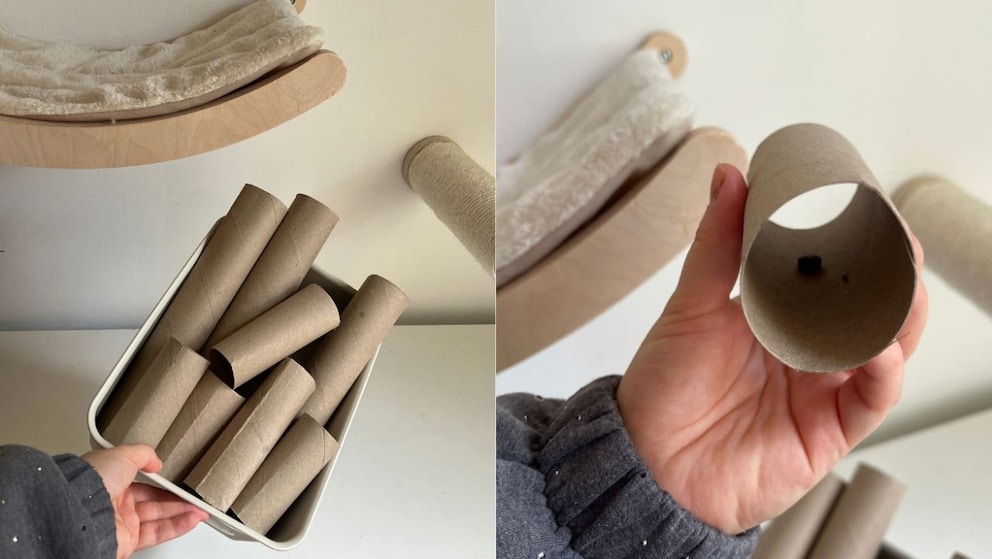
Particularly practical: The rolls can be changed repeatedly. Sometimes the cat fishes the reward from the top, sometimes through side openings. Different-sized rolls add variety. The cardboard rolls also work as cut spirals: If you hide a few treats inside, the cat can sniff them out and fish them out with its paws.
It’s important not to make the rolls too long or too tight, so the cat can easily reach its “prey” and doesn’t get hurt.