

August 28, 2024, 3:35 pm | Read time: 5 minutes
The great Alexandrine parakeet, unlike its smaller relative, the ring-necked parakeet, is relatively rare in pet ownership. Its size alone means it has specific care requirements.
Origin
The Alexandrine parakeet, a close relative of the rose-ringed parakeet (also known as the smaller Alexandrine parakeet), originates from Asia. Various members of the parakeet family are native to countries such as Afghanistan, Pakistan, and India. They are also found in Myanmar, Thailand, Laos, Cambodia, and Vietnam. Populations also live in the wild in Sri Lanka and the Andaman Islands. There are four different subspecies in these regions, which can also be found in the pet trade:
- Andaman Alexandrine parakeet (Psittacula eupatria magnirostris)
- Northern Alexandrine parakeet (Psittacula eupatria nipalensis)
- Burmese Alexandrine parakeet (Psittacula eupatria avensis)
- Laos Alexandrine parakeet (Psittacula eupatria siamensis)
It is believed that Alexander the Great, the Macedonian conqueror of Asia, once brought the parakeet to Europe. It is also said to be named after him, although this cannot be proven.
However, there are now some irresponsible owners who have released their parakeets. As a result, large populations of Alexandrine parakeets now exist in some German cities. These adaptable birds are not considered endangered, so there are no conservation requirements to observe. It is best to adopt Alexandrine parakeets captured in German cities to prevent the populations from growing even larger.
Appearance
The Alexandrine parakeet lives up to its name, averaging 48 to 62 centimeters in length–excluding the wings. Each wing measures 19 to 24 centimeters. The bird weighs between 260 and 300 grams.
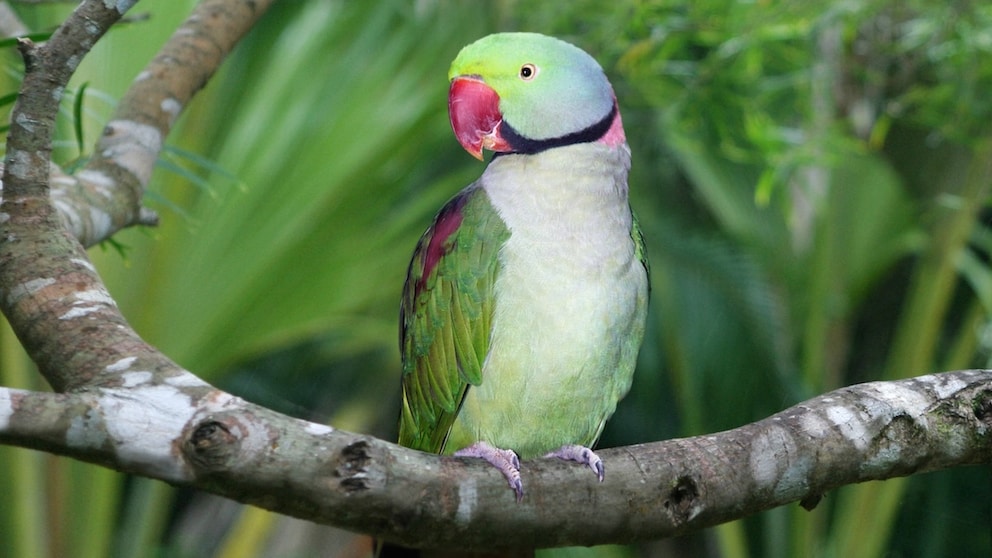
It is predominantly green-feathered, with the belly often showing a gray-green hue. Females and males initially look quite similar, but only males develop the characteristic neck ring upon reaching sexual maturity. This ring is thin and black at the front, becoming wider and red at the back. The upper tail feathers are green, while the lower ones are a vibrant yellow. Its red beak is particularly striking.
Behavior
The Alexandrine parakeet is a very social bird that lives in the wild with at least one partner or even in a flock. Therefore, it should never be kept alone in an aviary.
These diurnal birds have very loud calls, usually in the morning and evening when they would naturally search for food. Additionally, the Alexandrine parakeet is an enthusiastic and fast flyer, making its presence known even while flying. It should be allowed free flight daily.
Moreover, these large parrots prefer to stay among themselves. At most, one might try to socialize them with rose-ringed parakeets–though this is not recommended.
Behavior, appearance, and proper care of the blue-fronted Amazon
Origin, Husbandry, and Care of the Nectar-Feeding Coconut Lorikeets
Diet
Alexandrine parakeets feed on a mix of seeds and fresh food. There is specially formulated food for large parakeets available in pet stores, which they readily accept. However, it can also be composed of millet, oats, wheat, canary seed, and, in moderation, sunflower seeds. Millet is particularly suitable as sprouting food, which helps the birds meet their protein needs. During molting, additional protein, insects, or larvae should be provided, as their energy needs are very high at this time.
Various fruits and vegetables, as well as fresh herbs, are suitable as fresh food. Chickweed and dandelion are particularly popular. Carrots, apples, and various leafy greens are also well received. In the wild, they prefer guavas and enjoy cracking nuts with their beaks. However, caution is advised with avocados, which they should not consume. Additionally, grit or a mineral block should be provided for mineral intake.
Proper Care & Maintenance
The minimum dimensions for an aviary are 6 × 2 × 2.5 meters–if the Alexandrine parakeet pair receives daily free flight outside their enclosure. If they are to fly within the aviary, it should be at least 15 meters long. They also enjoy an outdoor aviary but feel most comfortable at a temperature of 18 to 25 degrees Celsius. They require a humidity of about 60 percent.
In winter, UV lamps should be used to provide additional sunlight. There are reports that some Alexandrine parakeets react with fear if they cannot see the moon at night. If this is the case, investing in a suitable night light and seeking advice from a specialist retailer is recommended.
Alexandrine parakeets are also known for using their beaks a lot and nibbling. Therefore, the aviary material should be untreated metal, without paints. The furnishings and perches, on the other hand, should be made of natural woods, which should be regularly checked for splinters or other signs of wear. Ropes, swings, and various toys should also be available to these intelligent birds.
Suitable substrates include parrot sand and soil, as well as hemp bedding or beech wood granulate. Additionally, a bathing area and various drinking options should be available in the enclosure. These should naturally be adjusted to the size of the birds and cleaned and refilled daily. The birds’ droppings should also be removed daily. With proper care, an Alexandrine parakeet can live 20 to 30 years.