

December 8, 2025, 1:07 pm | Read time: 5 minutes
If you’re looking for a colorful, lively, and low-maintenance aquatic turtle, the red-bellied short-necked turtle (Emydura subglobosa) is a great choice. Its bright belly coloration, peaceful nature, and easy breeding make it particularly attractive for beginners. But what exactly characterizes this river turtle–and what should you consider regarding its care, diet, and maintenance? This profile provides all the essential information about this fascinating reptile species.
Origin
The red-bellied short-necked turtle (Emydura subglobosa) belongs to the family of side-necked turtles and originates from the tropical regions of New Guinea and northern Australia. It has been kept in European terrariums since the 1970s, although it was previously little known in the hobby. In older literature, it was referred to by the now obsolete names Emydura albertisii or Emydura australis subglobosa until the valid name Emydura subglobosa became established.
Two subspecies are scientifically recognized: the more colorful nominate form Emydura subglobosa subglobosa, found in southern West New Guinea and Papua New Guinea and occasionally in northern Queensland (Jardine River), and the paler E. s. worrelli from the Northern Territory and northwest Queensland. The latter is rarely kept in Europe. A third proposed subspecies (E. s. angkibaanya) from the Jardine River has not been scientifically recognized. Today, nearly all animals available in the trade come from European captive breeding of the nominate form. Wild-caught specimens are practically no longer relevant, but this should be confirmed when purchasing to avoid poaching.
Appearance
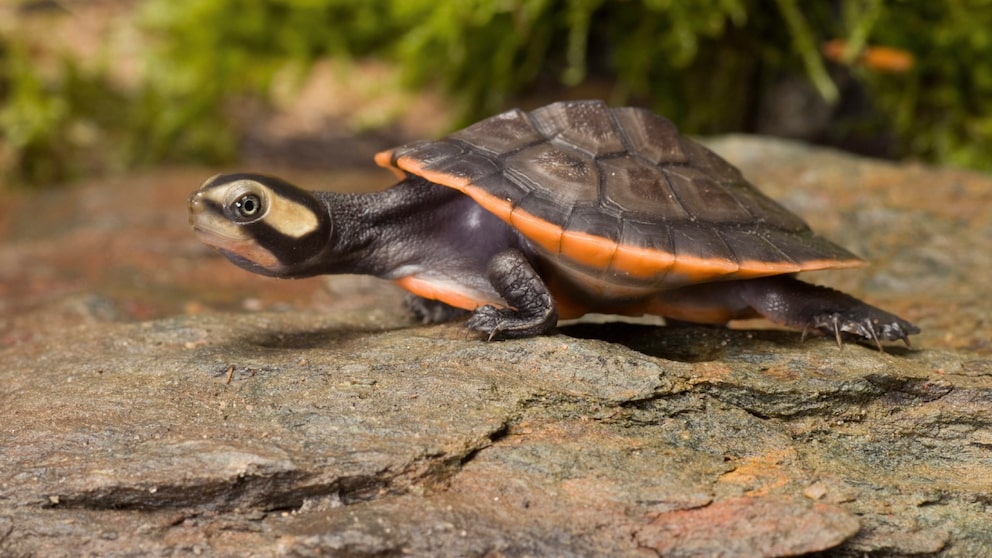
The red-bellied short-necked turtle is notable for its attractive appearance. The carapace is usually gray to dark gray and smoothly domed, while the eponymous plastron of the nominate form is intensely red–a coloration that remains throughout its life. The subspecies E. s. worrelli, on the other hand, has a yellowish plastron and broader heads in adult specimens.
The head is also striking with its characteristic markings: A dark base tone is interspersed with yellowish lines, and a yellow stripe usually runs behind the eye. Below the chin, a coral-colored pattern may appear. The red-bellied short-necked turtle is a side-necked turtle–it bends its head to the side in an S-shape rather than retracting it into the shell.
Males remain smaller with a maximum shell length of 20 cm, while females can reach up to 26 cm. The turtles from the Jardine River are generally smaller (females max. 22.5 cm, males max. 18.5 cm).
Behavior
This species is considered calm, peaceful, and well-tolerated, both with conspecifics and humans. It is fully aquatic, spending nearly its entire life in water and exhibiting active swimming behavior. Although they bask less frequently than other species, some individuals regularly use the basking spot–especially gravid females.
In groups, they are usually compatible, provided the gender ratio is correct (ideally 1 male to 2–3 females). However, if there are compatibility issues, solitary housing is also possible. Overall, the species is robust and low-stress–ideal for beginners.
As curious and active swimmers, red-bellied short-necked turtles need ample space to move. They exhibit a pronounced exploratory behavior and benefit from well-structured aqua-terrariums with hiding spots and visual barriers. While targeted engagement in the traditional sense is not necessary, a varied environment is. Some keepers report that the turtles respond to food training and can be specifically fed. Particularly exciting for the turtles are hunting games with live food such as insects or freshwater shrimp.
Proper Care & Maintenance
For adult turtles, a tank with a minimum length of 150 cm is required. A high water level is important, at least twice the height of the largest shell length in the tank. Juveniles can initially be kept in smaller tanks. A powerful filter ensures stable water quality–supplemented by regular water changes.
The land area primarily serves for disease prevention and as a basking spot. Ideal are dry, easily accessible cork tubes or stone structures. Female turtles additionally need an egg-laying area with a sand-soil mixture. A constant air temperature above the water protects against respiratory diseases.
Diet
Emydura subglobosa is an opportunistic omnivore with a clear focus on animal-based food. Suitable options include aquatic insects, mosquito larvae, freshwater shrimp, prawns, fish pieces, and turtle sticks. Plant-based components such as freshwater algae, dandelion, or fruit should be offered occasionally but are not always accepted.
Commercially available turtle pudding with plant content is often well-received. Warm-blooded meat (e.g., beef) should be avoided as it degrades water quality and is poorly digestible. Juveniles receive smaller food portions, including red mosquito larvae and fine smelt.

Proper Care for the Painted Turtle Chrysemys picta and Its Four Subspecies
Why This Turtle Smells–Yet Makes a Great Pet
Susceptibility to Certain Diseases
Red-bellied short-necked turtles are robust but sensitive to poor water quality, which can lead to skin and shell infections. Young turtles, in particular, are sensitive to low temperatures, so they should be kept at a constant 28–30°C during their first year.
Respiratory diseases can occur if the air temperature above the water is too low. They do not undergo hibernation–water temperatures below 20°C should be avoided. For recovery after egg-laying, a period at reduced temperatures (20–22°C) over three to four months can be beneficial. Regular veterinary check-ups help detect and treat infections early.
The Red-Bellied Short-Necked Turtle at a Glance
- Behavior: Calm, can be social, active swimmers, mostly aquatic, occasional basking
- Size: Males up to 20 cm, females up to 26 cm shell length
- Weight: Varies depending on size and diet between 1 and 2 kilograms
- Coloration: Carapace gray to dark gray, plastron reddish (nominate form)
- Special Features: Side-necked turtle, reddish plastron remains throughout life
- Care Requirements: Moderate, high demands on water quality, no hibernation needed
- Housing: Group housing possible, but can also live in solitary housing