

September 5, 2025, 2:58 pm | Read time: 4 minutes
“How old do turtles get?” is a question many have pondered, likely even before the Disney cult film “Finding Nemo.” The green sea turtle Crush is a full 150 years old in the film and talks with clownfish Marlin about his even older father, “Mr. Turtle.” But how old do these animals actually get—and are there differences between sea, land, and freshwater turtles?
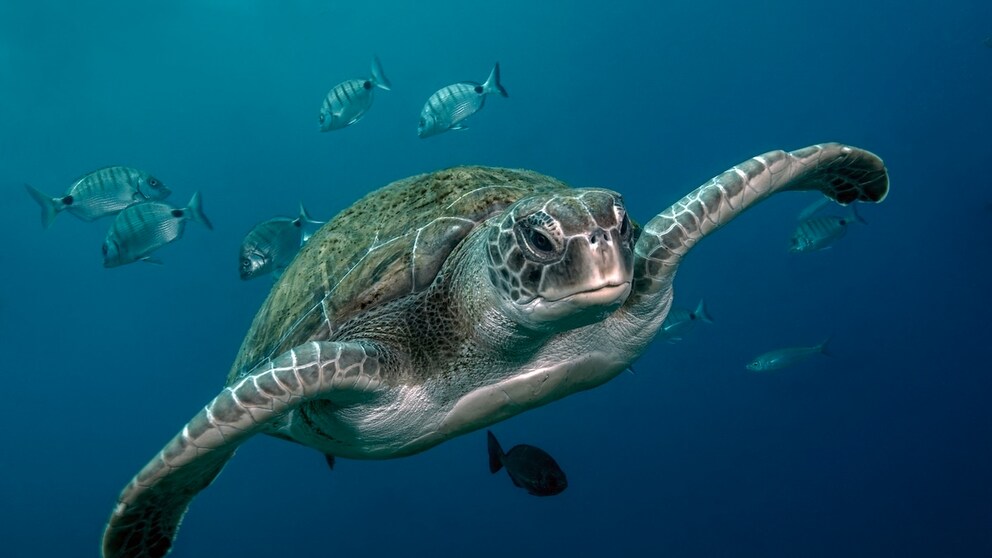
Sea Turtles–Ancient Mariners with Unknown Records
The 150-year-old sea turtle Crush surfs through life effortlessly in the film. While this number is more Hollywood than science, it’s not entirely unrealistic. Turtles are indeed among the longest-living animals. However, their life expectancy varies significantly depending on whether they are land, freshwater, or sea turtles.
The seven known species of sea turtles can live to remarkable ages. Scientific estimates suggest they can reach 80 to 100 years. However, it’s hard to know for sure, as their oceanic life makes tracking individual turtles over decades difficult. Additionally, turtle research doesn’t go far enough back to make definitive statements. What is certain is that sea turtles take their time. Some species need several decades before laying eggs for the first time. This late reproduction suggests their lifespan is correspondingly long.
Whether Crush from Finding Nemo can actually be 150 years old remains unclear—but it wouldn’t be unrealistic. Sea turtles are perfect examples of how evolution can shape animals to lead long lives if they escape the dangers of the sea.
Also interesting: Sea Turtle Researchers: “Adaptability of Every Living Being Has Limits”
Land Turtles–The Methuselahs Among Reptiles
When thinking of ancient turtles, most people picture the mighty giant tortoises of the Seychelles or Galápagos Islands. They can live well over 100 years. The most famous representative is “Jonathan,” a Seychelles giant tortoise, who is now over 190 years old.
But even smaller species like the Greek, Moorish, or European land turtles can live to a proud 50 to 80 years. With optimal care, even higher age records are possible. However, this was not widely known when land turtles experienced a boom in the pet industry a few years ago. Many were unaware that keeping these reptiles could be a lifelong commitment, possibly requiring arrangements for the animal’s care after one’s own passing.

The 9 Longest-Living Species in the World

Proper Care and Maintenance of the Cumberland Slider Turtle
Freshwater Turtles–The Comparatively Short-Lived
It’s quite different for the smaller freshwater turtles often kept in ponds or aquariums. Species like the red-eared slider typically reach an age between 20 and 40 years. With proper care, they can live up to 50 years, but in the wild, few achieve this.
A major issue here is also their care: Poor diet, small tanks, or lack of UV light significantly shorten their life expectancy. Nonetheless, even 30 years is a remarkable age for a relatively small reptile species.
Why Do Turtles Live So Long?
Turtles are among the longest-living animals on Earth—but the reasons vary depending on lifestyle and species.
Land Turtles benefit from their extremely slow metabolism and leisurely lifestyle. They move little, require minimal energy, and grow slowly. Their shell effectively protects them from many predators. Because they become sexually mature very late, their entire biology is geared toward reaching a high age and experiencing many reproductive cycles over decades. All this makes them true survival artists, unchallenged as age champions in the reptile kingdom.
Sea Turtles appear much more agile in contrast: They swim quickly, cover thousands of miles, and grow—like all reptiles—throughout their lives. Their high energy needs seem at odds with a long lifespan at first glance. But their evolution has found a different balance: They reach sexual maturity only after several decades. To have enough time for reproduction, their lifespan is accordingly long.
Freshwater Turtles fall somewhere in between. They also grow throughout their lives, but remain smaller and have significantly more natural enemies compared to their relatives. Their habitat—ponds, rivers, small lakes—is often less secure, and environmental toxins or improper care play a significant role. Therefore, they usually reach “only” 20 to 40 years, which is still remarkable compared to other small reptiles.
What they all have in common is that they have more time than most other animals—and they seem to enjoy it in peace. Whether on the meadow, in the pond, or in the world’s oceans, turtles remind us that sometimes the slow, deliberate, and steady have the longest endurance.