


January 2, 2026, 10:06 am | Read time: 6 minutes
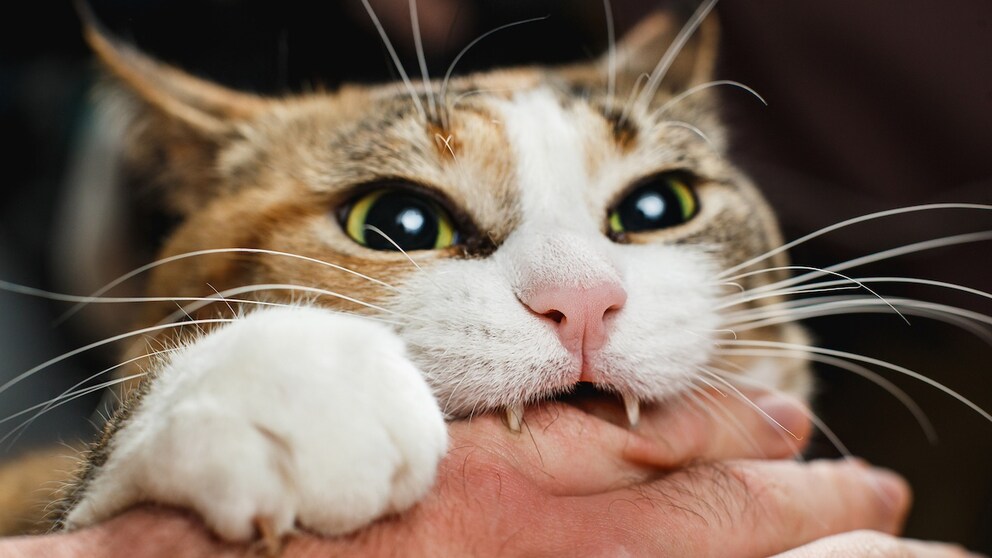
A bite from a dog or cat is often painful—and carries far greater risks than one might initially suspect. Especially because it often involves one’s own pet, many tend to underestimate the injury. But this can have fatal consequences: Even small wounds from an animal bite can become deeply infected. Experts explain when veterinary care is sufficient and when urgent medical help is needed.
Caught in the crossfire because the dog was attacked by another dog? Or the cat snapped because it felt threatened? Animal bites are a painful experience—especially when the culprit is a four-legged friend you love so much.
So: Bandage it up, brush it off, it’ll heal on its own? Not every bite wound can be trusted to do so. With a bit of bad luck, it can become dangerous. What you can do yourself and what warning signs indicate a doctor’s visit is necessary—the most important questions and answers about animal bites.
1. After the Initial Shock: How Do I Properly Care for the Bite Wound?
“It would be wrong to just wipe a bleeding wound with a paper towel and then think: That’s it,” says infectious disease specialist Prof. Andrew Ullmann from the University Hospital Würzburg.
Better: immediately rinse the area with water or a saline solution, then use a wound disinfectant. Finally, treat it with a bandage or a sterile wound dressing plus a gauze bandage.
2. How Serious Is Such an Animal Bite Anyway?
It’s not easy to answer that generally. “But basically, any animal bite can lead to really serious problems and should not be dismissed as trivial,” says Prof. Frank Hildebrand, director of orthopedics, trauma, and reconstructive surgery at the University Hospital RWTH Aachen.
Serious health problems can mainly arise from infections: In the mouth and throat of dogs, cats, and others, various bacteria live. These germs can be transferred into the wound—and thus into the human body—via the teeth, which have saliva on them.
By the way: “Regarding the risk of infection, human bites are also very dangerous because we also have a large variety of bacteria in our oral cavity,” says Andrew Ullmann.
3. Does It Make a Difference Whether a Dog or a Cat Has Bitten?
“Basically, you can’t say whether dog or cat bites are more dangerous,” says Andrew Ullmann. The extent of the injury is crucial. Tricky: “Sometimes you underestimate it because it may just look like a small needle mark. But an infection can spread in depth,” says the infectious disease specialist.
There, inflammations, known as phlegmons or abscesses, can form. One should not be misled by the fact that the skin surface has long since closed. Under the skin, bacteria continue to cause damage.
According to Frank Hildebrand, cats can pose a higher risk of infection because they have very sharp and long teeth. Even with seemingly small wounds, bacteria can penetrate deep into the tissue and multiply there.
The vice president of the German Society for Orthopedics and Trauma Surgery often observes that patients only go to the doctor days later. By then, the wounds are sometimes already severely infected.
4. Can Even a Small Scratch Be a Reason to Visit the Doctor’s Office?
Yes, because for a layperson, it’s often difficult to assess whether the wound is only superficial or extends into deeper tissue layers. In case of doubt, the rule is: Better to go to the doctor once too often than too little. And definitely clean the wound and monitor its development very closely.
“Anyone with a pre-existing condition with a weakened immune system should definitely see a doctor for a bite injury,” says Andrew Ullmann. An antibiotic therapy may be necessary.
In some cases, according to the infectious disease professor, the emergency room is the right place to go. This is especially true if children have been bitten—and also if the bite is on the face, which is more common in children than in adults.
5. What Warning Signs Should Definitely Prompt a Visit to the Doctor?
“At the latest, if the area around the bite hurts, is red, swollen, or I have a throbbing sensation, these are certainly signs of a beginning or existing infection, with which I must definitely go to the doctor quickly,” says Frank Hildebrand.
Andrew Ullmann points out that fever can also indicate an infection. “You might not take it seriously because it’s cold or flu season and the bite may have happened several days ago.”
6. What Can Happen if Infections Remain Untreated?
The consequences of an infection can be immense: There is a risk of damage to muscles, tendons, nerves, bones, and joints. “Since adults are often affected by bite injuries on the arms and hands, this can have significant effects on hand function in everyday life,” warns Frank Hildebrand.
If left untreated for a longer period, an infection can also spread to the entire body. In this case, it is called sepsis, a so-called blood poisoning—a life-threatening condition. A warning sign for this: a feeling of illness that you have never experienced before.

The cat has bitten! What to do now

Tetanus in Dogs: What Owners Should Know
7. How Do Doctors Treat an Inflamed Bite Wound?
According to Hildebrand, an existing infection is a surgical emergency. “The basis of surgical therapy is the extensive cleaning and rinsing of the wound.” All infected tissue must be removed because it serves as a breeding ground for bacteria.
Additionally, tissue samples are taken to determine the germs in order to initiate a targeted antibiotic therapy.
8. Can I Do Anything Prophylactically to Prevent a Bite From Having Serious Health Consequences?
At least regarding the risk of tetanus, you can take precautions. Tetanus is transmitted by certain bacteria that enter the body through wounds. Experts agree: Everyone should have complete tetanus vaccination protection. Depending on how long ago the last vaccination was, it will be refreshed as part of the treatment after an animal bite. Therefore, the advice is: Anyone visiting a doctor’s office with a bite wound should bring their vaccination record directly.

Don’t Be Dismissed
“From my own experience and that of friends and colleagues, I know that animal bites are unfortunately sometimes taken lightly. ‘Oh, it’s just a small bite’—this sentence is unfortunately not uncommon, even in medical settings. But animal bites are always potentially dangerous, even if the wound initially looks harmless. Animal saliva contains numerous germs that can penetrate deep into the tissue and cause severe infections. Especially the narrow canine teeth of cats penetrate deeply into the tissue at specific points.
Therefore, it is important not to be dismissed by the doctor or in the emergency room. Always insist that the wound is thoroughly assessed, cleaned, and—if necessary—treated with antibiotics. The tetanus status should always be checked. It’s best to bring the vaccination record directly or submit it as soon as possible.
Even small bite or scratch injuries can become inflamed days later—so it’s better to have them checked by a doctor one time too many than one time too few. Every animal bite belongs in medical hands—regardless of how ‘small’ it seems.”